Author: VS Note Editorial

  • Wonik IPS: The Korean Deposition Equipment Maker Behind Chip Fabs

    Wonik IPS: The Korean Deposition Equipment Maker Behind Chip Fabs

    Every memory chip is built up from extremely thin layers of material laid down on a silicon wafer. Wonik IPS makes the machines that lay down those layers. Its customers are chipmakers, and it also sells equipment to display and solar cell factories.

    The company is listed on KOSDAQ, the Korean exchange’s market for growth and technology companies, which is separate from the main KOSPI board. Its ticker is 240810.

    Its name often comes up in Korean coverage of Samsung Electronics’ earnings. This article explains what the company sells, who buys it, how large its FY2025 business was, and why a strong quarter at a chipmaker does not turn straight into equipment sales.

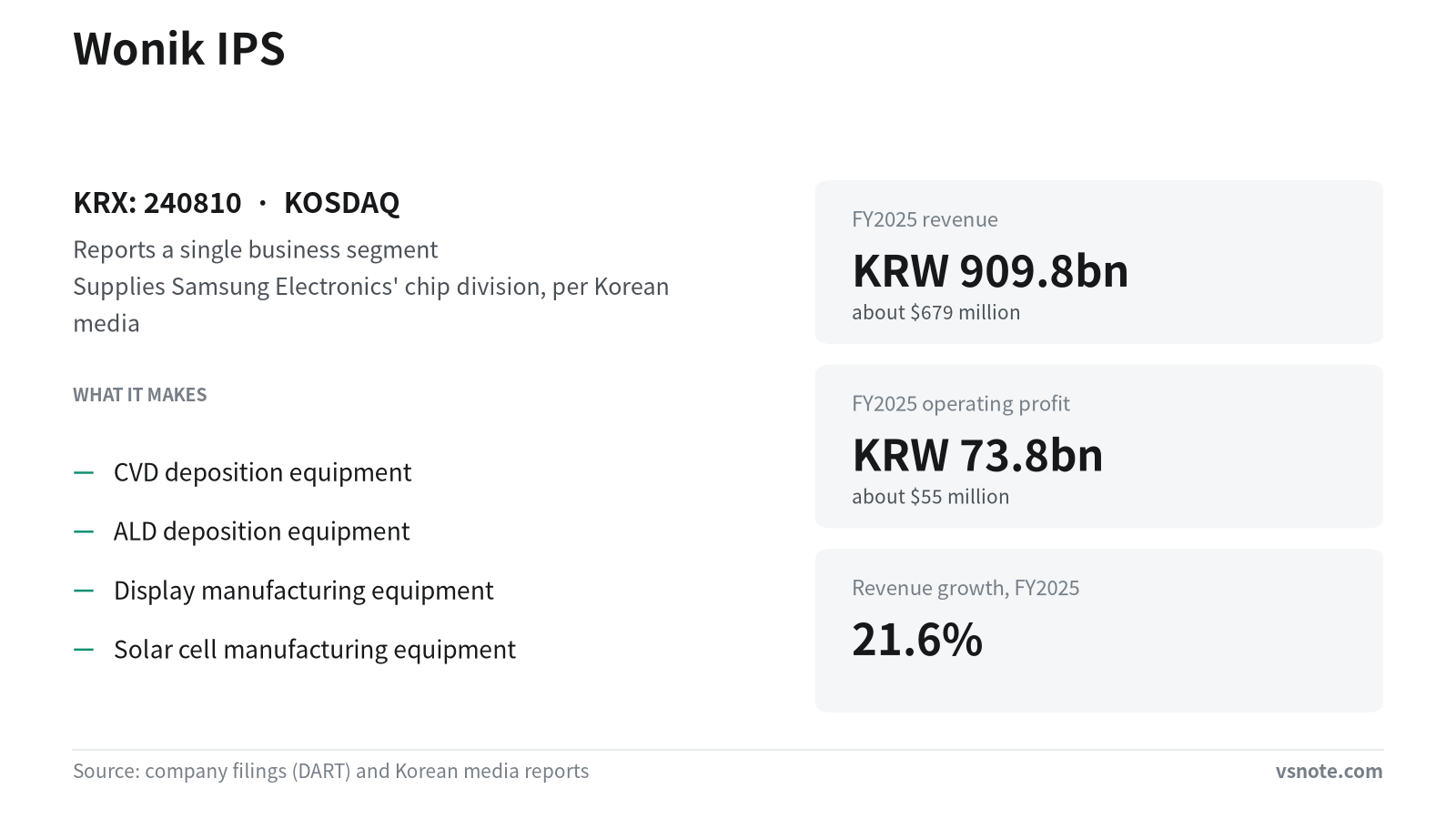
    WONIK IPS CO., LTD. (원익아이피에스) · KRX: 240810 · KOSDAQ

    Won amounts are converted at ₩1,339.2 per US dollar (Bank of Korea ECOS, KRW/USD base rate, 2026-10-08) for scale only.


    What its machines do inside a chip plant

    Wonik IPS makes and sells core manufacturing equipment for semiconductors, displays and solar cells. Its main field is semiconductor deposition, which means building a circuit layer by settling material onto a wafer surface one very thin film at a time.

    Think of deposition as putting very thin coats of paint on a wall, again and again. Wonik IPS does not sell the paint. It sells the machine that applies the coats.

    The comparison only goes so far. Real deposition does not involve brushing on a liquid. Gas settles onto the surface inside a vacuum chamber, building films only a few atoms thick. A single chip also contains many films of different materials, stacked over and over.

    Its core products are CVD and ALD equipment. CVD (chemical vapour deposition) forms a film when gases react on the wafer. ALD (atomic layer deposition) builds the film one atomic layer at a time, which gives finer control over thickness.

    • Semiconductor manufacturing equipment, mainly deposition (CVD, ALD)
    • Display manufacturing equipment
    • Solar cell manufacturing equipment

    Where it sits in the chipmaking chain

    Chipmaking runs in stages. Materials suppliers provide wafers, gases and chemicals. Equipment makers build the machines that process them. Chipmakers run those machines in their fabs to make chips, and the chips end up in servers, phones and other devices.
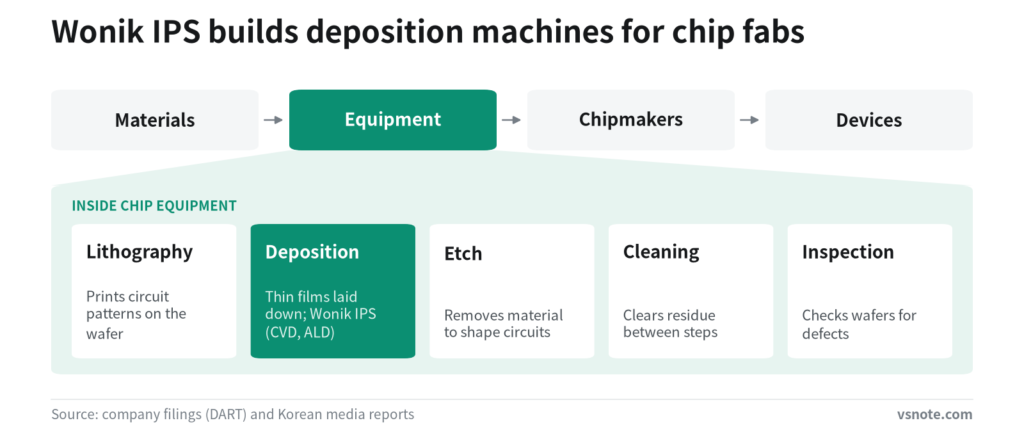
    Industry map running from materials suppliers to equipment makers, chipmakers and end devices, with the equipment stage highlighted and opened up to show that Wonik IPS works in deposition.

    Wonik IPS works at the equipment stage, specifically deposition. According to Korean media reports, it supplies equipment to the semiconductor division of Samsung Electronics, known as Device Solutions (DS).

    In Korean financial media, companies like this are grouped as “sobujang”, a short form for materials, parts and equipment suppliers to manufacturers. That is the label the company usually carries in Samsung-related news.

    The company’s annual report says US, Japanese and Dutch companies hold high shares of the global semiconductor equipment market. The same report describes Wonik IPS as one of the Korean equipment makers that have localised key semiconductor equipment, meaning they produce in Korea machines that chipmakers used to import. It adds that Korea’s localisation rate for chip equipment is gradually rising.

    The filings and reports cited here give no market share figures for Wonik IPS or its competitors in deposition equipment.


    Reading the numbers of a company that mostly sells machines

    The figures below come from the company’s annual report, filed on DART, the electronic disclosure system run by Korea’s Financial Supervisory Service. Korean companies number their fiscal years from incorporation. For Wonik IPS, the 10th fiscal period is FY2025 and the 9th is FY2024. All figures are consolidated, meaning the parent company and its subsidiaries are combined, as opposed to the separate (standalone) figures for the parent alone.

    Consolidated revenue for FY2025 was KRW 909.8 billion (about $679 million), up 21.6% from KRW 748.2 billion (about $559 million) in FY2024.

    Operating profit rose from KRW 10.6 billion (about $8 million) in FY2024 to KRW 73.8 billion (about $55 million) in FY2025. Net profit rose from KRW 20.7 billion (about $15 million) to KRW 84.0 billion (about $63 million).
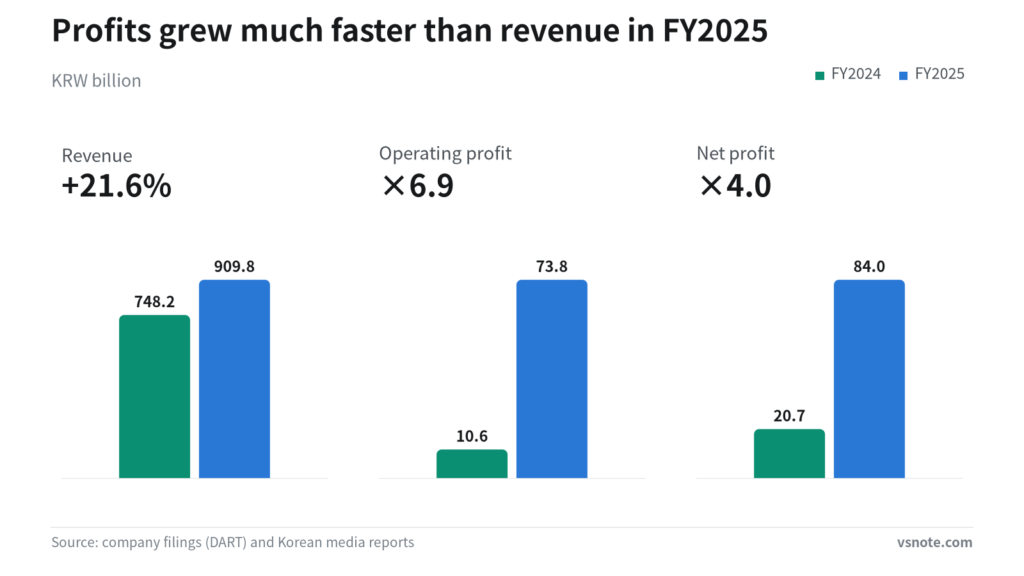
    Grouped bar chart comparing Wonik IPS's consolidated revenue, operating profit and net profit in FY2024 and FY2025.

    Net profit was larger than operating profit in FY2025. The filing excerpts cited here do not explain why.

    Product sales, meaning machines the company builds itself, were KRW 786.6 billion (about $587 million) in FY2025, or 86.5% of revenue. The rest, KRW 123.2 billion (about $92 million), came from goods and services: items bought in and resold, plus work such as servicing installed equipment.

    Because most revenue comes from selling machines, these numbers depend on customers deciding to buy equipment. When chipmakers add capacity, product sales rise. When they hold back, product sales fall.

    The company reports a single business segment. It says that because it makes all its products at the same limited sites with the same equipment and staff, its business cannot easily be split. As a result, outsiders cannot see how much revenue comes from semiconductors, displays or solar cells.


    Does a big Samsung quarter mean more machine orders?

    The company’s annual report says the semiconductor equipment industry moves with the growth of its downstream market, the chip industry. So a link to Samsung exists, but it is indirect.

    According to Korean media reports, Samsung Electronics announced preliminary results for the third quarter of 2026 on 8 October 2026, with operating profit of KRW 107.40 trillion (about $80.20 billion). The reports describe this as the first time a Korean company’s quarterly operating profit went above KRW 100.00 trillion (about $74.67 billion).

    The same reports say the semiconductor division drove the result. The main reason cited was higher DRAM and NAND flash prices as demand for AI servers grew. The reports also say Samsung’s sales of HBM4 for Nvidia’s Vera Rubin platform start to show up from that quarter. HBM (high-bandwidth memory) is stacked DRAM placed next to AI processors to feed them data quickly.

    Profit earned from higher chip prices does not become an equipment order by itself. In between, the chipmaker has to decide to expand or upgrade its fabs, the moment in the paint analogy when the owner decides to paint a new room.
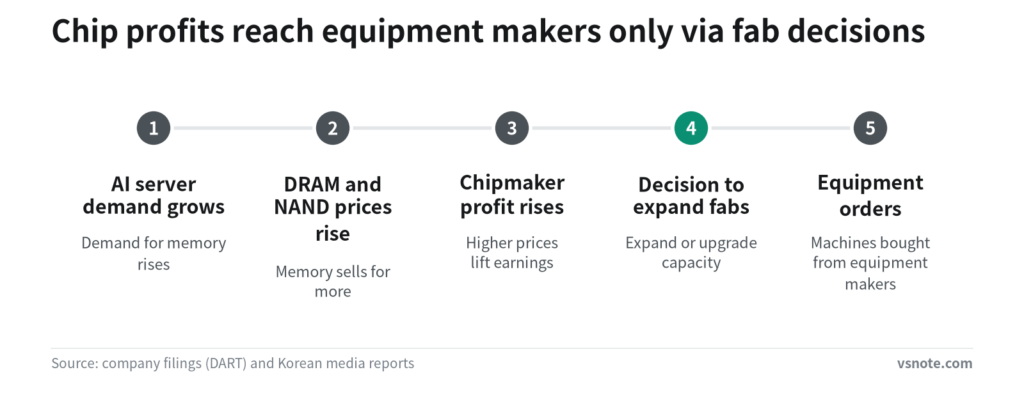
    Five-step chain from AI server demand to higher memory prices, chipmaker profit, a decision to expand or upgrade fabs, and finally equipment orders, with the expansion decision highlighted.

    The filings and reports cited here do not show Wonik IPS’s order backlog, its revenue by customer, or any Samsung decision to expand capacity. Those are the facts to look for in the next round of news about Samsung’s capital spending.


    Frequently asked questions

    Q. What does Wonik IPS actually make?

    A. Manufacturing equipment for semiconductors, displays and solar cells. Its main products are deposition machines, specifically CVD and ALD equipment, which lay thin films of material onto wafers.

    Q. Is Wonik IPS a Samsung supplier?

    A. According to Korean media reports, it supplies equipment to Samsung Electronics’ semiconductor (DS) division. The filings cited here do not show what share of its revenue comes from Samsung.

    Q. How large was the business in FY2025?

    A. The company’s annual report shows FY2025 consolidated revenue of KRW 909.8 billion (about $679 million), up 21.6% from the prior year, and operating profit of KRW 73.8 billion (about $55 million). Products the company builds itself made up 86.5% of revenue.

    Q. Why can’t I see revenue split between chips, displays and solar?

    A. The company reports one business segment. It says its products are made at the same sites with the same equipment and staff, so it does not split them.

    Q. Where are the company’s filings?

    A. On DART, Korea’s electronic disclosure system run by the Financial Supervisory Service. Annual reports use fiscal period numbers: for this company, the 10th period is FY2025.


    Sources

    • https://dart.fss.or.kr/dsaf001/main.do?rcpNo=20260316001453
    • https://blog.naver.com/kodlandman2026/224434886191
    • https://blog.naver.com/sorak0131/224434918891
    • https://blog.naver.com/jicprid/224432676426
    • https://blog.naver.com/jsc415/224435472234

    This article explains company filings and published figures for information only. It is not investment advice or a recommendation to buy or sell any security. Figures can change after publication — check the original filings before making decisions.
  • Ecopro BM: what it makes and what its rights issue involves

    Ecopro BM: what it makes and what its rights issue involves

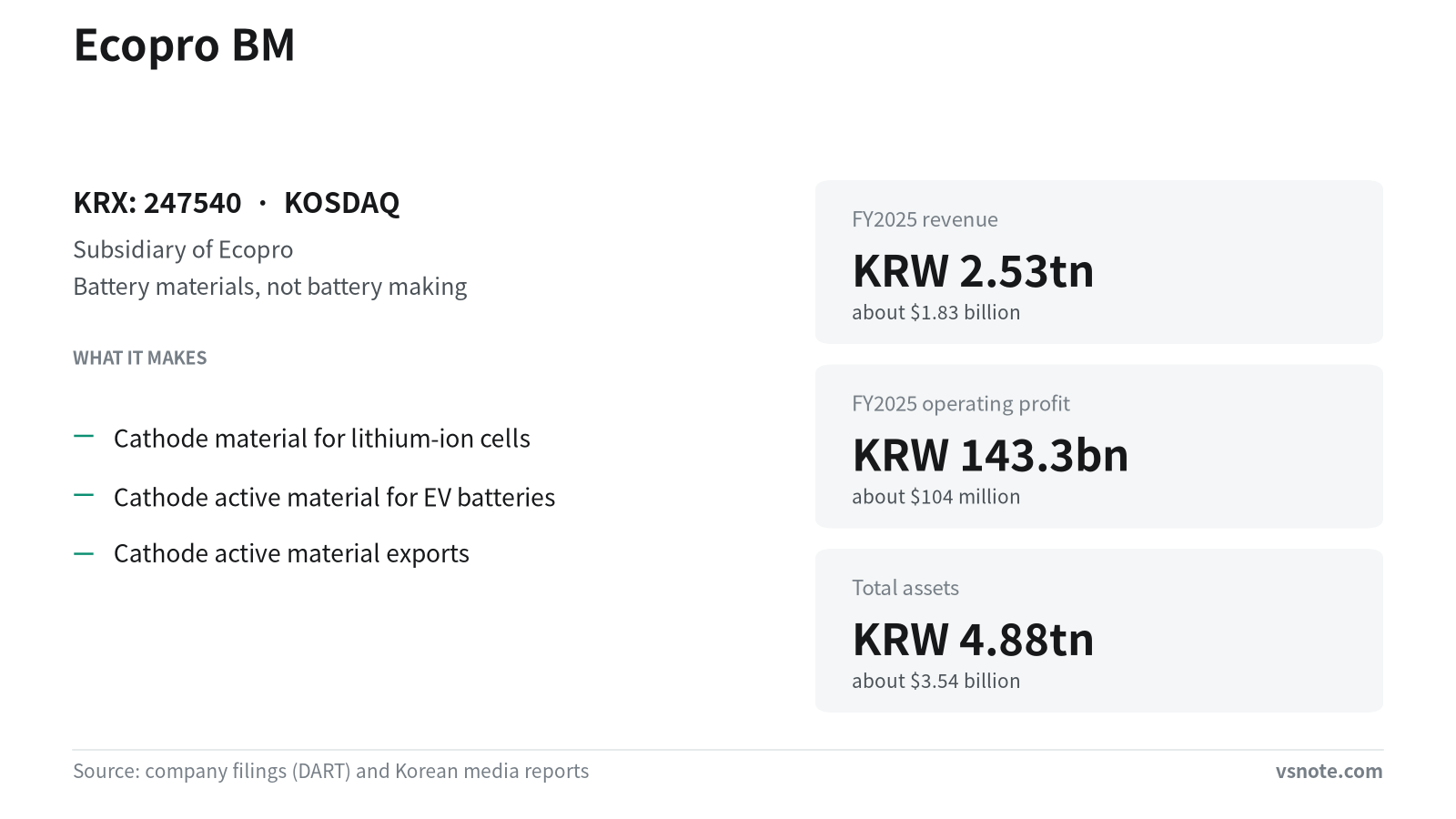
    Ecopro BM develops and produces cathode material — the cathode active material that goes inside a lithium-ion rechargeable cell. It is a battery materials business, not a battery maker: it sells one of the cell’s key materials to the companies that assemble cells.

    The shares trade on KOSDAQ, one of the two main boards of the Korea Exchange alongside KOSPI, under ticker 247540.

    The company is also in the middle of a rights offering, which is why holders may see an unfamiliar second line, Ecopro BM 18R, sitting in their accounts next to the shares. This article covers where the company sits in the battery chain, what its FY2025 figures show, and what the offering does.

    ECOPRO BM CO.,LTD. (에코프로비엠) · KRX: 247540 · KOSDAQ

    Won amounts are converted at ₩1,380.3 per US dollar (Bank of Korea ECOS, KRW/USD base rate, 2026-09-18) for scale only.


    What a cathode material maker actually sells

    A lithium-ion cell is built from four key materials. The cathode is the component with the high charge and discharge voltage; the anode is the component with the low charge and discharge voltage; the electrolyte is the medium through which lithium ions move; and the separator is there to prevent an electrical short.

    Battery manufacturers either buy those key materials or produce them in-house, and then build the cell. The finished cells go on to IT, automotive and energy companies.

    Ecopro BM occupies one of those four slots. It develops and produces the cathode material used in electric-vehicle batteries and hands it to the companies that make the cells — so the customers named in its own sales are battery makers, not carmakers or device brands.


    Why several companies are called Ecopro

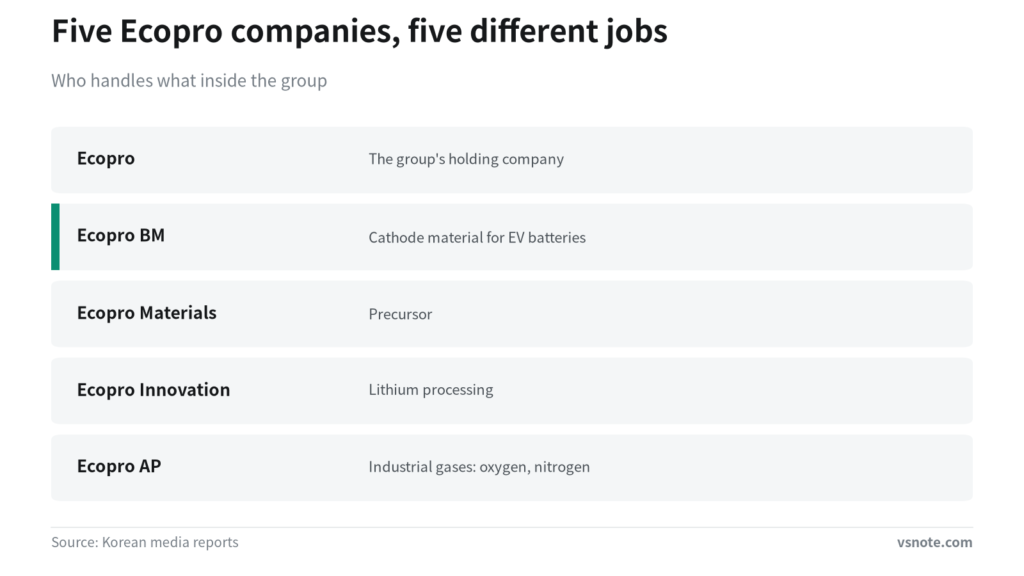
    Searching the name turns up a cluster of similar ones, and that is not coincidence: the group splits the process into separate companies. Ecopro is the group’s holding company and Ecopro BM is its subsidiary.

    Ecopro Materials handles precursor — the intermediate compound that is processed further into cathode material. Ecopro Innovation handles lithium processing, and Ecopro AP supplies the industrial gases, such as oxygen and nitrogen, used in the production process.

    Five Ecopro group companies listed with what each handles: holding company, cathode material, precursor, lithium processing and industrial gases.

    That places Ecopro BM downstream of the precursor and lithium steps and upstream of the cell makers, with cathode active material exports appearing among its consolidated sales items.

    Readers usually want a market share figure at this point. The filings and reports cited here do not show one, so the company’s position is described only by what sits on either side of it in the chain.


    Revenue down, operating profit back in the black

    Korean companies file their annual reports through DART, the electronic disclosure system run by the Financial Supervisory Service, and they number their fiscal years from incorporation. The company’s 10th fiscal period is 2025.

    The annual report shows consolidated revenue for FY2025 of KRW 2.53 trillion (about $1.83 billion), down from KRW 2.77 trillion (about $2.00 billion) in the preceding period.

    Operating profit moved the other way, to KRW 143.3 billion (about $104 million) from KRW -34.1 billion (about -$25 million). Net profit followed, at KRW 91.6 billion (about $66 million) against KRW -58.5 billion (about -$42 million) a year earlier.

    Total assets stood at KRW 4.88 trillion (about $3.54 billion), up from KRW 4.32 trillion (about $3.13 billion).

    What the disclosure establishes is the direction of each line: sales fell while profit turned positive. Whether that swing came from volumes or from costs and selling prices is not something these figures separate out.


    Why shareholders are being asked to buy new shares

    The company announced a rights offering to fund facility spending, working capital and the acquisition of securities in other companies. According to Korean media reports, the size was subsequently cut, and the facility and working-capital uses were removed from the stated plan, leaving about KRW 886.1 billion (about $642 million) for the acquisition of securities in other companies; net proceeds are put at roughly KRW 881.6 billion (about $639 million).

    For scale, the same reports can be read against the annual report: FY2025 net profit of KRW 91.6 billion (about $66 million) and total assets of KRW 4.88 trillion (about $3.54 billion).

    The structure is a rights offering to existing shareholders, with any shares left unsubscribed then offered to the general public. Reports put the issue at 9,900,990 new shares; the allotment ratio per share held on the record date is fixed in the filing.

    Those rights arrive in the account as a separate listed line with its own ticker, distinct from 247540 — the certificate shown as Ecopro BM 18R. It can be sold during its trading window or used to subscribe; if a holder does neither, the right lapses and is extinguished.

    The dates that govern all of this — when the certificates trade, when the issue price is fixed, when subscription and payment fall due — are set out in the securities registration statement the company filed on DART on 2 September 2026, and in the correction filing that revised the indicative price downward. Anyone acting on the offering should read those filings rather than a summary.


    Where the money is pointed, and what the rating agencies did

    According to the prospectus dated 2 September 2026 as reported in Korean media, about KRW 765.0 billion (about $554 million) of the proceeds is earmarked for an investment in BNSI, an Indonesian smelter that processes nickel into battery raw material. That is roughly 86% of the stated use of funds.

    The money is to go into a special-purpose vehicle — a company set up solely to hold the stake — and the precise mix of equity injection and lending is reported as not yet fixed.

    The remaining KRW 121.1 billion (about $88 million) is allocated to the company’s Hungarian entity. The company said on 24 August 2026 that it had begun converting a line at the Hungarian plant, with a plan to supply material for European premium electric vehicles from the fourth quarter of 2027; reports described the intended customer as a German automaker. That plan is pending.

    Alongside that, reports record rating actions on the parent. Korea Ratings lowered Ecopro’s unsecured bond rating one notch in June 2025, from A- with a negative outlook to BBB+ with a stable outlook, and NICE Investors Service in August 2026 kept the rating at A- while moving the outlook from stable to negative.

    The same reports put Ecopro’s net debt as having risen from KRW 2.20 trillion (about $1.59 billion) to KRW 3.21 trillion (about $2.32 billion), and note that its last public bond market raise was KRW 40.0 billion (about $29 million) in February 2026.

    On 2 September 2026, Ecopro is reported to have issued KRW 95.0 billion (about $69 million) of unsecured private placement notes: KRW 38.0 billion (about $28 million) of 18-month paper at 5.6% and KRW 57.0 billion (about $41 million) of two-year paper at 6.5%.

    Those are the two disclosed records that sit side by side — where the company is committing capital, and how the agencies have marked the parent’s funding position.


    Frequently asked questions

    Q. Does Ecopro BM manufacture batteries?

    A. No. It develops and produces cathode material, one of the four key materials in a lithium-ion cell, and supplies it to battery manufacturers. Those manufacturers buy or make the key materials, build the cells, and sell them on to IT, automotive and energy companies.

    Q. What is the difference between Ecopro and Ecopro BM?

    A. Ecopro is the group’s holding company and Ecopro BM is its subsidiary. Within the group, Ecopro Materials handles precursor, Ecopro Innovation handles lithium processing, Ecopro AP supplies industrial gases for the production process, and Ecopro BM makes the cathode material.

    Q. What is the Ecopro BM 18R line that appears next to the shares?

    A. It is the subscription-rights certificate from the rights offering, carried under its own ticker separate from 247540. A certificate like this can be sold while it trades or used to subscribe for the new shares; a right that is neither sold nor exercised lapses. The trading window, the subscription dates and the final price are set in the company’s securities registration statement on DART.

    Q. What is the money being raised for?

    A. The remaining stated purpose is the acquisition of securities in other companies. Korean media reports put the amount at about KRW 886.1 billion (about $642 million), of which roughly 86%, or about KRW 765.0 billion (about $554 million), is allocated to an investment in BNSI, an Indonesian nickel smelter, through a special-purpose vehicle whose equity-and-loan structure is reported as not yet settled; about KRW 121.1 billion (about $88 million) goes to the Hungarian entity. Facility and working-capital uses were deleted from the plan when the size was reduced.

    Q. Do the credit rating changes apply to Ecopro BM itself?

    A. The rating actions described in the reports cited here are on Ecopro, the parent. Korea Ratings moved its unsecured bond rating from A- with a negative outlook to BBB+ with a stable outlook in June 2025, and NICE Investors Service kept A- in August 2026 while changing the outlook to negative.


    Sources

    • https://dart.fss.or.kr/dsaf001/main.do?rcpNo=20260318001622
    • https://blog.naver.com/qrator_bin/224404448490
    • https://blog.naver.com/agentverse/224414588234
    • https://blog.naver.com/h-y-e/224412932187
    • https://blog.naver.com/frimanlo/224413660565
    • https://blog.naver.com/s_note1/224411837381
    • https://blog.naver.com/globalesg/224412357008
    • https://dealsite.co.kr/articles/168918

    This article explains company filings and published figures for information only. It is not investment advice or a recommendation to buy or sell any security. Figures can change after publication — check the original filings before making decisions.
  • Jusung Engineering sells the machines that make chips, not chips

    Jusung Engineering sells the machines that make chips, not chips

    Jusung Engineering’s name comes up in Korean market wrap-ups next to other semiconductor stocks. That does not mean its chips are inside your phone. The company does not make chips.

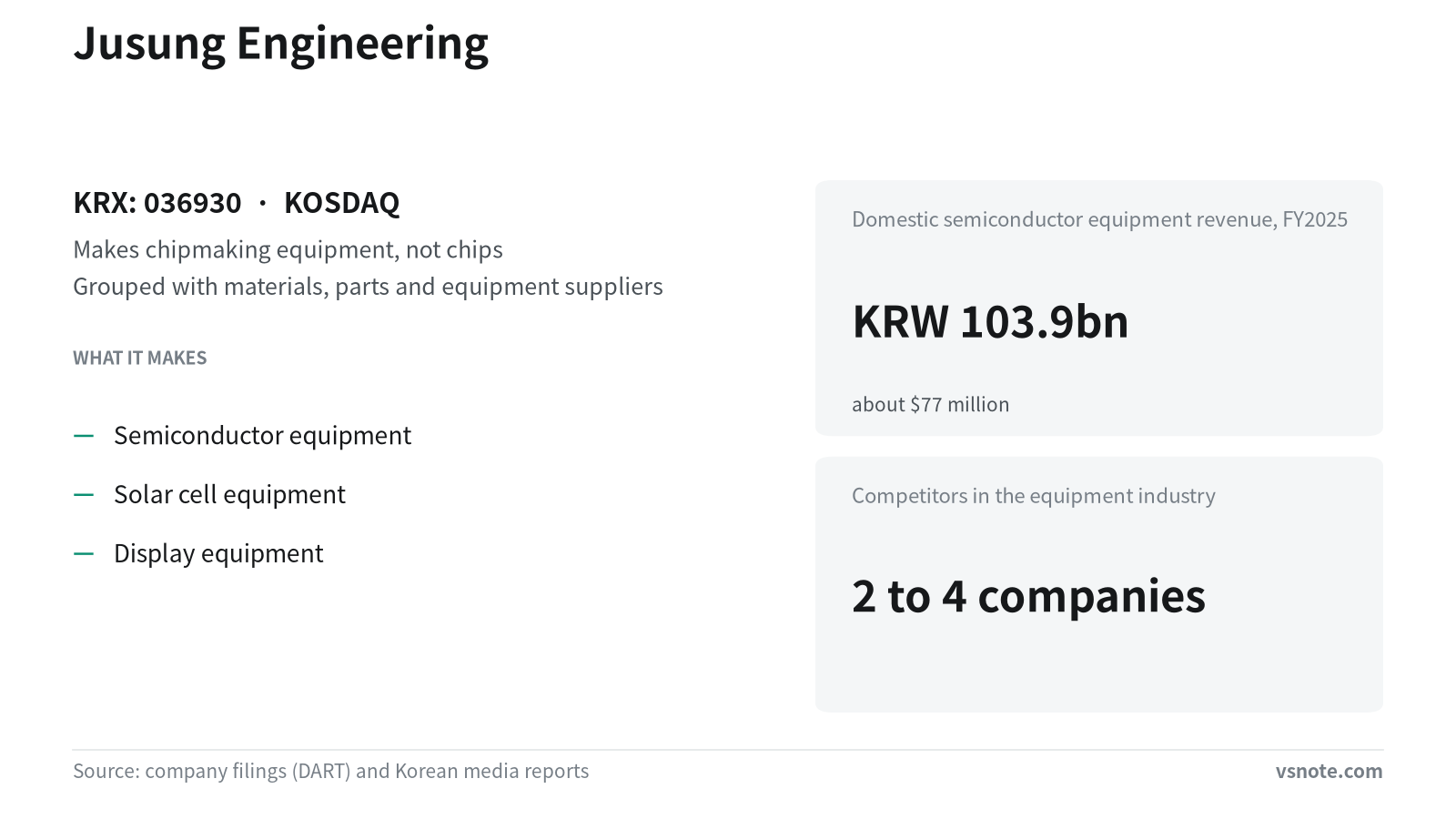
    It makes the machines that chipmakers use to produce them. The company trades on KOSDAQ, ticker 036930. KOSDAQ is the Korea Exchange’s market for growth and technology companies, and KOSPI is its main board.

    That one difference explains most of what follows, including why its revenue can swing sharply from one year to the next.

    JUSUNG ENGINEERING Co.,Ltd. (주성엔지니어링) · KRX: 036930 · KOSDAQ

    Won amounts are converted at ₩1,345.3 per US dollar (Bank of Korea ECOS, KRW/USD base rate, 2026-09-15) for scale only.


    Chips, or the machines that make chips

    Think of a bakery. One business bakes and sells bread. A different business supplies its ovens and mixers. Jusung Engineering is the second kind.

    The company’s annual report describes a business in semiconductor and solar cell manufacturing equipment. It reports three segments: semiconductor equipment, solar cell equipment and display equipment.

    Its core product is deposition equipment. Deposition means laying down a film, too thin to see, on the wafer that will become chips.

    So the company earns money when a chipmaker installs new equipment in a factory, not when chips are sold. A bakery that sells a lot of bread still does not buy a new oven every month.

    In Korea the company is grouped with materials, parts and equipment suppliers. These are companies whose products go into making finished goods rather than being finished goods themselves.


    Where the machine sits in the supply chain

    The next question is usually where the company ranks in its field. The sources cited here include no market share figure for the company, so this article uses three other measures: who buys the equipment, what it takes to sell it, and how large the company is.

    • Buyers are device makers, the companies that manufacture chips and run the factories. Consumers do not buy this equipment.
    • The equipment has to be developed to fit each buyer’s system. The annual report lists this as one of the competitive factors for entering the semiconductor market.
    • On size, Korean media reports place the company among the largest KOSDAQ stocks by market value, and some put it in the top 10.

    Built to the buyer’s specification

    This is where the bakery analogy stops working. An oven can be picked from a catalogue, but this equipment has to be designed around the buyer’s own production process.

    The seller does not build machines ahead of time and wait for orders. It builds them to conditions the buyer sets.

    That requirement also explains the next point: not every company can make this equipment and sell it.


    Why only a few companies make the same equipment

    This number comes from the company, not from an outside count. Its annual report says competition in the semiconductor equipment industry narrows down to two to four companies.

    The same report gives three competitive factors for entering the semiconductor market:

    • Developing equipment that fits the device maker’s system
    • Sustained investment in research and development
    • A range of products broad enough to cope with the business cycle

    Domestic sales tripled while total revenue fell

    Korean filings number fiscal years in sequence. For this company, the 30th fiscal period is FY2024 and the 31st is FY2025. The annual reports covering both were filed in March 2026 on DART, Korea’s electronic disclosure system run by the Financial Supervisory Service.

    The annual report splits semiconductor equipment revenue into domestic and export sales, and reading one without the other gives the opposite impression.

    • Domestic — KRW 34.2 billion (about $25 million) in FY2023, KRW 44.2 billion (about $33 million) in FY2024, KRW 103.9 billion (about $77 million) in FY2025
    • Export — KRW 180.6 billion (about $134 million), then KRW 305.5 billion (about $227 million), then KRW 199.8 billion (about $149 million)
    • Total — KRW 214.8 billion (about $160 million), then KRW 349.7 billion (about $260 million), then KRW 303.7 billion (about $226 million)

    Domestic sales more than doubled in the latest year and are about three times what they were two years earlier. Total semiconductor equipment revenue fell over the same year, because exports gave back more than the domestic gain added. The figures are consolidated, meaning they include subsidiaries, not separate (standalone) figures for the parent company alone.

    Both movements come from how the business works rather than from a one-off event. When equipment is built to each buyer’s process, sales bunch up in the years a customer adds capacity and thin out in the years it does not — and customers in different places add capacity at different times.

    So neither figure is a trend on its own. A doubling does not mean the company doubles every year, and a lower total does not by itself mean decline. One period’s figure describes that period.

    These figures also leave something out: solar cell and display equipment are counted separately.


    Where demand for new equipment comes from

    If revenue arrives when customers install equipment, the open question is whether customers will keep installing it. The sources cited here contain no research firm estimate of this market’s size or growth, so this article reports none.

    What the annual report does give is the company’s own description of the industry. It calls semiconductors a technology-intensive industry with a short product life cycle, used in advanced fields such as artificial intelligence, quantum computing, fintech, autonomous vehicles and humanoid robots.

    The report also calls it a high-value-added industry with large spillover effects on core industries such as electronics, information and communications, machinery and automobiles.

    The short life cycle matters most here. When the products change, the processes that make them have to change too, and that is when manufacturers buy new equipment. The filings cited here do not show how large that demand will be or when it will come.


    Frequently asked questions

    Q. Does Jusung Engineering make chips?

    A. No. It makes the equipment used to manufacture semiconductors, solar cells and displays. Its buyers are chip manufacturers that run factories, not consumers.

    Q. Who are Jusung Engineering’s competitors?

    A. The annual report says competition in the semiconductor equipment industry narrows down to two to four companies. The filings cited here do not name them.

    Q. Domestic revenue more than doubled. Does that mean steady growth?

    A. Domestic semiconductor equipment revenue rose to KRW 103.9 billion (about $77 million) in FY2025 from KRW 44.2 billion (about $33 million) in FY2024. Total semiconductor equipment revenue fell over the same year, from KRW 349.7 billion (about $260 million) to KRW 303.7 billion (about $226 million), because export sales fell. The equipment is built for each customer’s process, so sales depend on when customers invest in new capacity — and customers in different places invest at different times. A single period’s figure should not be read as a trend.

    Q. What do the 30th and 31st fiscal periods mean in the filings?

    A. Korean filings number fiscal years in sequence. For this company, the 30th period is FY2024 and the 31st is FY2025. The annual reports are available on DART, Korea’s electronic disclosure system run by the Financial Supervisory Service.

    Q. Is there a forecast for the market this company sells into?

    A. The sources cited here include no research firm estimate of the market’s size or growth. The annual report describes semiconductors as a technology-intensive industry with a short product life cycle, used in fields such as artificial intelligence, autonomous vehicles and humanoid robots.


    Sources

    • https://dart.fss.or.kr/dsaf001/main.do?rcpNo=20260318000323
    • http://www.choicenews.co.kr/news/articleView.html?idxno=170819
    • http://www.inews24.com/view/2000699
    • https://www.news2day.co.kr/article/20260901500211
    • https://www.namdonews.com/news/articleView.html?idxno=921905

    This article explains company filings and published figures for information only. It is not investment advice or a recommendation to buy or sell any security. Figures can change after publication — check the original filings before making decisions.
  • LIG Defense&Aerospace explained: Korea’s air defense missile maker

    LIG Defense&Aerospace explained: Korea’s air defense missile maker

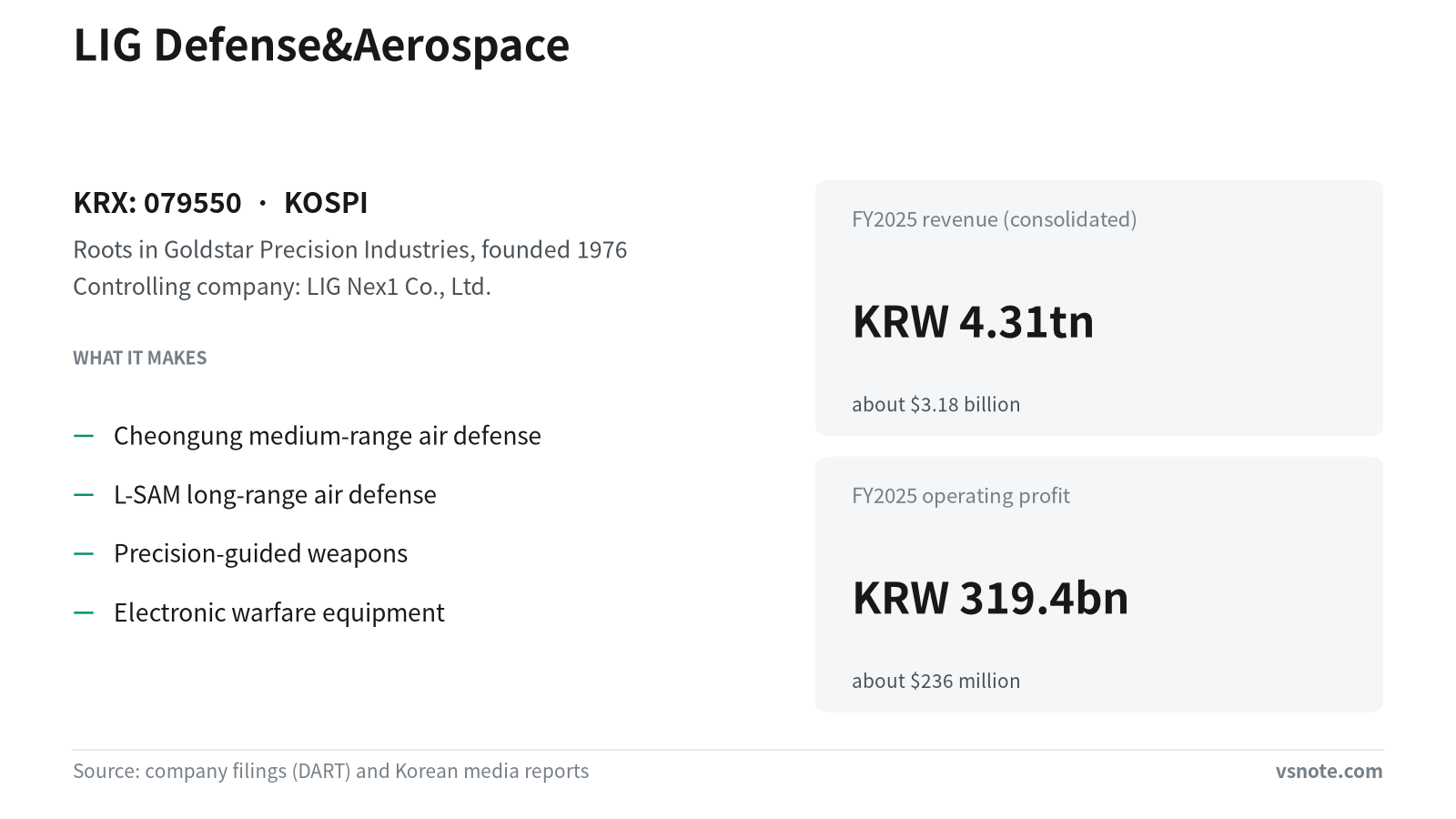
    LIG Defense&Aerospace is a South Korean defense manufacturer listed on KOSPI, the main board of the Korea Exchange, under ticker 079550. It traces its roots to Goldstar Precision Industries, founded in 1976.

    It makes precision-guided weapons, surveillance and reconnaissance systems, command, control and communications equipment, avionics and electronic warfare equipment. Its best-known products are air defense systems: the missiles, radars and launchers that detect incoming missiles and aircraft and shoot them down.

    Two of these are Cheongung, a medium-range system, and L-SAM, a long-range system. Each covers one layer of a country’s air defense network. The rest of this article follows from that: which layer the company sells, who it competes with for that layer, and why a new export contract is not the same thing as this year’s revenue.

    LIG Defense&Aerospace Co., Ltd. (엘아이지디펜스앤에어로스페이스) · KRX: 079550 · KOSPI

    Won amounts are converted at ₩1,353.3 per US dollar (Bank of Korea ECOS, KRW/USD base rate, 2026-09-16) for scale only.


    What the company’s missiles are built to stop

    The company’s annual report lists five business areas: precision-guided weapons, surveillance and reconnaissance, command, control and communications, avionics, and electronic warfare. Precision-guided munitions (PGM) are weapons that steer themselves onto a target after launch instead of flying a fixed path. The company reports PGM as a separate product line in its sales breakdown.

    Its core business is exporting two air defense systems, Cheongung (medium range) and L-SAM (long range). L-SAM is described as covering upper-tier defense at altitudes of 40–60km.

    Readers who know the name LIG Nex1 are looking at the same company. It was renamed LIG Defense&Aerospace, and Korean media reported the change at the end of March 2026 — after the FY2025 annual report was filed on March 23, which is why that report still carries the former name. The listing did not change: the same KRX ticker, 079550, and the same DART corporate registration.


    Which layer it covers, and who buys it

    The filings cited here do not give market shares. The company’s position is easier to judge on three points: which layer of air defense it supplies, who its customers are, and where it sits in the supply chain.

    In the air defense network, Cheongung covers the medium-range layer and L-SAM the upper layer. According to Korean media reports, the company will take part in L-SAM mass production.

    The company’s buyers are governments. It works with Korea’s Defense Acquisition Program Administration (the government agency that buys weapons), the Agency for Defense Development and the Defense Agency for Technology and Quality. Korean media report that Cheongung has already been exported to Saudi Arabia, Iraq and the UAE, and that other Middle Eastern countries, including Qatar, are seeking to buy it.

    In the supply chain, the company buys parts and subassemblies from smaller suppliers and turns them into complete weapon systems. One supplier reportedly signed a contract to supply metal assembly parts and ten other items for the government’s Block-1 electronic warfare aircraft development program. Another listed supplier reportedly counts the company as a major customer that makes up 33% of its revenue.


    Who it competes with, and who it works with

    Competition in air defense happens layer by layer. According to Korean media reports, the Swiss government is running a program for a next-generation long-range ground-based air defense system, and L-SAM is competing against SAMP/T NG from Eurosam, a French-Italian joint venture.

    Two outside factors reportedly shape that contest. Switzerland ordered five Patriot batteries from the United States in 2022, and deliveries have been delayed by 5–7 years. Reports also say the US-Iran war has left Patriot missiles in short supply.

    Europe is also changing the rules for buying weapons. The EU reportedly requires at least 65% of component costs to be sourced from Europe or certain partner countries for a large defense lending program. Korean media report that the company is responding with local factories and joint ventures.

    The Swiss Federal Council was reported to be due to decide the program’s direction by 18 September. The sources cited here do not include the outcome.

    With Germany’s Rheinmetall, the relationship is a partnership in which each company covers a different layer. The two reportedly plan to enter NATO markets together by combining Rheinmetall’s very-short-range air defense with the company’s medium- and long-range systems. They are also reportedly developing a short-range air defense (SHORAD) system that pairs Rheinmetall’s Skyranger 30 with the company’s Singung system.

    At home, bids have closed for the KF-21 fighter’s long-range air-to-air missile program, which is reportedly worth KRW 1.90 trillion (about $1.40 billion). Korean media report that the procurement agency is considering restricting the company’s eligibility to bid on government contracts over a bribery case involving executives. Under such a restriction, the company would be barred from government tenders for a set period. Reports say no sanction has been decided yet.


    Revenue already earned versus orders still to deliver

    Korean companies number their fiscal periods from their founding year. The company’s 24th period is FY2025 and its 23rd is FY2024. The figures below are consolidated, meaning they include subsidiaries. Korean filings also report separate (standalone) figures for the parent entity alone.

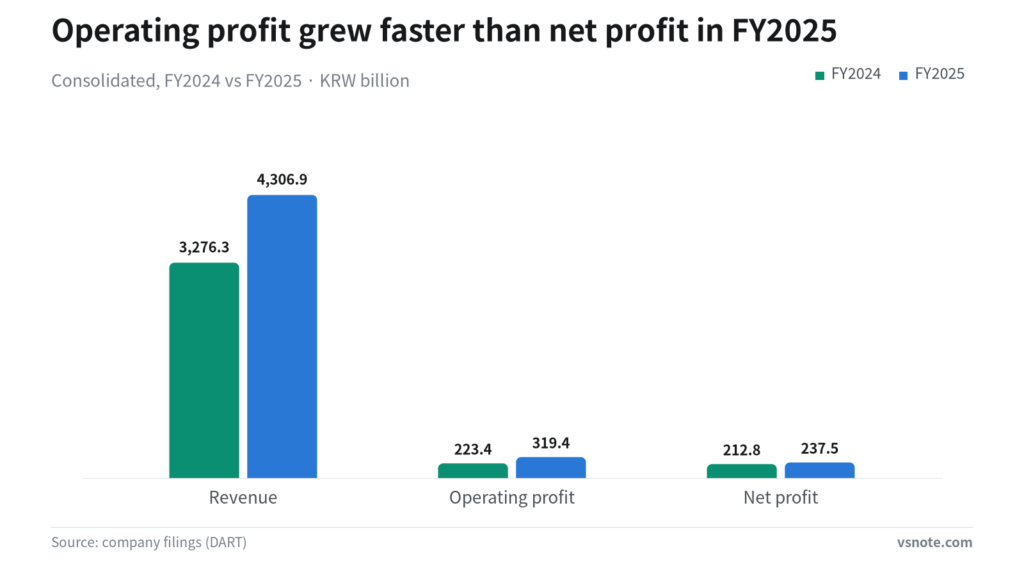
    The annual report shows FY2025 consolidated revenue of KRW 4.31 trillion (about $3.18 billion), up from KRW 3.28 trillion (about $2.42 billion) in FY2024. Operating profit rose to KRW 319.4 billion (about $236 million) from KRW 223.4 billion (about $165 million).

    Net profit was KRW 237.5 billion (about $175 million), compared with KRW 212.8 billion (about $157 million) a year earlier. Net profit rose less steeply than operating profit, and the filings cited here do not explain why.

    Grouped bar chart comparing consolidated revenue, operating profit and net profit for FY2024 and FY2025.

    These figures reflect weapons already delivered. Order backlog is different: it counts contracts the company has signed but not yet delivered, so it turns into revenue later.

    According to Korean media reports, the company’s domestic order backlog is KRW 10.52 trillion (about $7.77 billion), or 43% of its total backlog. News of a new export contract therefore adds to backlog first. It does not show up in that year’s revenue right away.


    Where rising air defense spending goes

    The company’s filings define the defense industry as the production and development of goods a country needs for its military defense. In the broader sense, that includes non-combat supplies such as uniforms and field rations. Either way, demand ultimately comes from government budgets.

    Korean media reports trace the growth of Korean defense exports. Export orders won by Korean defense companies ran at about $2.6 billion to $3.1 billion a year in 2016–2020, peaked at $17.3 billion in 2022, and were $15.4 billion last year. Korea Investors Service, a Korean credit rating agency, has said export competition for Korean defense companies has entered a new phase.

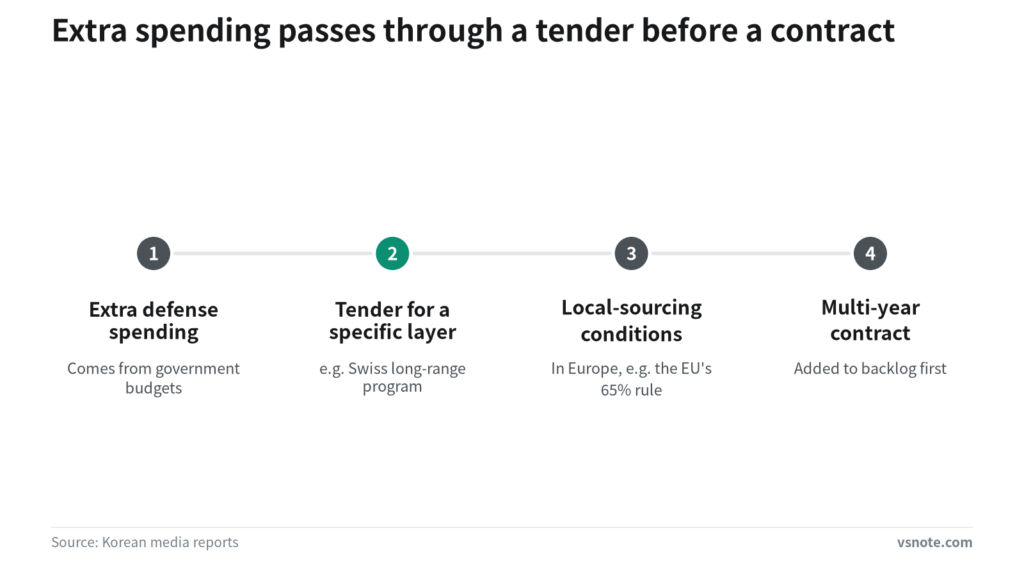
    Extra spending does not reach a supplier directly. It passes through each government’s tenders for specific air defense layers and, in Europe, through local-sourcing conditions such as the EU’s 65% rule, before it becomes a multi-year contract.

    Four steps from extra air defense spending through a government tender for a specific layer and local-sourcing conditions to a multi-year contract.

    According to Korean media reports, the company’s air defense exports to the Middle East are picking up, and it is pursuing European markets. It is also named as a company whose European prospects could grow depending on the Swiss long-range program.

    Winning one layer does not mean supplying a country’s whole network. Other layers can go to other countries’ products, as the Rheinmetall pairing shows. Whether more spending turns into contracts for this company is left for readers to judge.


    Frequently asked questions

    Q. Is LIG Defense&Aerospace the same as LIG Nex1?

    A. Yes. LIG Nex1 is the former name. Korean media reported the change at the end of March 2026, and the KRX ticker (079550) and DART registration are unchanged. The FY2025 annual report was filed on March 23, before the change, so it still uses the old name.

    Q. What are Cheongung and L-SAM?

    A. They are the company’s two main air defense systems. Cheongung covers the medium-range layer. L-SAM covers long-range, upper-tier defense and is described as operating at altitudes of 40–60km.

    Q. Which countries have bought the company’s air defense systems?

    A. According to Korean media reports, Cheongung has been exported to Saudi Arabia, Iraq and the UAE, and other Middle Eastern countries, including Qatar, are seeking to buy it.

    Q. What is the procurement sanction issue?

    A. According to Korean media reports, Korea’s Defense Acquisition Program Administration is considering restricting the company’s eligibility to bid on government contracts over a bribery case involving executives. Reports say no decision has been made.

    Q. How large is the company’s order backlog?

    A. Korean media report a domestic order backlog of KRW 10.52 trillion (about $7.77 billion), which is 43% of the total. Backlog is signed orders not yet delivered, so it is separate from reported revenue.


    Sources

    • https://dart.fss.or.kr/dsaf001/main.do?rcpNo=20260323001211
    • https://www.thelec.kr/news/articleView.html?idxno=54362
    • https://www.newsquest.co.kr/news/articleView.html?idxno=301069
    • https://biz.newdaily.co.kr/site/data/html/2026/09/16/2026091600107.html
    • https://blog.naver.com/foresttotree/224413895687
    • http://www.wowtv.co.kr/NewsCenter/News/Read?articleId=A202609160262&t=NN
    • https://dealsite.co.kr/articles/169078
    • https://www.cnbizm.com/news/articleView.html?idxno=315228
    • https://www.newsway.co.kr/news/view?ud=2026091515023765043
    • https://www.bloter.net/news/articleView.html?idxno=673669
    • https://theviewers.co.kr/View.aspx?No=4227155

    This article explains company filings and published figures for information only. It is not investment advice or a recommendation to buy or sell any security. Figures can change after publication — check the original filings before making decisions.
  • HD Hyundai Heavy Industries: why a shipbuilder builds power engines

    HD Hyundai Heavy Industries: why a shipbuilder builds power engines

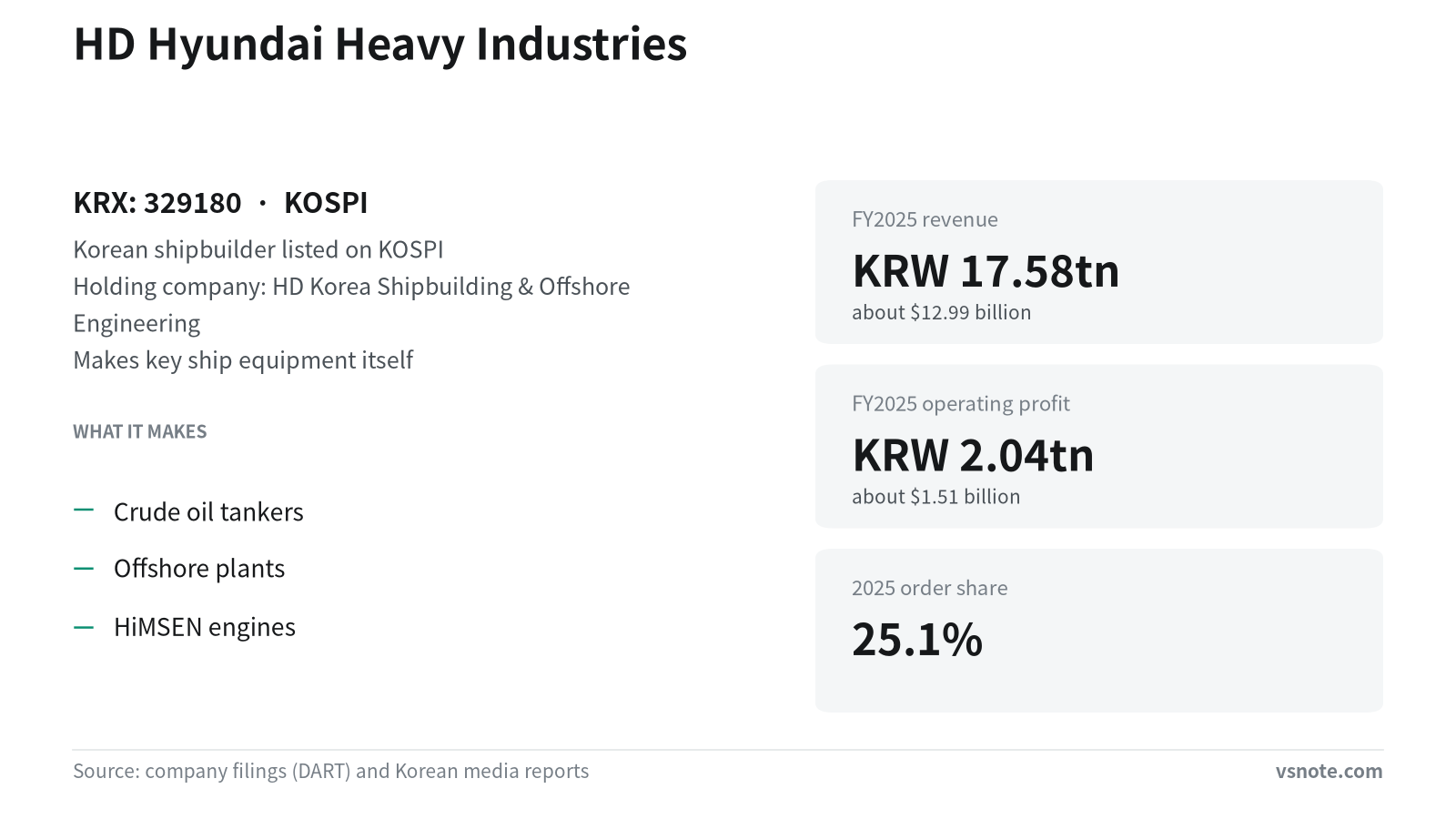
    HD Hyundai Heavy Industries is a Korean shipbuilder listed on KOSPI, the main board of the Korea Exchange, under ticker 329180. It builds large vessels such as crude oil tankers, plus offshore plants: the facilities that pump crude oil and natural gas from fields under the sea.

    It also makes key ship equipment itself, including engines. Recent news about power plant engines and small nuclear reactor parts is about that engine business moving onto land.

    Its holding company is HD Korea Shipbuilding & Offshore Engineering. It also has a subsidiary shipyard in the Philippines. Both names come up in the same news stories, so this guide separates them.

    HD HYUNDAI HEAVY INDUSTRIES CO.,LTD. (에이치디현대중공업) · KRX: 329180 · KOSPI

    Won amounts are converted at ₩1,353.3 per US dollar (Bank of Korea ECOS, KRW/USD base rate, 2026-09-16) for scale only.


    Ships, offshore plants and the engines that drive them

    The company’s annual report lists ships such as crude oil tankers as the main products of its shipbuilding division. Its second line of work is offshore plants.

    The filing describes the offshore plant industry as covering design, purchasing, construction, transport, installation and commissioning of facilities that produce crude oil and natural gas at offshore fields. These facilities are very large and technically complex, because each one depends on where it is installed and on the properties of the oil or gas it handles.

    The company makes or sources the main equipment for its ships itself. That includes HiMSEN, a four-stroke medium-sized engine it developed in 2000. Korean media report that more than 15,000 HiMSEN engines had been produced by 2024, and that the company has decided to sharply expand production of medium-speed engines for power generation on land.

    Think of a restaurant that starts bottling the sauce it made for its own dishes and selling it in stores. The engine built for the company’s ships is now being sold to power plants as well.

    Three names often appear alongside this one. HD Korea Shipbuilding & Offshore Engineering is the holding company. HD Hyundai Philippines Shipyard is a subsidiary. The Hyundai Heavy Industries branch of the Korean Metal Workers’ Union uses the name without the “HD” prefix.


    Who measures the size of a shipbuilder, and how

    In its annual report, the company says only that it holds a leading position in shipbuilding. It gives no market share of its own for offshore plants, because each one is built to order and share cannot be calculated for individual products.

    The share figures available here come from somewhere else: the annual report of Hanwha Ocean, another Korean shipbuilder. Orders there are measured in gross tonnage (GT), a measure of a ship’s enclosed volume, not its weight.

    Hanwha Ocean’s report gives these figures for HD Hyundai Heavy Industries’ orders:

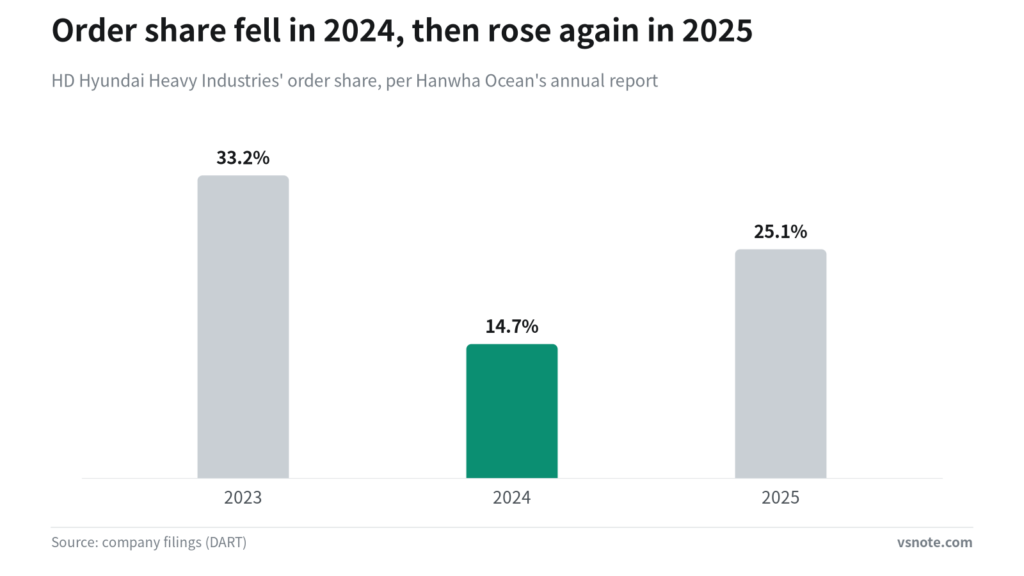
    • 2023: 5,304 thousand GT, an order share of 33.2%
    • 2024: 2,730 thousand GT, an order share of 14.7%
    • 2025: 6,209 thousand GT, an order share of 25.1%
    Bar chart of HD Hyundai Heavy Industries' order share: 33.2% in 2023, 14.7% in 2024 and 25.1% in 2025.

    What the company says sets it apart, and what nearby yards are signing

    In its filing, the company lists its competitive strengths: long experience and know-how in building ships, a wide range of products, and a record of business with major shipping lines around the world.

    Other Korean yards are signing crude tanker contracts too. According to Korean media reports, the company won orders for four VLCCs (very large crude carriers) in the first half of this year through its subsidiary HD Hyundai Philippines Shipyard.

    The same reports say Hanwha Ocean won four VLCCs from Pan Ocean this year for about KRW 736.0 billion (about $544 million). Samsung Heavy Industries disclosed on July 2 a contract with a shipowner in Oceania to build two crude oil tankers, worth KRW 273.4 billion (about $202 million).

    These are separate contracts of different sizes. They are listed here side by side, not ranked. The sources cited here do not name any overseas competitor shipyards.


    Why revenue rose the year after a low order year

    Korean filings number each fiscal year. In the annual report, the 7th period is FY2025 and the 6th period is FY2024. The figures below are consolidated, meaning they include subsidiaries; Korean filings also show separate (standalone) figures for the parent company alone.

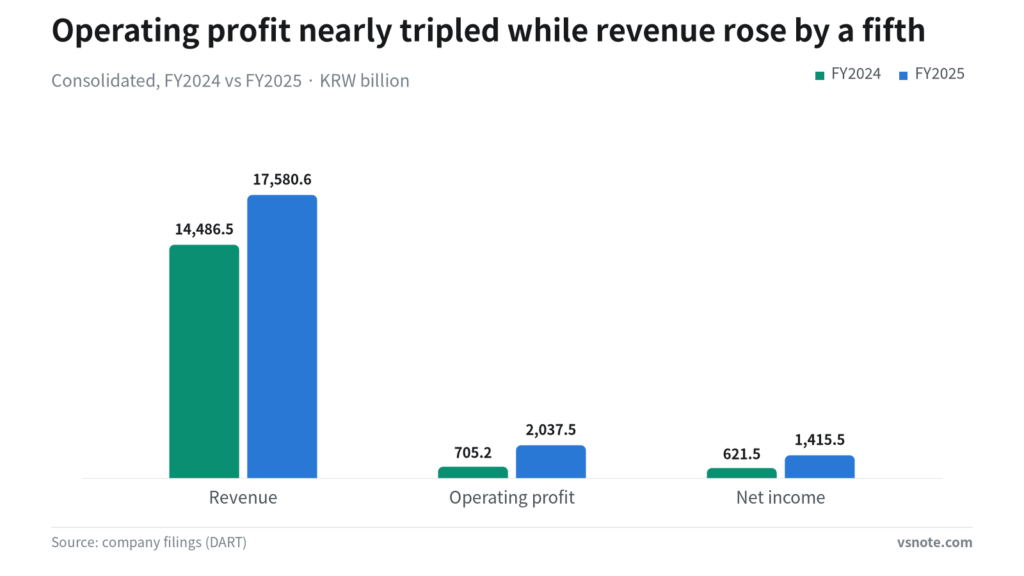
    Orders were low in 2024, at 2,730 thousand GT. Even so, consolidated revenue rose from KRW 14.49 trillion (about $10.70 billion) in FY2024 to KRW 17.58 trillion (about $12.99 billion) in FY2025.

    Operating profit went from KRW 705.2 billion (about $521 million) to KRW 2.04 trillion (about $1.51 billion), and net income from KRW 621.5 billion (about $459 million) to KRW 1.42 trillion (about $1.05 billion). Total assets at year-end grew from KRW 19.39 trillion (about $14.33 billion) to KRW 26.16 trillion (about $19.33 billion).

    Grouped bar chart comparing consolidated revenue, operating profit and net income for FY2024 and FY2025.

    The explanation lies in when each number is counted. An order is counted in the year the contract is signed, while revenue from a ship is booked over the years it takes to build. The order figures and the revenue figures can therefore point to different years.

    The sales and order tables in the annual report are as of December 31, 2025.


    The engine and SMR plants, and who forecasts the demand

    According to Korean media reports, the company announced a total investment of KRW 1.07 trillion (about $792 million) in a power engine production base and an SMR component plant. SMRs are small modular reactors; the plant will make their main components, such as sodium reactors.

    Of the total, KRW 833.6 billion (about $616 million), or 78%, goes to a new plant for HiMSEN engines used in power generation on land. The reported annual capacity of that plant is 3GW. The SMR plant receives KRW 238.6 billion (about $176 million).

    For scale, the total investment is slightly more than half of FY2025 consolidated operating profit. The company reportedly plans to use the expansion to target power infrastructure for AI data centers.

    Others have published forecasts of that power demand. BlackRock put US power demand in 2025 at 489GW, with data centers accounting for 3.9%. The International Energy Agency (IEA) forecast that global data center electricity consumption will rise from about 415TWh in 2024 to about 950TWh in 2030. EPRI projected that US data centers could account for 9–17% of total US electricity consumption in 2030.

    Demand for ships has its own measure. According to Clarksons Research figures cited in Korean media, 64 VLCCs were ordered worldwide in the first quarter of this year, compared with 3 in the first quarter of last year.

    This is where the sauce analogy breaks down. A bottled sauce can sell the next day, but the engine plant targets completion in May 2028 and the SMR plant in the first half of 2029, so none of this shows up in current results. The buyers also change, from shipping lines to the companies that build power infrastructure.


    Frequently asked questions

    Q. Is HD Hyundai Heavy Industries the same company as HD Korea Shipbuilding & Offshore Engineering?

    A. No. According to the annual report, HD Korea Shipbuilding & Offshore Engineering is the holding company of HD Hyundai Heavy Industries. HD Hyundai Heavy Industries trades on KOSPI under ticker 329180.

    Q. Where does the order market share figure come from?

    A. The share figures cited here come from Hanwha Ocean’s annual report, not from HD Hyundai Heavy Industries’ own filing. They show 33.2% for 2023, 14.7% for 2024 and 25.1% for 2025. The company itself says only that it holds a leading position, and it does not calculate a market share for offshore plants.

    Q. What do the 6th and 7th periods mean in the filings?

    A. Korean filings number fiscal years. In this company’s annual report, the 6th period is FY2024 and the 7th period is FY2025.

    Q. Do the new engine and SMR plants contribute to revenue yet?

    A. Not yet, going by their timelines. According to Korean media reports, the power engine plant targets completion in May 2028 and the SMR component plant in the first half of 2029.

    Q. What is a HiMSEN engine?

    A. HiMSEN is a four-stroke medium-sized engine that the company developed in 2000. It is used in ships, and the company is expanding production of the version used for power generation on land.


    Sources

    • https://dart.fss.or.kr/dsaf001/main.do?rcpNo=20260320000859
    • https://dart.fss.or.kr/dsaf001/main.do?rcpNo=20260317000644
    • https://www.businesspost.co.kr/BP?command=article_view&num=447262
    • https://www.mediawatch.kr/news/article.html?no=261050
    • https://www.newsquest.co.kr/news/articleView.html?idxno=300974
    • https://www.newsquest.co.kr/news/articleView.html?idxno=300948
    • https://blog.naver.com/won24_/224407153829
    • https://blog.naver.com/prestar_fn/224412156377
    • https://blog.naver.com/rfkang49/224411227377
    • https://blog.naver.com/sobakcc/224412143266
    • https://blog.naver.com/julsongai777/224412061800

    This article explains company filings and published figures for information only. It is not investment advice or a recommendation to buy or sell any security. Figures can change after publication — check the original filings before making decisions.
  • Hanwha Ocean explained: LNG carriers, warships and order timing

    Hanwha Ocean explained: LNG carriers, warships and order timing

    Hanwha Ocean is a shipbuilder based in Geoje, South Gyeongsang Province, that builds ships to order. It is listed on KOSPI, the main board of the Korea Exchange, under ticker 042660, and Korean market coverage groups it with shipbuilding and defense stocks. Its predecessor was Daewoo Shipbuilding & Marine Engineering.

    It builds three kinds of vessels: commercial ships such as LNG carriers, crude oil tankers and container ships; offshore units that produce and store oil at sea; and warships such as frigates. Most of its money comes from commercial ships sold abroad, and in FY2025 its commercial ship sales were almost entirely exports.

    News headlines focus on submarines and frigates, but the figures point elsewhere. A shipbuilder takes an order first and builds the ship later, so today’s results come from orders won earlier. A ‘selection’ or an ‘unveiling’ in this week’s news is not yet a signed contract.

    Hanwha Ocean Co., Ltd. (한화오션) · KRX: 042660 · KOSPI

    Won amounts are converted at ₩1,345.3 per US dollar (Bank of Korea ECOS, KRW/USD base rate, 2026-09-15) for scale only.


    Where the ships built in Geoje go

    The company’s annual report is filed on DART, Korea’s electronic disclosure system run by the Financial Supervisory Service. Korean filings label each fiscal year with a sequential period number, so the 26th period is FY2025, the 25th is FY2024 and the 24th is FY2023.

    The report lists LNG carriers (LNGC, ships that carry liquefied natural gas), LPG carriers and container ships among the commercial ship segment’s products. The business scope also covers crude oil tankers, FPSOs (floating production, storage and offloading units, which produce crude oil at sea and store it until it is offloaded) and drilling rigs such as drillships.

    In FY2025, export sales in the commercial ship segment far exceeded domestic ship sales, and they made up most of the company’s consolidated revenue. The annual report shows consolidated revenue of KRW 12.78 trillion (about $9.50 billion) for FY2025, up from KRW 10.78 trillion (about $8.01 billion) in FY2024. Korean companies publish consolidated figures, which include subsidiaries, and separate figures for the parent company alone. This article uses consolidated figures.

    LNG carriers lead the mix. In the report’s main products table, the LNG carrier line in the commercial ship segment has a 77.3% sales share for FY2025.

    The company traces its roots to Daewoo Shipbuilding & Marine Engineering, which won a frigate order from Thailand in 2013. Philly Shipyard, a name that also appears in coverage, is a US shipyard that Hanwha acquired. It is not the Geoje yard.


    How much of each year’s new orders it wins

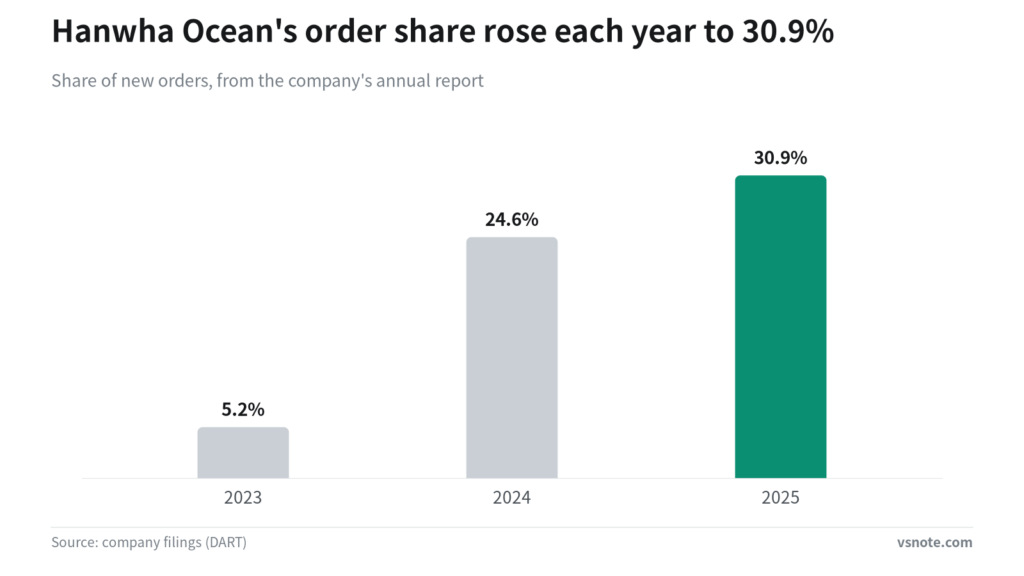
    A company that builds to order does not measure its market position by units sold. It measures its share of the new orders placed each year. That share is counted in GT (gross tonnage), which measures the space inside a ship rather than its weight.

    The market share table in the company’s annual report shows this path:

    • 2023: 828 thousand GT of orders, a 5.2% share
    • 2024: 4,569 thousand GT of orders, a 24.6% share
    • 2025: 7,638 thousand GT of orders, a 30.9% share
    Bar chart of Hanwha Ocean's share of new orders: 5.2% in 2023, 24.6% in 2024 and 30.9% in 2025.

    These shares come from the company’s own annual report, not from an outside research firm, and the filings cited here do not show whether the base is the Korean market or the global market. The same table lists HD Hyundai Heavy Industries, whose share over the same three years was 33.2%, 14.7% and 25.1%.


    Two kinds of competition: shipowners and governments

    Commercial ships are ordered by shipowners. Warships are bought by governments through tenders, so the competition takes a different form and involves shipbuilders from other countries.

    According to Korean media reports, the Royal Thai Navy’s next-generation frigate competition drew HD Hyundai Heavy Industries, Spain’s Navantia, Singapore’s ST Engineering and a defense company from Türkiye. In Canada’s next submarine program, Hanwha Ocean did not win, and the Canadian government chose Germany’s TKMS as preferred bidder.

    In Thailand the company has a track record. In 2018, as Daewoo Shipbuilding & Marine Engineering, it delivered the 3,700-ton-class frigate Bhumibol Adulyadej to the Royal Thai Navy, and the ship now serves as the navy’s flagship.


    Where the frigate and floating data center news stands

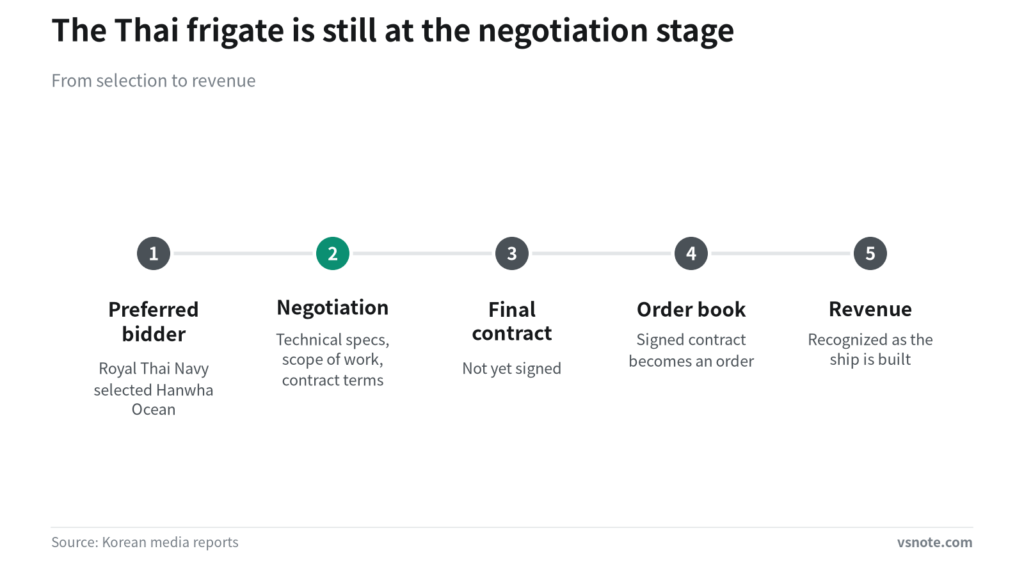
    According to Korean media reports, the Royal Thai Navy selected Hanwha Ocean as preferred bidder for its next-generation frigate program. A preferred bidder is the party chosen to negotiate terms before any final contract is signed. The program is reportedly worth about KRW 683.3 billion (about $508 million). For scale, FY2025 consolidated revenue was KRW 12.78 trillion (about $9.50 billion).

    The reports say the final contract has not been signed. The company is expected to negotiate detailed technical specifications, the scope of work and contract terms with the navy before the final terms are set.

    Step diagram showing the path from preferred bidder selection to negotiation, final contract, order book and revenue, with the Thai frigate program highlighted at negotiation.

    Its bid is the OCEAN-40F, a 4,000-ton-class export frigate developed from the Bhumibol Adulyadej. After losing in Canada, the company has said it still sees other submarine export opportunities.

    The second item is a floating data center the company developed itself, rated at the 60MW class and reportedly shown to the public for the first time at Gastech 2026. The American Bureau of Shipping (ABS), a classification society that certifies ship designs against technical standards, granted Approval in Principle (AiP) for its concept design. AiP is issued at the concept design stage and is not a construction contract.

    In the reports cited here, neither the frigate nor the data center is a signed contract, so neither has reached the order book or revenue. The sources cited here contain no forecast for the shipbuilding industry. What they do show is structure: commercial ship sales lean heavily on LNG carriers.


    Frequently asked questions

    Q. Is Hanwha Ocean a defense company or a commercial shipbuilder?

    A. It is both, but the annual report shows that commercial ships sold abroad make up most of its revenue. In FY2025, the LNG carrier line had a 77.3% sales share in the commercial segment’s products table. Warships such as frigates are a separate line of business that gets a lot of news coverage.

    Q. Has Hanwha Ocean signed the Thai frigate contract?

    A. Not according to Korean media reports. The Royal Thai Navy selected it as preferred bidder, and the final contract is still under negotiation. The program is reportedly worth about KRW 683.3 billion (about $508 million).

    Q. What does the 30.9% order share for 2025 mean?

    A. It is the company’s share of new orders in 2025, measured in gross tonnage, as reported in its own annual report. The filings cited here do not show whether that share is of the Korean market or the global market.

    Q. Is Hanwha Ocean the same company as Daewoo Shipbuilding & Marine Engineering?

    A. Daewoo Shipbuilding & Marine Engineering is its predecessor. That company won a frigate order from Thailand in 2013 and delivered the frigate Bhumibol Adulyadej in 2018. Philly Shipyard is a different business: a US shipyard acquired by Hanwha.


    Sources

    • https://dart.fss.or.kr/dsaf001/main.do?rcpNo=20260317000644
    • https://www.pinpointnews.co.kr/news/articleView.html?idxno=487283
    • https://blog.naver.com/rktnco/224412200022
    • https://blog.naver.com/market_decoder/224411728167
    • https://gaundekr.tistory.com/15795069
    • https://blog.naver.com/pure-vitamin/224410376873
    • https://blog.naver.com/tmishaha/224410961151
    • https://www.busan.com/view/busan/view.php?code=2026091313294192853
    • https://blog.naver.com/wealthinking0909/224410008283

    This article explains company filings and published figures for information only. It is not investment advice or a recommendation to buy or sell any security. Figures can change after publication — check the original filings before making decisions.
  • HD Hyundai Electric: what it makes and how orders become revenue

    HD Hyundai Electric: what it makes and how orders become revenue

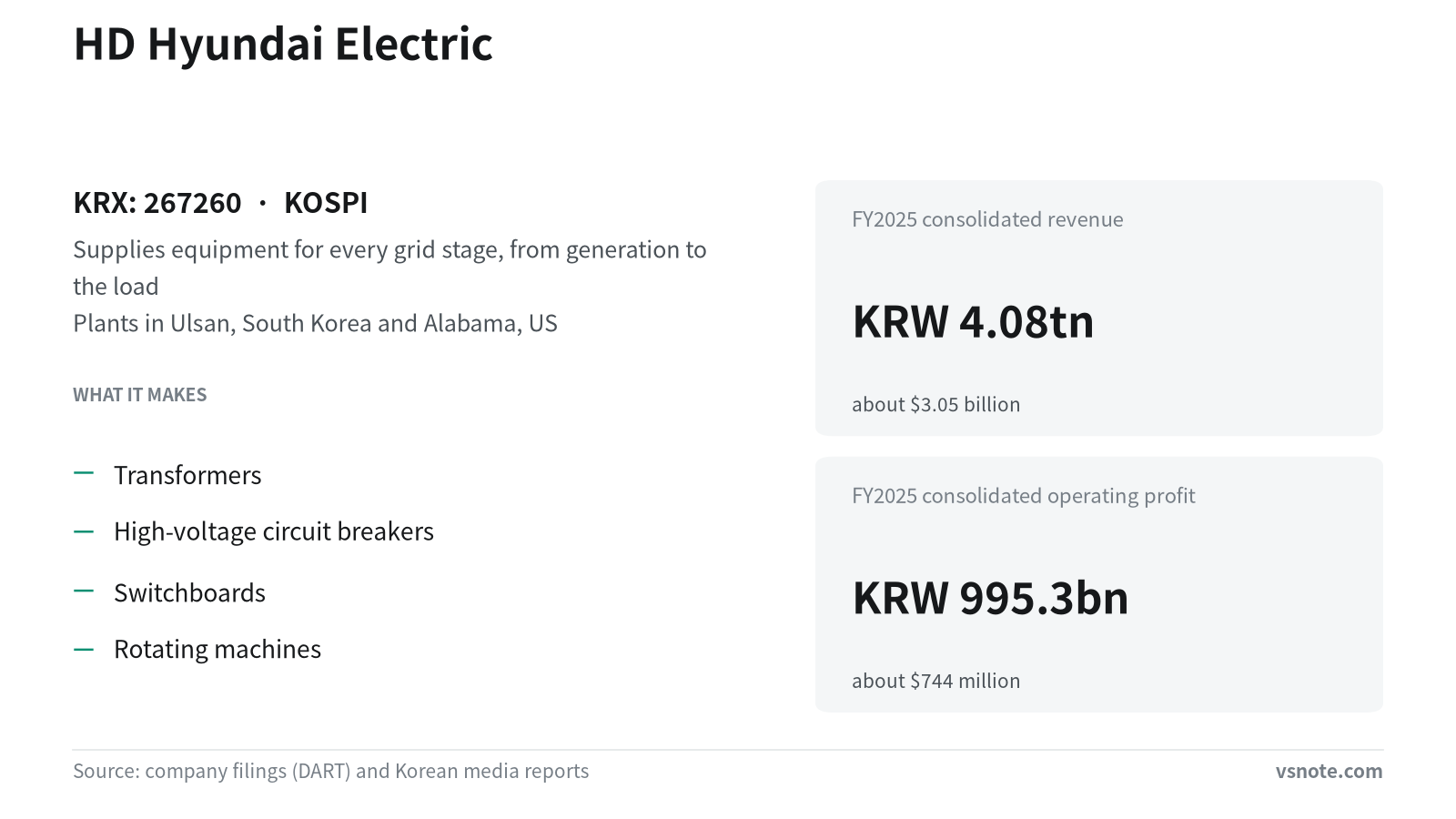
    Electricity made at a power plant goes through several stages before it reaches a factory, an office tower or a data center. Each stage needs heavy equipment. HD Hyundai Electric makes that equipment: transformers, circuit breakers, switchboards and rotating machines.

    The company does not sell electricity or collect power bills. The buyers are the parties that build power grids and large facilities, and they pay for the machines. The ‘HD Hyundai’ in its name is the name of a business group, and the company is one of that group’s affiliates.

    HD Hyundai Electric is listed on KOSPI, the main board of Korea’s stock exchange, under ticker 267260. Once it is clear that the company sells machines built to order, news about it falls into three kinds: who is buying, how orders already won turn into revenue, and where new demand comes from.

    HD HYUNDAI ELECTRIC CO.,LTD (에이치디현대일렉트릭) · KRX: 267260 · KOSPI

    Won amounts are converted at ₩1,338.2 per US dollar (Bank of Korea ECOS, KRW/USD base rate, 2026-09-11) for scale only.


    What stands between the power plant and the building

    Every national grid follows the same flow, the company’s annual report explains. Electricity is generated, transmitted, distributed and finally consumed by the end user, which is known as the load.

    The filing defines the electrical equipment industry as the business of making the machines needed to build and run that grid. HD Hyundai Electric supplies electrical equipment and energy solutions for all four stages.

    A parcel network gives a rough picture. Parcels move from trunk-route trucks to regional hubs to local delivery before they reach a door. HD Hyundai Electric is not the carrier in this picture. It builds the hubs and the sorting equipment.

    The comparison fails in two places. A hub can hold parcels before sending them on, but electricity has nowhere to be stacked up and must flow onward as soon as it arrives. And a transformer does not split a load into smaller boxes. It changes voltage, the pressure that pushes electricity along the line.

    The filings sort the company’s products by grid stage into power equipment, distribution equipment and rotating machines. Power equipment includes transformers, which raise or lower voltage, and high-voltage circuit breakers, which cut off the current.

    The equipment the company and its subsidiaries take orders for also includes switchboards and rotating machines. A switchboard is the cabinet that takes incoming power and splits it among the circuits inside a building. A rotating machine is equipment that does its work by spinning, driven by electricity.

    The company’s group ties show up in its disclosures. On August 14, 2026, it filed a notice on DART, Korea’s electronic disclosure system run by the Financial Supervisory Service, about changes to its trade in goods and services with affiliates under the same controlling shareholder.


    Who buys the equipment, and where it is made

    These are large machines. According to Korean media reports, the company’s plant in Ulsan, South Korea, builds large 500kV transformers, and each unit of the high-voltage equipment made there costs about KRW 10.0 billion (about $7 million).

    The company also manufactures in the United States. Its Alabama plant can reportedly make 105 power transformers a year, and a second plant there is expected to add about 50% to that capacity once it is finished.

    The buyers now go beyond grid projects. In July 2026, the company reportedly signed a long-term framework agreement with a global big tech company to supply power and distribution equipment for data centers in North America. Korean media describe direct contracts with big tech companies as a way for the company to reach more types of customer.

    Buyers in Korea matter too. Reports say more deliveries to semiconductor projects in Korea helped raise distribution equipment sales in the second quarter of 2026.

    In Korea, HD Hyundai Electric is grouped with Hyosung Heavy Industries and LS Electric as a domestic power equipment maker. The sources cited here do not compare the three companies or say what separates them, and they do not cover competitors outside Korea.


    When an order becomes revenue

    This equipment is ordered first, then built, then handed over. So three kinds of figure describe money at different points in time: revenue for a period, orders already in hand, and framework agreements stated as a ceiling.

    Start with full years. Korean filings number fiscal years in sequence, so FY2025 appears as the 9th period and FY2024 as the 8th. The figures below are consolidated, meaning they include subsidiaries, not just the parent company on its own (the separate, or standalone, figures).

    The annual report shows consolidated revenue of KRW 4.08 trillion (about $3.05 billion) in FY2025, up from KRW 3.32 trillion (about $2.48 billion) in FY2024. Operating profit rose from KRW 669.0 billion (about $500 million) to KRW 995.3 billion (about $744 million) over the same period, growing faster than revenue.

    Korean media reports say the company’s results have improved every year for five years, starting in 2021.

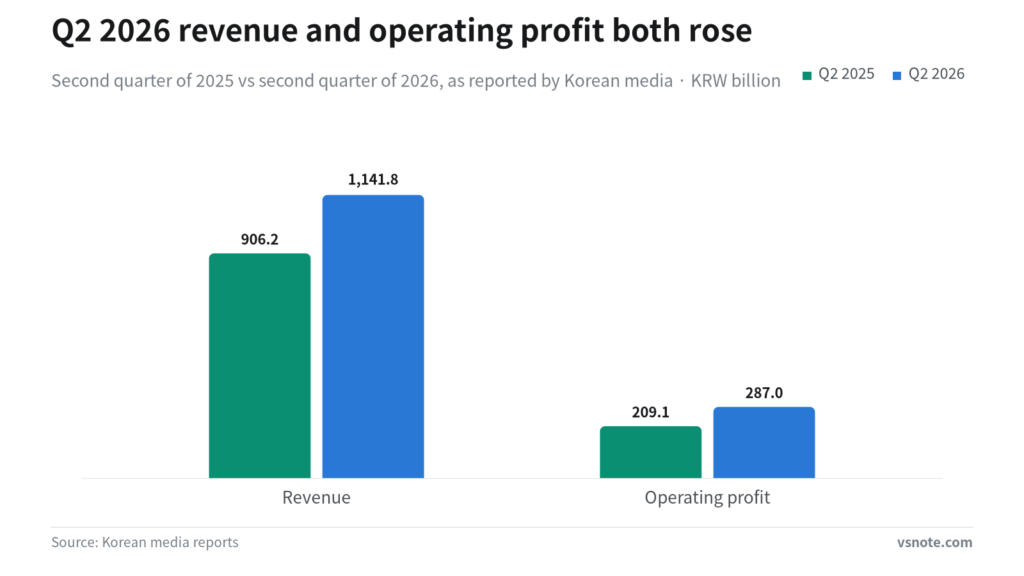
    Quarterly figures also come from media reports. For the second quarter of 2026, revenue was reportedly KRW 1.14 trillion (about $853 million) and operating profit KRW 287.0 billion (about $214 million), for an operating margin of 25.1%. For the second quarter of 2025, the same reports give revenue of KRW 906.2 billion (about $677 million) and operating profit of KRW 209.1 billion (about $156 million).

    Grouped bar chart comparing revenue and operating profit in the second quarter of 2025 and the second quarter of 2026.

    Distribution equipment brought in KRW 231.2 billion (about $173 million) of that second-quarter 2026 revenue.

    Order backlog is the value of orders received but not yet delivered and booked as revenue. Korean media reports put the backlog at $8.49 billion at the end of the second quarter of 2026. That figure is reported in US dollars, and the sources cited here give no exchange rate for it and no delivery schedule, so it cannot be set against won revenue to show how many years of work it covers.

    A framework agreement sets the terms for future purchases without fixing the actual orders. The July 2026 big tech agreement is reportedly worth up to KRW 1.12 trillion (about $838 million), and the actual orders are to come in stages through 2028, following data center construction schedules.

    That ceiling is neither revenue nor a single order. It is a maximum, and it becomes orders only as the buildings go up.


    Where new orders come from

    This industry depends on grids being built and expanded. Demand comes from facilities that need a new power supply: power plants, data centers and semiconductor facilities.

    A new power plant needs equipment at each stage between it and its users. According to Korean media reports, the Encinal gas-fired combined-cycle power plant in Texas, 6.3GW in total, is being pursued as the first project under Korea’s investment program in the United States. Reported plans for that first project also include building large nuclear power plants.

    The sources cited here do not connect HD Hyundai Electric to either of those projects.

    Data centers are a second source. Korean media report that demand for power equipment is rising, in part because more AI data centers are being built.

    Semiconductor facilities are a third, as the reported role of Korean chip projects in second-quarter distribution equipment sales shows.

    Views differ on whether this will last. According to Korean media reports, Kim Young-ki, the company’s president, has described its current growth as a structural ‘step’ rather than a lucky supercycle. That is the company’s own view.

    Calling it a supercycle carries the opposite assumption: that demand could fall back when the cycle ends. The sources cited here do not show which reading is right.


    Frequently asked questions

    Q. Is HD Hyundai Electric a power utility?

    A. No. It does not sell electricity. It makes transformers, circuit breakers, switchboards and rotating machines, and sells them to the parties that build power grids and large facilities.

    Q. How large is the data center agreement with a big tech company, and when does it become revenue?

    A. According to Korean media reports, the long-term framework agreement signed in July 2026 is worth up to KRW 1.12 trillion (about $838 million). Actual orders are to come in stages through 2028, following data center construction schedules, so the ceiling is not the same as revenue.

    Q. Where does the company make its equipment?

    A. Its Ulsan plant in Korea builds large 500kV transformers, and it also has a plant in Alabama. Korean media report that the Alabama plant can make 105 power transformers a year and that a second plant there is expected to add about 50% to that capacity once finished.

    Q. Where can I read the company’s own filings?

    A. Korean listed companies file on DART, the electronic disclosure system run by the Financial Supervisory Service. Annual reports number fiscal years in sequence, so FY2025 is the 9th period, and they report both consolidated and separate (standalone) figures.

    Q. Which Korean companies are grouped with it?

    A. Korean media group HD Hyundai Electric with Hyosung Heavy Industries and LS Electric as domestic power equipment makers. The sources cited here do not compare them.


    Sources

    • https://dart.fss.or.kr/dsaf001/main.do?rcpNo=20260316000940
    • https://dart.fss.or.kr/dsaf001/main.do?rcpNo=20260814002823
    • https://www.mk.co.kr/article/12144433
    • https://enter.etoday.co.kr/news/view/302298
    • https://blog.naver.com/ronto1/224408816328
    • https://blog.naver.com/bmchoice365/224408537619
    • https://blog.naver.com/mamie-reiki/224408801953
    • https://blog.naver.com/rs1717/224406516868
    • https://blog.naver.com/engineer_ji/224405574510
    • https://blog.naver.com/ezcomi1/224405594250
    • http://www.metroseoul.co.kr/article/20260909500019
    • https://www.ajunews.com/view/20260908153847082
    • https://blog.naver.com/handsomejuno/224406405806

    This article explains company filings and published figures for information only. It is not investment advice or a recommendation to buy or sell any security. Figures can change after publication — check the original filings before making decisions.
  • How Alteogen earns: licensing a switch from IV drips to injections

    How Alteogen earns: licensing a switch from IV drips to injections

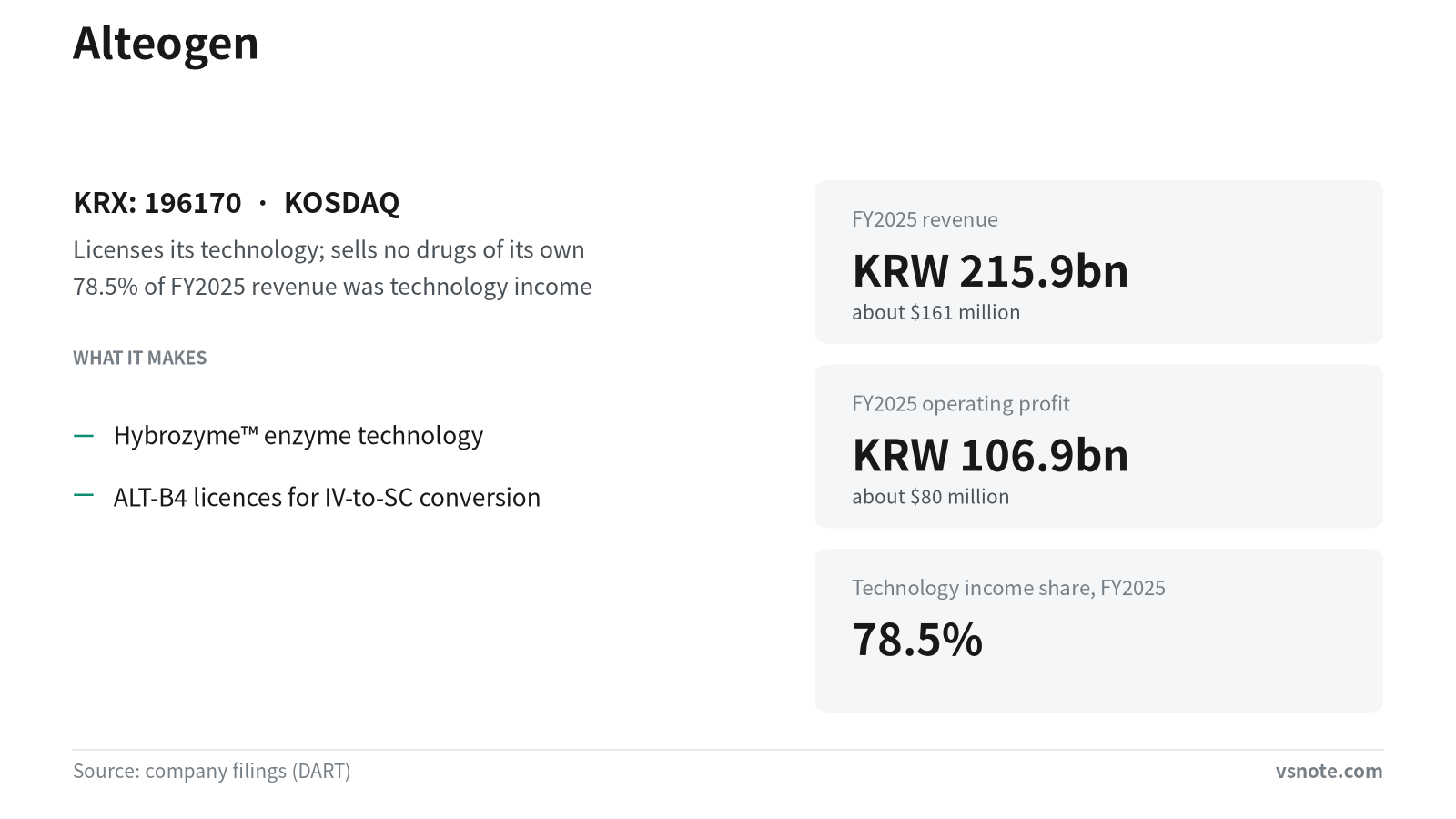
    Alteogen is a biotech company listed on KOSDAQ, the Korea Exchange’s market for growth and technology companies, under ticker 196170. It does not sell its own medicines.

    Instead, it owns an enzyme technology called Hybrozyme™. It lets a biologic drug that was designed as an intravenous (IV) infusion into a vein be given as a subcutaneous (SC) injection under the skin. Alteogen licenses this technology to global drugmakers such as MSD and Novartis and is paid in stages, not all at once.

    In FY2025, 78.5% of the company’s revenue came from this kind of technology income. Keytruda Qlex often appears next to Alteogen’s name in the news, but it is not an Alteogen drug: it is MSD’s product, and it uses Alteogen’s technology.

    Alteogen Inc. (알테오젠) · KRX: 196170 · KOSDAQ

    Won amounts are converted at ₩1,338.2 per US dollar (Bank of Korea ECOS, KRW/USD base rate, 2026-09-11) for scale only.


    A technology licensor, not a drug seller

    Headlines about very large licensing deals can make Alteogen sound like a big drugmaker. What it actually owns is narrower. Hybrozyme™ is a protein-engineering technology based on hyaluronidase, an enzyme, and it converts IV drug formulations into SC ones.

    A travel plug adapter is a fair comparison. An adapter leaves the appliance unchanged and lets it fit a different socket. In the same way, Alteogen’s technology leaves a partner’s IV drug unchanged and lets it be given as an injection under the skin.

    The comparison stops working in two places. An adapter is bought once and simply plugged in, but a drug combined with this technology still has development steps ahead of it. And Alteogen is not paid once, the way a product is sold. Money comes in as the partner reaches set stages.

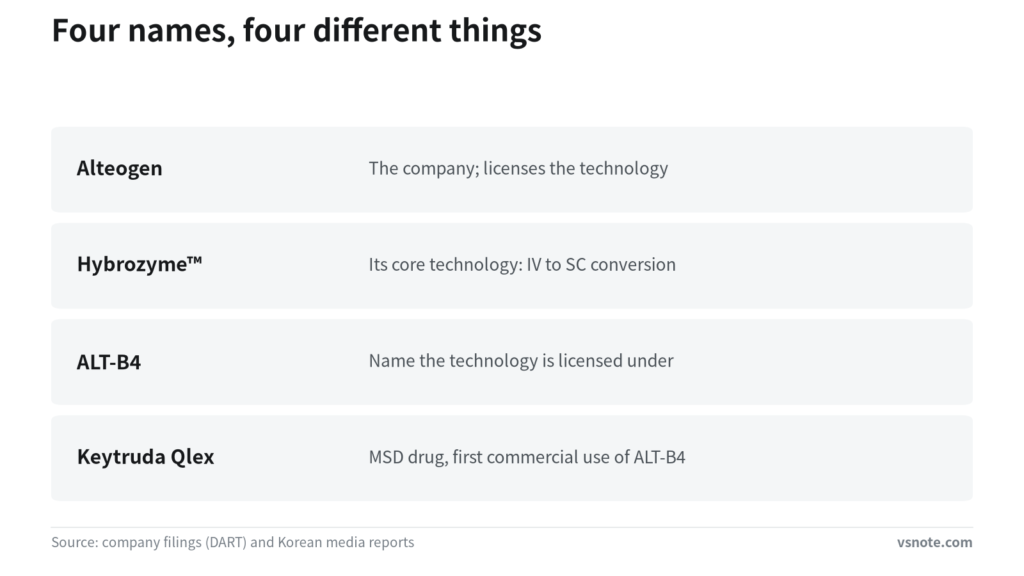
    Four names get mixed up in the news. Alteogen is the company, and Hybrozyme™ is its core technology. ALT-B4 is the name under which the technology is licensed to partners. Keytruda Qlex is an MSD drug, and it is reportedly the first commercial product to use ALT-B4.

    Diagram that sorts out Alteogen, Hybrozyme™, ALT-B4 and Keytruda Qlex, with what each one is.

    Whose drugs the technology goes into

    The technology works inside someone else’s medicine, so Alteogen’s customers are global drugmakers. The partners named in the sources used here are MSD, Novartis, Daiichi Sankyo, Sandoz and Intas.

    It is used at one specific point: when a biologic that already exists as an IV drug is reformulated as an SC version. Keytruda Qlex is the example that is already on the market.

    According to Korean media reports, Novartis signed a technology transfer agreement with Alteogen on September 2 to convert IV biologics into SC formulations using ALT-B4. A technology transfer, also called a license-out, means Alteogen grants a partner the right to use its technology in the partner’s own drugs.

    Under that deal, Novartis secured options from Alteogen. An option here is the right to decide later, product by product, whether to take a product forward under the licence. Hana Securities, a Korean brokerage, describes the deal as a package covering several products. The filings used here do not state how many.

    A Hana Securities report also lists development milestones still ahead from Daiichi Sankyo (for its drug Enhertu), Sandoz and Intas. A milestone is a payment that falls due when a partner’s drug passes an agreed development or sales stage.

    The sources used here do not show who else offers similar technology, so they cannot be used to judge the competition.


    Why the headline deal value is not money received

    According to Korean media reports, the Novartis agreement is worth up to about KRW 4.40 trillion (about $3.29 billion). That is a ceiling. It assumes every option is exercised and every development and commercialization milestone is met.

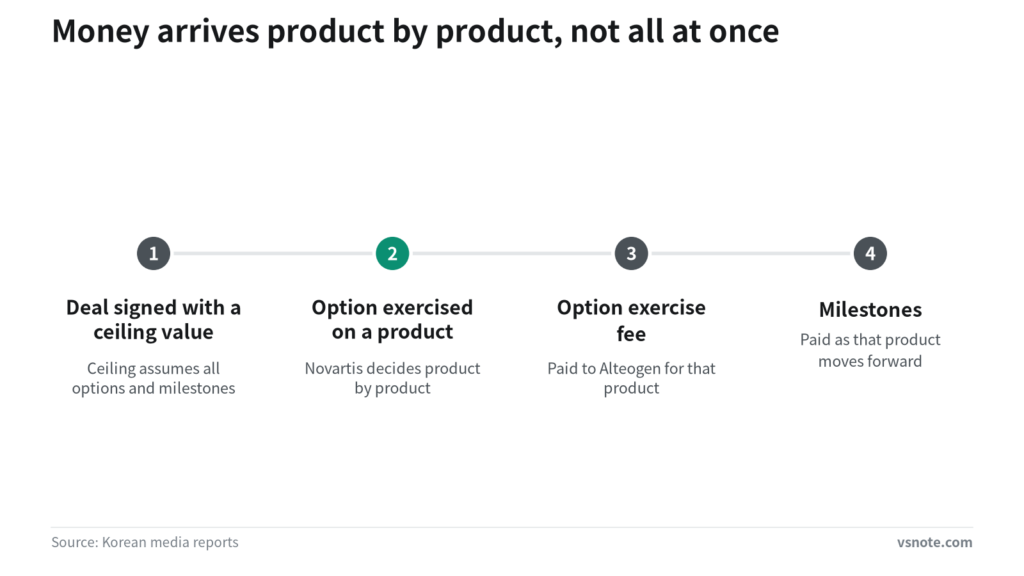
    In practice, the money comes product by product. Each time Novartis exercises an option on a product, Alteogen receives an option exercise fee. It then receives milestones as that product moves forward.

    Four-step diagram of the Novartis deal: the ceiling value, an option exercised on a product, the option exercise fee, and milestones as that product moves forward.

    The MSD contract is also paid in stages. It includes sales milestones linked to Keytruda Qlex, which are payments triggered by the drug’s sales. Alteogen’s first sales milestone arose on August 31, 2026.

    The same reports say MSD and Alteogen have not made the detailed milestone conditions public. Before the first milestone was announced, Hana Securities estimated the Qlex sales level that would trigger it. That was the brokerage’s estimate, not a contract term.


    Why a licensor’s annual results can change sharply

    The company’s annual report is filed on DART, Korea’s electronic disclosure system run by the Financial Supervisory Service. Korean filings number fiscal years in sequence, so FY2025 is Alteogen’s 18th fiscal period and FY2024 its 17th. Korean companies report both consolidated and separate (parent-only) figures, and the figures here are consolidated.

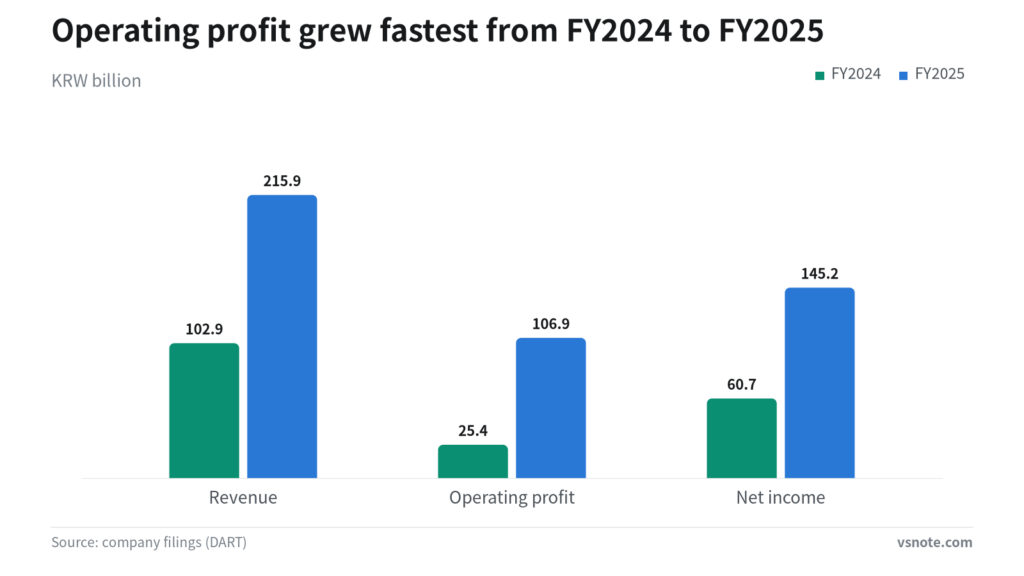
    Revenue was KRW 215.9 billion (about $161 million) in FY2025, more than double the KRW 102.9 billion (about $77 million) of FY2024. Operating profit rose to KRW 106.9 billion (about $80 million) from KRW 25.4 billion (about $19 million), and net income rose to KRW 145.2 billion (about $108 million) from KRW 60.7 billion (about $45 million).

    Grouped bar chart comparing consolidated revenue, operating profit and net income for FY2024 and FY2025.

    Technology service revenue made up 78.5% of FY2025 revenue. This is the line in the filings that holds income from licensing ALT-B4 and related deals. That income comes with events such as signings, option exercises and milestones, so each year’s total depends on how many of those events happen in it.

    A large share of this income is earned abroad. The filings record the export part of technology service revenue in US currency for both years. The Korean-currency figures above can therefore also reflect exchange-rate movements.


    Are more IV drugs moving to under-the-skin versions?

    Alteogen’s income depends on partners’ drugs being converted and sold. So the real demand question is how far IV drugs move to SC versions and how well those versions sell. In the sources used here, Keytruda Qlex is the only case with sales data.

    According to Korean media reports, MSD’s official figures for the first half of 2026 show Qlex sales were higher in the second quarter than in the first.

    For July and August, Alteogen published its own estimate based on Bloomberg wholesale acquisition cost (WAC) data. WAC is a list-price measure, not reported sales. On that basis, August was about 14.3% above July, and Qlex was reported at 12.7% of the Keytruda franchise.

    Adding MSD’s first-half figure to Alteogen’s WAC estimate gives a January–August total. But that total mixes an official sales report with a list-price estimate.

    The next products in line are analysts’ views, not results. Securities-industry analysis says several Novartis drug types in development, including antibodies and ADCs (antibody-drug conjugates), are in late-stage clinical trials. Hana Securities says three AOC (antibody-oligonucleotide conjugate) treatments in the Novartis deal are due to launch one after another from 2027.

    Because the reports say the sales milestone conditions are not public, Qlex sales figures cannot be matched to specific payments to Alteogen. Two things show how this area is developing: partners’ reported sales of converted drugs, and news of option exercises.


    Frequently asked questions

    Q. Is Keytruda Qlex an Alteogen product?

    A. No. It is MSD’s drug, and it uses Alteogen’s ALT-B4 technology. According to Korean media reports, it was the first commercial product to use ALT-B4. Alteogen earns from it through payments in its contract, such as sales milestones.

    Q. Will Alteogen receive the full reported value of the Novartis deal?

    A. Not automatically. According to Korean media reports, the figure of up to about KRW 4.40 trillion (about $3.29 billion) assumes all options are exercised and all development and commercialization milestones are met. The money arrives product by product, as options are exercised and milestones are reached.

    Q. Why did Alteogen’s profit change so much in FY2025?

    A. The company’s annual report shows consolidated operating profit of KRW 106.9 billion (about $80 million) in FY2025, compared with KRW 25.4 billion (about $19 million) in FY2024. Most of its revenue is licensing income that comes with events such as signings, option exercises and milestones, so results can move sharply from one year to the next.

    Q. Where does Alteogen file its reports, and what is the ’18th fiscal period’?

    A. Alteogen is listed on KOSDAQ under ticker 196170 and files its disclosures on DART, Korea’s electronic disclosure system run by the Financial Supervisory Service. Korean filings number fiscal years in sequence: the 18th period is FY2025 and the 17th is FY2024.

    Q. What triggers a Keytruda Qlex sales milestone?

    A. According to Korean media reports, MSD and Alteogen have not made the detailed conditions public. The first sales milestone arose on August 31, 2026. Any estimate of the sales level behind it came from Hana Securities, not from the contract.


    Sources

    • https://dart.fss.or.kr/dsaf001/main.do?rcpNo=20260323001596
    • https://blog.naver.com/infomoney_blog/224408857526
    • https://blog.naver.com/briefory/224407738775
    • https://www.sisajournal-e.com/news/articleView.html?idxno=423619
    • https://www.huffingtonpost.kr/article/260360

    This article explains company filings and published figures for information only. It is not investment advice or a recommendation to buy or sell any security. Figures can change after publication — check the original filings before making decisions.
  • Hanwha Aerospace: what it builds, and how to size an export contract

    Hanwha Aerospace: what it builds, and how to size an export contract

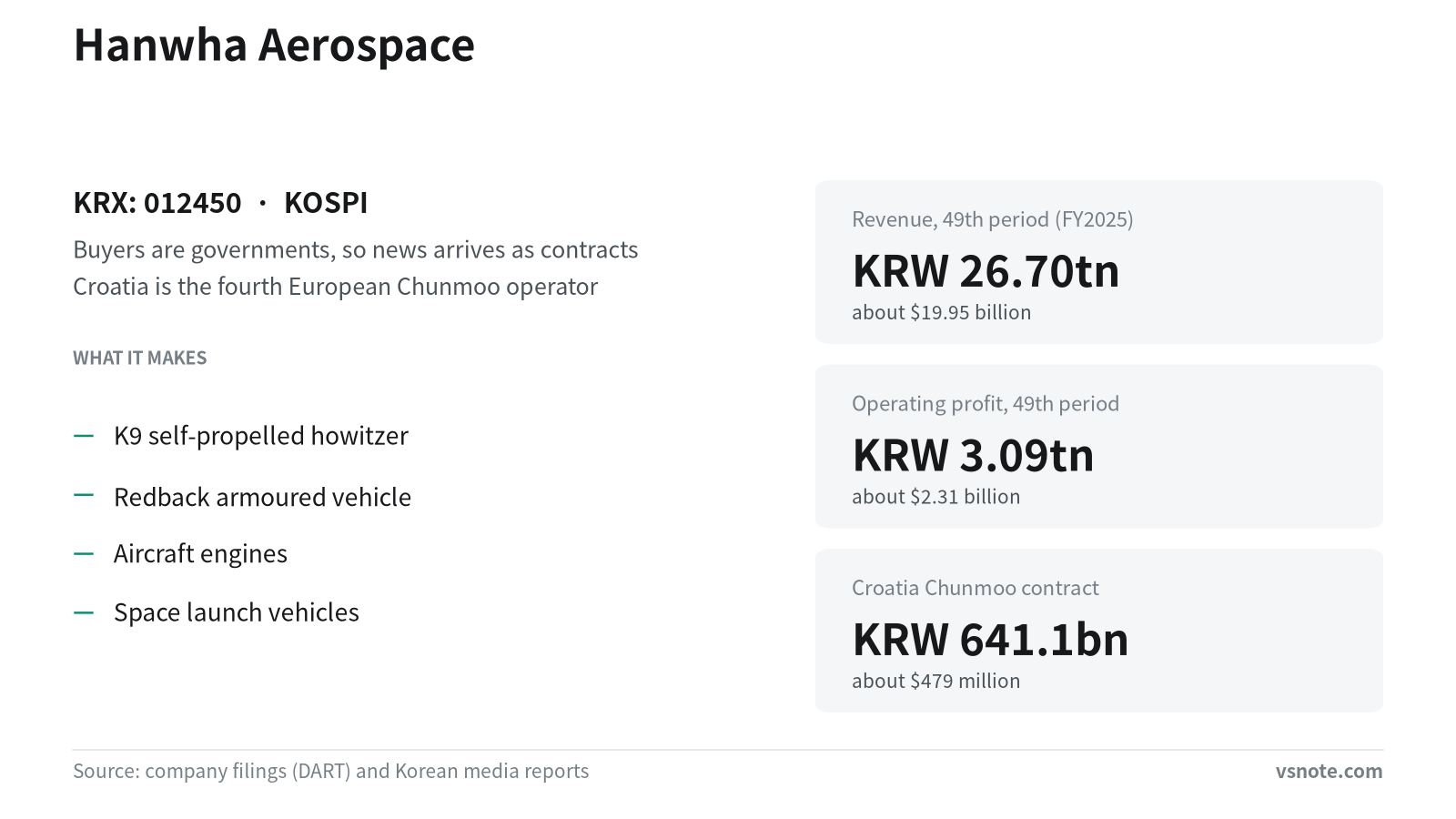
    Hanwha Aerospace is a Korean manufacturer listed on the KOSPI, the main board of the Korea Exchange (the KOSDAQ is its board for smaller companies), under ticker 012450. It builds ground weapon systems such as self-propelled howitzers and armoured vehicles, aircraft engines, and space launch vehicles.

    Its buyers are governments, so news about the company usually arrives as a contract announcement. The one that brings most English-language readers here is an export contract with Croatia’s defence ministry for Chunmoo, a multiple-launch guided missile system, reported at about KRW 641.1 billion (about $479 million).

    A contract total on its own tells you very little. This article sets that figure next to the contract’s four-year term, next to what the package actually contains, and next to the company’s own disclosed revenue and order backlog.

    HANWHA AEROSPACE CO., LTD. (한화에어로스페이스) · KRX: 012450 · KOSPI

    Won amounts are converted at ₩1,338.2 per US dollar (Bank of Korea ECOS, KRW/USD base rate, 2026-09-11) for scale only.


    An aerospace name, an order book on the ground

    The name points at air and space, and the company does make aircraft engines and work on space launch vehicles. Its other leg is ground defence — self-propelled howitzers and armoured vehicles — with the K9 self-propelled howitzer and the Redback armoured vehicle among its main product lines.

    Chunmoo sits on that ground side. The material cited here describes it as a multiple-launch guided missile weapon system: a launch vehicle carrying several guided missiles rather than a single round.

    According to Korean media reports, ground-defence revenue came to KRW 2.11 trillion (about $1.57 billion), and the segment’s order backlog has grown to around KRW 38.30 trillion (about $28.62 billion). Backlog here means work already under contract but not yet delivered, which will be recognised as revenue in later periods.

    That is the mismatch worth holding on to from the start: the thickest layer of contracted-but-undelivered work is in the part of the business that rolls on the ground.


    What the Croatia contract actually covers

    According to Korean media reports, the contract was signed with Croatia’s defence ministry and runs from 10 September 2026 to 9 September 2030.

    It is not a handover of launchers and nothing else. The package covers 18 Chunmoo launchers together with ammunition resupply vehicles, fire command vehicles, precision guided rockets, integration with a command-and-control system, training, and integrated logistics support — the part of a defence contract that commits the seller to supply spare parts, maintenance and training after delivery.

    The same reports describe this as the first Korean weapon system exported to Croatia and the first large defence contract between the two countries. Croatia becomes the fourth European operator of Chunmoo, after Poland, Norway and Estonia.

    The company also plans to build the maintenance and repair arrangement with local Croatian firms, according to those reports.


    Measuring one contract against the company’s own accounts

    A contract total works like the “total over the plan” printed large on a mobile-phone contract: it only acquires meaning once you divide it by the term. The comparison breaks straight away, though — a phone plan splits evenly month by month, while how much of this contract falls into which year is not something the material cited here sets out.

    The company’s annual report for its 49th fiscal period — Korean filings number fiscal years in sequence from a company’s founding, and the 49th is FY2025 — shows consolidated revenue of KRW 26.70 trillion (about $19.95 billion), against KRW 11.24 trillion (about $8.40 billion) in the preceding period — more than double, which is not something a defence order book does on its own in one year. What changed between the two periods, and whether the companies consolidated into the group were the same in both, is not set out in the material cited here; that is the first thing to check in the filing itself before reading the jump as growth. Consolidated means the parent and the companies it controls added together, as distinct from separate (standalone) figures covering the parent alone. Annual reports of this kind are published on DART, the electronic disclosure system run by Korea’s Financial Supervisory Service.

    Operating profit rose from KRW 1.73 trillion (about $1.29 billion) to KRW 3.09 trillion (about $2.31 billion). Net profit moved the other way, from KRW 2.54 trillion (about $1.90 billion) to KRW 2.20 trillion (about $1.65 billion) — items below the operating line land in the net figure, and the report cited here does not break out what drove the divergence. Total assets are shown at KRW 53.95 trillion (about $40.32 billion).

    Grouped bars comparing consolidated revenue, operating profit and net profit for the 49th fiscal period against the preceding period.

    For the second quarter of 2026, Korean media reports give consolidated revenue of KRW 9.29 trillion (about $6.94 billion), up 47.2% from a year earlier, and operating profit of KRW 1.37 trillion (about $1.02 billion), up 58.5% — reported as the first quarter in which quarterly operating profit passed KRW 1.00 trillion (about $747 million).

    Set KRW 641.1 billion (about $479 million) beside a single year of consolidated revenue, beside the ground-defence backlog cited earlier, and across a delivery window that runs to 2030, and the number reads differently from the headline. That is the measuring exercise to repeat the next time an export figure appears in a headline: term, annual revenue, backlog — and a reminder that operating profit and net profit are different lines that can move in opposite directions.


    Another Korean name in the same field, and why the backlogs do not line up

    Hyundai Rotem is classified in the same ground-defence field. According to Korean media reports, its order backlog stood at about KRW 30.40 trillion (about $22.72 billion) in the second quarter of 2026, passing KRW 30.00 trillion (about $22.42 billion) for the first time.

    The two backlog figures look adjacent, but they measure different things. Hanwha Aerospace’s number covers its ground-defence segment; Rotem’s covers the whole company, so reading them as like-for-like would be a mistake.

    Two further items appear in the same reports: Rotem’s K2 tank obtained NATO’s AQAP2110 quality assurance certification in July 2026, described as the first Korean case, and Rotem’s second-quarter 2026 operating profit was lower than a year earlier. Hanwha Aerospace’s ground-defence operating profit is given as KRW 533.0 billion (about $398 million).

    The sources cited here do not show contract sizes or market shares for European producers, so this article places the company against no wider competitive field.


    Where further volume is contracted or planned to come from

    The structure of the Croatia deal points past the initial handover: each added operator brings support obligations — maintenance, resupply vehicles, training, logistics — written into the contract rather than sold separately afterwards. Croatia is the fourth such operator in Europe.

    Separately, according to Korean media reports, the company is building its own GPU farm in Yongin, Gyeonggi Province, with total investment of KRW 40.0 billion (about $30 million), installing Nvidia’s high-performance H200 and B300 GPUs.

    The same reports describe a Hanwha plan to spend about KRW 2.00 trillion (about $1.49 billion) through 2040 developing a defence AI model called Defense OS, named for application to the K9A3 self-propelled howitzer, Chunmoo and Arion-SMET. Which AI functions would go into each weapon is not set out in the material cited here.

    On the aircraft engine side, the reports cited record Airbus net orders of 1,091 aircraft for January to August 2026 and Boeing net orders of 453 over the same months, with Boeing deliveries of 600 aircraft in 2025 and 418 in January to August 2026.

    What the material cited here does not contain is any institutional forecast of how large these markets become. The contract term, the disclosed accounts and the company’s stated plans are what this article can show; the last step is the reader’s.


    Frequently asked questions

    Q. What does Hanwha Aerospace actually make?

    A. Ground weapon systems such as self-propelled howitzers and armoured vehicles — the K9 self-propelled howitzer and the Redback armoured vehicle are among its main lines — together with aircraft engines and space launch vehicle work. Chunmoo, the multiple-launch guided missile system in the Croatia contract, belongs to the ground side.

    Q. How large is the Croatia contract relative to the company?

    A. Korean media reports put it at about KRW 641.1 billion (about $479 million), running from 10 September 2026 to 9 September 2030. The company’s annual report shows consolidated revenue of KRW 26.70 trillion (about $19.95 billion) for FY2025, and reports give the ground-defence backlog at around KRW 38.30 trillion (about $28.62 billion). Those are the yardsticks; how much of the contract falls in each year is not set out in the sources cited here.

    Q. Where do these figures come from, and can I check them myself?

    A. The annual figures come from the company’s filing for its 49th fiscal period (FY2025), the kind of report published on DART, Korea’s electronic disclosure system operated by the Financial Supervisory Service. The company trades on the KOSPI under ticker 012450. Filings present both consolidated and separate (parent-only) figures; the ones used here are consolidated. The quarterly and contract details come from Korean media reports rather than from filings.

    Q. Why did net profit fall while operating profit rose?

    A. The annual report shows operating profit rising from KRW 1.73 trillion (about $1.29 billion) to KRW 3.09 trillion (about $2.31 billion) while net profit fell from KRW 2.54 trillion (about $1.90 billion) to KRW 2.20 trillion (about $1.65 billion). Items outside the operating line feed into the net figure, and the material cited here does not break down what produced the gap.

    Q. Can the backlog be compared with Hyundai Rotem’s?

    A. Not directly. Korean media reports give Rotem’s second-quarter 2026 backlog as about KRW 30.40 trillion (about $22.72 billion) on a company-wide basis, while the Hanwha Aerospace figure covers its ground-defence segment only. The two cover different scopes, so putting them side by side as equivalents would mislead.


    Sources

    • https://dart.fss.or.kr/dsaf001/main.do?rcpNo=20260316001112
    • https://www.gukjenews.com/news/articleView.html?idxno=3692632
    • https://www.newsworks.co.kr/news/articleView.html?idxno=853496
    • https://news.bbsi.co.kr/news/articleView.html?idxno=4106134
    • https://www.mediawatch.kr/news/article.html?no=261005
    • http://www.efnews.co.kr/news/articleView.html?idxno=132360
    • https://www.pointe.co.kr/news/articleView.html?idxno=84616
    • https://dealsite.co.kr/articles/168864
    • https://biz.sbs.co.kr/article_hub/20000334107?division=NAVER
    • https://www.ktv.go.kr/content/view?content_id=760861
    • https://blog.naver.com/daily_benefit365/224408313205
    • https://blog.naver.com/sky230718/224408342386
    • https://blog.naver.com/jony97/224408697560
    • https://blog.naver.com/treehome_0121/224408693255

    This article explains company filings and published figures for information only. It is not investment advice or a recommendation to buy or sell any security. Figures can change after publication — check the original filings before making decisions.
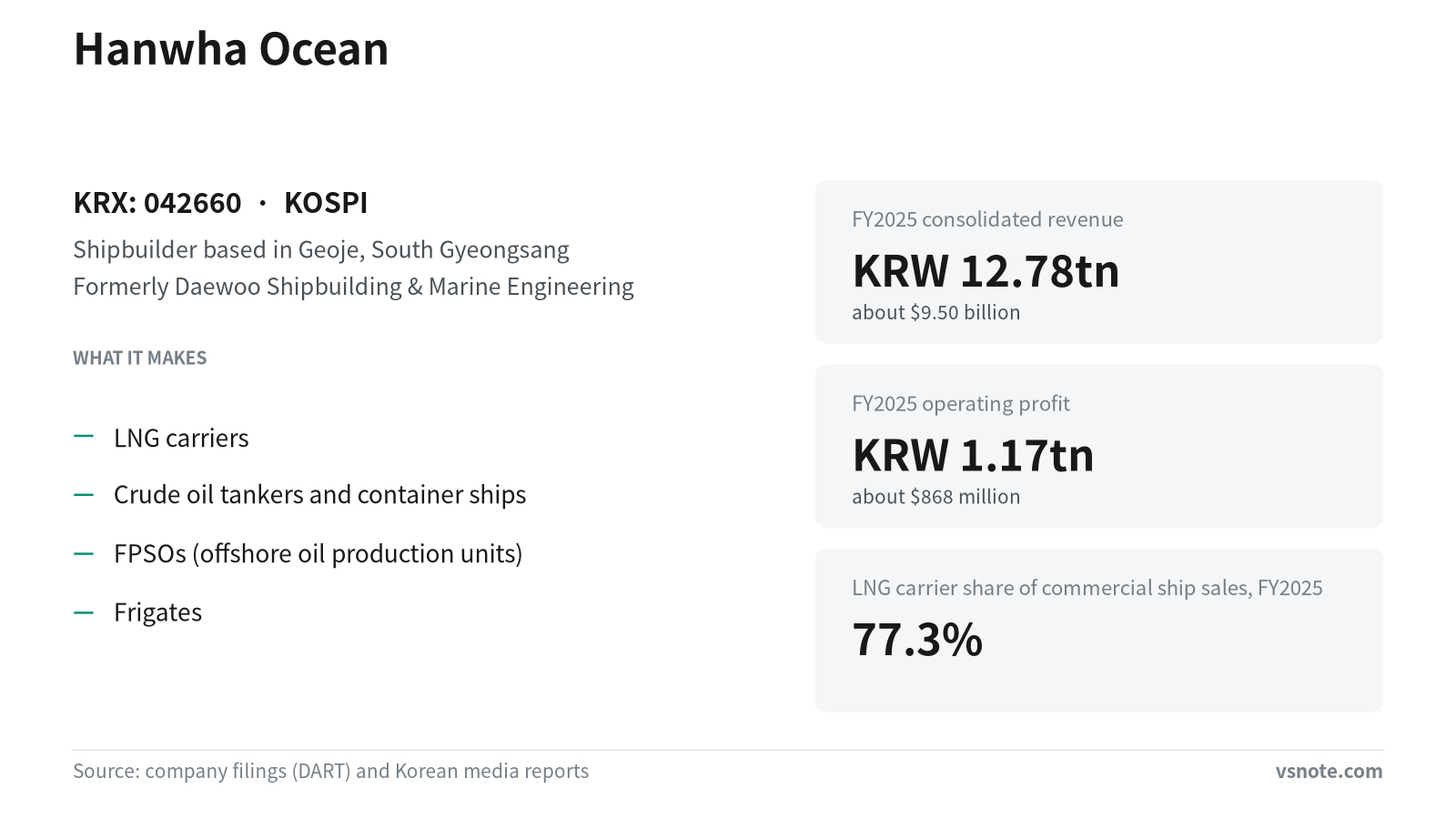
  • What Doosan Enerbility actually builds for a power plant

    What Doosan Enerbility actually builds for a power plant

    Doosan Enerbility, an affiliate of Korea’s Doosan Group, designs, fabricates and installs the large equipment that sits inside a power plant. Its shares are listed on the KOSPI, the main board of the Korea Exchange, under ticker 034020. (Korea’s second board is the KOSDAQ.)

    It does not sell to consumers. Its buyers are the organisations that build power stations — in Korea, the company’s own filings measure its domestic position against equipment ordered by Korea Electric Power Corporation, Korea Hydro & Nuclear Power and independent power producers, and it also works for owners abroad.

    The useful way to hold the company in mind is not “a nuclear company” but a made-to-order workshop for very heavy things: the party that designs the plant and the party that cuts the metal are not the same, and the day a contract is signed is not the day the piece is handed over. That gap is why order headlines and the income statement do not move at the same speed.

    DOOSAN ENERBILITY CO., LTD. (두산에너빌리티) · KRX: 034020 · KOSPI

    Won amounts are converted at ₩1,338.2 per US dollar (Bank of Korea ECOS, KRW/USD base rate, 2026-09-11) for scale only.


    Which part of a power plant the company makes

    The company’s annual report describes a business that designs, manufactures and services power generation equipment, including nuclear and combined-cycle plants, and that also takes on EPC work — contracts in which one company handles engineering, procurement of materials and construction as a single package.

    The items listed for the business are NSSS (the reactor and the steam-producing equipment at the heart of a nuclear plant), BOP (everything apart from that core equipment — the auxiliary systems that make the plant actually run), turbines, desalination and water-treatment facilities, castings and forgings, and plant installation.

    Castings and forgings are a business in their own right: the company produces basic materials by casting and forging, which is the starting point for the heaviest components. It also builds renewable-energy equipment including offshore wind turbines.

    In nuclear specifically, the equipment industry is the business of producing and supplying a plant’s principal apparatus — reactors, steam generators and the like, often grouped as “main equipment.” The company is described as holding the technology and the production facilities to fabricate reactors and steam generators for large reactors. It does not follow from any of this that it designs reactor types; it makes the hardware.

    Outside nuclear, the company developed its own large gas turbine for power generation and has built a product line running from small to large units. Korean media accounts describe the first gas turbine built in Korea as Doosan’s.

    According to Korean media reports, its plant business spans three things at once: manufacturing plant equipment, providing plant services, and plant engineering and construction. In wind, it is reported to take part across the value chain — turbine supply, project development, equipment, EPC and maintenance.

    One name-level distinction is worth fixing early, because the news flow blurs it. TerraPower, NuScale Power and X-energy appear in stories about this company as counterparties it has built cooperative relationships with — they are partners, not parts of it.


    Two market-share numbers, measured with two different rulers

    Korean filings label fiscal periods by count rather than by calendar year, so the annual report speaks of the 61st, 62nd and 63rd fiscal years. With a December year-end, those are FY2023, FY2024 and FY2025. In FY2025, the company’s disclosed share of the domestic nuclear main-equipment market was 100%.

    That was not a one-period result: the filing shows the same 100% for FY2023, FY2024 and FY2025 alike.

    The overseas figure sits in the same disclosure and looks nothing like it. For FY2025, the company’s overseas nuclear market share is given as 3.0%.

    The two numbers are not in conflict, because they are not measured the same way. The domestic share counts main equipment ordered by Korea Electric Power Corporation, Korea Hydro & Nuclear Power and independent power producers. The overseas share is calculated on new nuclear units by country over roughly the past ten years, including units under construction.

    Read alone, the first number says “sole supplier at home” and the second says “small presence abroad.” Both are true of different questions, and the company’s disclosure keeps them side by side. Market share is also broken out by segment — power generation equipment and desalination equipment are disclosed separately.

    Korean media coverage places the company in the domestic nuclear value chain as a reactor and main-equipment firm, and separately as an SMR firm. It is reported to be able to supply main equipment for large reactors, and to produce gas turbines in the 380MW class.


    What it takes to make the same things

    If one company supplies all the domestic nuclear main equipment, the obvious question is what keeps the position. The annual report answers it directly, in the company’s own words: the core competitive factors in power plant EPC, equipment and services are product technology, competitive manufacturing capability, and the supply chain that supports it.

    Nuclear equipment carries a very high quality requirement. Meeting it, the filing says, requires design, materials, welding, machining and assembly capability — a set of skills that has to exist together, not separately.

    The broader power equipment industry divides into nuclear plant equipment, combined-cycle equipment and offshore wind turbines. Of these, the nuclear equipment industry is described as having large ripple effects on upstream and downstream industries, requiring long-term technology development and large-scale investment, and being fostered strategically at the national level.

    Put together, the dividing line in this business is capability rather than price: whether a shop can make the part at all. The filings cited here do not name any domestic or overseas competitor, so who else clears that bar is not something this material settles.

    The same capability framing extends to newer work. The company is developing technology to burn hydrogen mixed into gas turbine fuel and to extend that toward firing on hydrogen alone.


    Revenue up, profit down

    The figures that follow are consolidated — parent and subsidiaries combined. Korean issuers also file separate, or standalone, statements covering the parent alone; the two sets are different numbers, and everything here is the consolidated set.

    Consolidated revenue in FY2025 was KRW 17.06 trillion (about $12.75 billion), up from KRW 16.23 trillion (about $12.13 billion) in FY2024.

    Operating profit moved the other way, from KRW 1.02 trillion (about $760 million) in FY2024 to KRW 762.7 billion (about $570 million) in FY2025. Net profit fell from KRW 394.7 billion (about $295 million) to KRW 205.2 billion (about $153 million) over the same two periods.

    Grouped bar chart comparing consolidated revenue, operating profit and net profit for FY2024 and FY2025.

    Set those earnings against the balance sheet and the shape of the business shows. Total consolidated assets were KRW 27.51 trillion (about $20.56 billion) at the end of FY2025, against KRW 26.31 trillion (about $19.66 billion) a period earlier — a very large asset base carrying a comparatively thin profit.

    This is where the workshop image breaks down. A workshop with no orders can simply fold up the bench; a company of this kind carries its plants and heavy machining capacity whether or not the order book is full.

    The filings cited here do not give the company’s explanation for the decline in profit, so the cause is not something this article can supply.

    The direction did not hold. According to Korean media reports, first-half 2026 revenue rose about 8% against the same period a year earlier and operating profit rose by more than 32%. Those reports point to the half-year report as of June 2026 filed with DART, Korea’s electronic disclosure system run by the Financial Supervisory Service, where Korean issuers lodge their statutory filings.

    Two years in one direction and a half-year in the other: one or two years of figures do not settle what this company earns across a cycle.


    What stands between an order and an earnings line

    The bridge between the news flow and the income statement is the order backlog: work that has been contracted but not yet built and handed over, and therefore not yet recognised as revenue. According to Korean media reports, the backlog stood at KRW 26.40 trillion (about $19.73 billion) at the end of the first half of 2026.

    Recent contracts show the timeline involved. Korean media reports say that on 14 August 2026 the company signed a contract with TerraPower to fabricate main equipment for an SMR — a small modular reactor, built in factory-made modules and shipped to site rather than assembled wholly in place.

    The same reports describe the scope: equipment for TerraPower’s first plant, under construction in Kemmerer, Wyoming, in the United States. The items are the reactor guard vessel, the reactor support structure and the reactor internals, applied to TerraPower’s sodium reactor. The Kemmerer project is reported at 345MW.

    That contract did not appear from nowhere. The cooperation is reported to have begun in December 2024 with a contract to review whether the first unit’s key equipment could be manufactured at all — a study, years before the fabrication order.

    Four-stage sequence running from the December 2024 manufacturability review to the Kemmerer plant the equipment is destined for.

    Two other contracts are reported in the same window: on 21 August 2026, a construction contract for the Misfah combined-cycle power plant in Oman, and on 27 July 2026, a contract to supply key materials for units 5 and 6 of the Laiyang nuclear plant in China.

    For all three, the sources cited here give neither contract values nor when any of the work would be recognised as revenue. That last step — from a signed order to a line in the accounts — is the one the reader has to leave open.

    On where demand is said to be coming from, Korean media reports say the Encinal gas-fired combined-cycle plant in Texas, at 6.3 to 6.4 gigawatts, was selected as the first project under Korea’s investment programme in the United States. The project is reported to be staged: about 1.4GW of gas turbine capacity by 2030, then sequential expansion toward 4.9GW of high-efficiency combined-cycle capacity once demand and economics are confirmed.

    Writing about that project, Han Seung-hun, an analyst at Shinhan Securities, said in a report that if commercial operation of 1.4GW by 2030 is the target, ordering is likely to move early and to centre on gas turbines, which take a long time to procure. That is a statement about the project’s procurement sequence, not about any company’s order book.

    Beyond Encinal, Korean media reports say a plan to build eight large nuclear plants in the United States is under review as a follow-on to the same investment programme. It is reported as under consideration; nothing in the material cited here says it has been decided.


    Frequently asked questions

    Q. Is Doosan Enerbility a nuclear company?

    A. Only in part. Its annual report lists nuclear main equipment alongside turbines, BOP — the auxiliary systems outside the reactor island — desalination and water-treatment facilities, castings and forgings, and plant installation, plus EPC work where it handles engineering, procurement and construction together. It also makes offshore wind turbines and developed its own large gas turbine for power generation.

    Q. Its filing shows 100% domestic nuclear main-equipment share and 3.0% overseas. How can both be true?

    A. They measure different things. The 100% figure — reported for FY2023 through FY2025 — counts main equipment ordered by Korea Electric Power Corporation, Korea Hydro & Nuclear Power and independent power producers. The 3.0% figure, for FY2025, is calculated against new nuclear units by country over roughly the past decade, including units under construction.

    Q. When a new order is announced, does it show up in revenue?

    A. Not at signing. Contracted work that has not yet been built and delivered sits in the order backlog, which Korean media reports put at KRW 26.40 trillion (about $19.73 billion) at the end of the first half of 2026. For the 2026 contracts reported in Korean media — TerraPower, Oman and China — the sources cited here give no contract values and no revenue-recognition timing.

    Q. What is the company’s relationship to TerraPower, NuScale Power and X-energy?

    A. They are counterparties, not parts of the group. Korean media reports describe cooperative relationships built with NuScale Power and X-energy, and a contract signed with TerraPower in August 2026 to fabricate the reactor guard vessel, reactor support structure and reactor internals for its sodium reactor at Kemmerer, Wyoming.

    Q. Where do these numbers come from, and which set should I read?

    A. The financial and market-share figures here are from the company’s annual report; the company files with DART, Korea’s electronic disclosure system run by the Financial Supervisory Service, and is listed on the KOSPI under ticker 034020. Note two Korean conventions: fiscal periods are numbered rather than named by calendar year (here the 63rd is FY2025), and issuers file both consolidated statements and separate, parent-only statements — every figure in this article is consolidated.


    Sources

    • https://dart.fss.or.kr/dsaf001/main.do?rcpNo=20260320001246
    • https://www.doosanenerbility.com/en
    • https://blog.naver.com/iriad80/224407711147
    • https://blog.naver.com/salimhae/224407696851
    • https://blog.naver.com/jony97/224407004282
    • https://blog.naver.com/ryuhongreoul/224406923554
    • https://blog.naver.com/warmblack2024/224407142872
    • https://blog.naver.com/onulsdaily/224407596295
    • https://www.businesspost.co.kr/BP?command=article_view&num=446804

    This article explains company filings and published figures for information only. It is not investment advice or a recommendation to buy or sell any security. Figures can change after publication — check the original filings before making decisions.