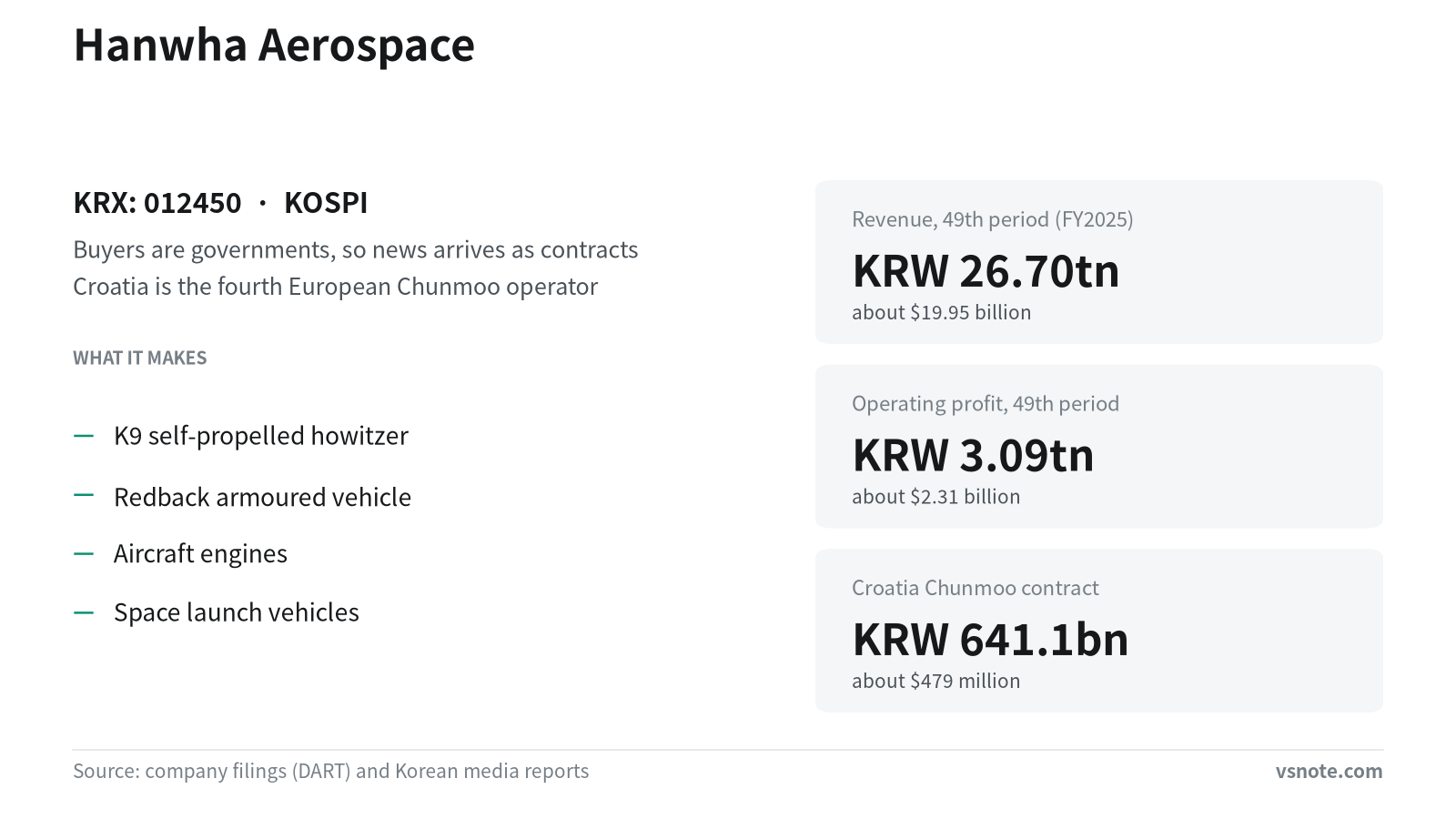
Hanwha Aerospace is a Korean manufacturer listed on the KOSPI, the main board of the Korea Exchange (the KOSDAQ is its board for smaller companies), under ticker 012450. It builds ground weapon systems such as self-propelled howitzers and armoured vehicles, aircraft engines, and space launch vehicles.
Its buyers are governments, so news about the company usually arrives as a contract announcement. The one that brings most English-language readers here is an export contract with Croatia’s defence ministry for Chunmoo, a multiple-launch guided missile system, reported at about KRW 641.1 billion (about $479 million).
A contract total on its own tells you very little. This article sets that figure next to the contract’s four-year term, next to what the package actually contains, and next to the company’s own disclosed revenue and order backlog.
HANWHA AEROSPACE CO., LTD. (한화에어로스페이스) · KRX: 012450 · KOSPI
Won amounts are converted at ₩1,338.2 per US dollar (Bank of Korea ECOS, KRW/USD base rate, 2026-09-11) for scale only.
An aerospace name, an order book on the ground
The name points at air and space, and the company does make aircraft engines and work on space launch vehicles. Its other leg is ground defence — self-propelled howitzers and armoured vehicles — with the K9 self-propelled howitzer and the Redback armoured vehicle among its main product lines.
Chunmoo sits on that ground side. The material cited here describes it as a multiple-launch guided missile weapon system: a launch vehicle carrying several guided missiles rather than a single round.
According to Korean media reports, ground-defence revenue came to KRW 2.11 trillion (about $1.57 billion), and the segment’s order backlog has grown to around KRW 38.30 trillion (about $28.62 billion). Backlog here means work already under contract but not yet delivered, which will be recognised as revenue in later periods.
That is the mismatch worth holding on to from the start: the thickest layer of contracted-but-undelivered work is in the part of the business that rolls on the ground.
What the Croatia contract actually covers
According to Korean media reports, the contract was signed with Croatia’s defence ministry and runs from 10 September 2026 to 9 September 2030.
It is not a handover of launchers and nothing else. The package covers 18 Chunmoo launchers together with ammunition resupply vehicles, fire command vehicles, precision guided rockets, integration with a command-and-control system, training, and integrated logistics support — the part of a defence contract that commits the seller to supply spare parts, maintenance and training after delivery.
The same reports describe this as the first Korean weapon system exported to Croatia and the first large defence contract between the two countries. Croatia becomes the fourth European operator of Chunmoo, after Poland, Norway and Estonia.
The company also plans to build the maintenance and repair arrangement with local Croatian firms, according to those reports.
Measuring one contract against the company’s own accounts
A contract total works like the “total over the plan” printed large on a mobile-phone contract: it only acquires meaning once you divide it by the term. The comparison breaks straight away, though — a phone plan splits evenly month by month, while how much of this contract falls into which year is not something the material cited here sets out.
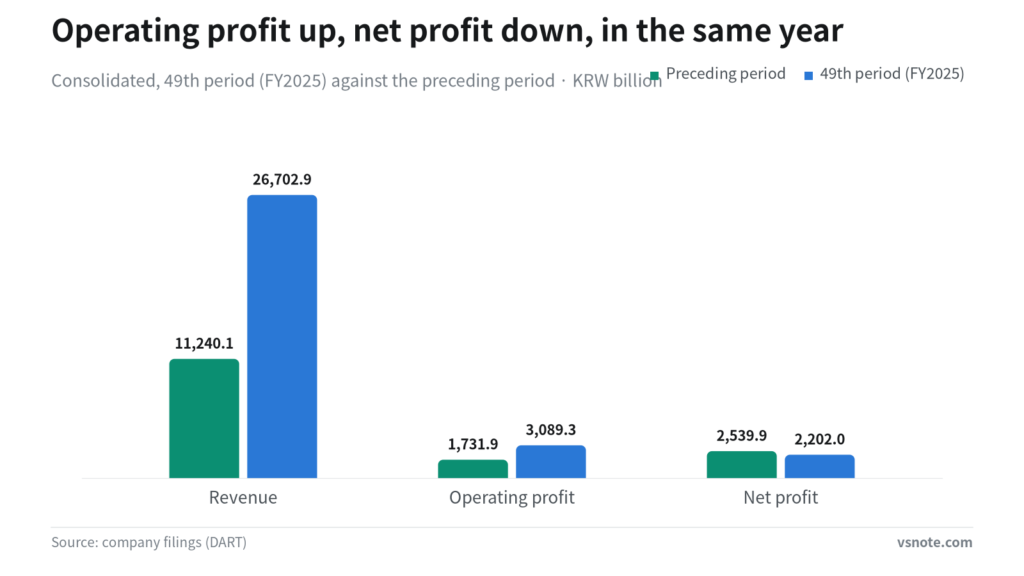
The company’s annual report for its 49th fiscal period — Korean filings number fiscal years in sequence from a company’s founding, and the 49th is FY2025 — shows consolidated revenue of KRW 26.70 trillion (about $19.95 billion), against KRW 11.24 trillion (about $8.40 billion) in the preceding period — more than double, which is not something a defence order book does on its own in one year. What changed between the two periods, and whether the companies consolidated into the group were the same in both, is not set out in the material cited here; that is the first thing to check in the filing itself before reading the jump as growth. Consolidated means the parent and the companies it controls added together, as distinct from separate (standalone) figures covering the parent alone. Annual reports of this kind are published on DART, the electronic disclosure system run by Korea’s Financial Supervisory Service.
Operating profit rose from KRW 1.73 trillion (about $1.29 billion) to KRW 3.09 trillion (about $2.31 billion). Net profit moved the other way, from KRW 2.54 trillion (about $1.90 billion) to KRW 2.20 trillion (about $1.65 billion) — items below the operating line land in the net figure, and the report cited here does not break out what drove the divergence. Total assets are shown at KRW 53.95 trillion (about $40.32 billion).
For the second quarter of 2026, Korean media reports give consolidated revenue of KRW 9.29 trillion (about $6.94 billion), up 47.2% from a year earlier, and operating profit of KRW 1.37 trillion (about $1.02 billion), up 58.5% — reported as the first quarter in which quarterly operating profit passed KRW 1.00 trillion (about $747 million).
Set KRW 641.1 billion (about $479 million) beside a single year of consolidated revenue, beside the ground-defence backlog cited earlier, and across a delivery window that runs to 2030, and the number reads differently from the headline. That is the measuring exercise to repeat the next time an export figure appears in a headline: term, annual revenue, backlog — and a reminder that operating profit and net profit are different lines that can move in opposite directions.
Another Korean name in the same field, and why the backlogs do not line up
Hyundai Rotem is classified in the same ground-defence field. According to Korean media reports, its order backlog stood at about KRW 30.40 trillion (about $22.72 billion) in the second quarter of 2026, passing KRW 30.00 trillion (about $22.42 billion) for the first time.
The two backlog figures look adjacent, but they measure different things. Hanwha Aerospace’s number covers its ground-defence segment; Rotem’s covers the whole company, so reading them as like-for-like would be a mistake.
Two further items appear in the same reports: Rotem’s K2 tank obtained NATO’s AQAP2110 quality assurance certification in July 2026, described as the first Korean case, and Rotem’s second-quarter 2026 operating profit was lower than a year earlier. Hanwha Aerospace’s ground-defence operating profit is given as KRW 533.0 billion (about $398 million).
The sources cited here do not show contract sizes or market shares for European producers, so this article places the company against no wider competitive field.
Where further volume is contracted or planned to come from
The structure of the Croatia deal points past the initial handover: each added operator brings support obligations — maintenance, resupply vehicles, training, logistics — written into the contract rather than sold separately afterwards. Croatia is the fourth such operator in Europe.
Separately, according to Korean media reports, the company is building its own GPU farm in Yongin, Gyeonggi Province, with total investment of KRW 40.0 billion (about $30 million), installing Nvidia’s high-performance H200 and B300 GPUs.
The same reports describe a Hanwha plan to spend about KRW 2.00 trillion (about $1.49 billion) through 2040 developing a defence AI model called Defense OS, named for application to the K9A3 self-propelled howitzer, Chunmoo and Arion-SMET. Which AI functions would go into each weapon is not set out in the material cited here.
On the aircraft engine side, the reports cited record Airbus net orders of 1,091 aircraft for January to August 2026 and Boeing net orders of 453 over the same months, with Boeing deliveries of 600 aircraft in 2025 and 418 in January to August 2026.
What the material cited here does not contain is any institutional forecast of how large these markets become. The contract term, the disclosed accounts and the company’s stated plans are what this article can show; the last step is the reader’s.
Frequently asked questions
Q. What does Hanwha Aerospace actually make?
A. Ground weapon systems such as self-propelled howitzers and armoured vehicles — the K9 self-propelled howitzer and the Redback armoured vehicle are among its main lines — together with aircraft engines and space launch vehicle work. Chunmoo, the multiple-launch guided missile system in the Croatia contract, belongs to the ground side.
Q. How large is the Croatia contract relative to the company?
A. Korean media reports put it at about KRW 641.1 billion (about $479 million), running from 10 September 2026 to 9 September 2030. The company’s annual report shows consolidated revenue of KRW 26.70 trillion (about $19.95 billion) for FY2025, and reports give the ground-defence backlog at around KRW 38.30 trillion (about $28.62 billion). Those are the yardsticks; how much of the contract falls in each year is not set out in the sources cited here.
Q. Where do these figures come from, and can I check them myself?
A. The annual figures come from the company’s filing for its 49th fiscal period (FY2025), the kind of report published on DART, Korea’s electronic disclosure system operated by the Financial Supervisory Service. The company trades on the KOSPI under ticker 012450. Filings present both consolidated and separate (parent-only) figures; the ones used here are consolidated. The quarterly and contract details come from Korean media reports rather than from filings.
Q. Why did net profit fall while operating profit rose?
A. The annual report shows operating profit rising from KRW 1.73 trillion (about $1.29 billion) to KRW 3.09 trillion (about $2.31 billion) while net profit fell from KRW 2.54 trillion (about $1.90 billion) to KRW 2.20 trillion (about $1.65 billion). Items outside the operating line feed into the net figure, and the material cited here does not break down what produced the gap.
Q. Can the backlog be compared with Hyundai Rotem’s?
A. Not directly. Korean media reports give Rotem’s second-quarter 2026 backlog as about KRW 30.40 trillion (about $22.72 billion) on a company-wide basis, while the Hanwha Aerospace figure covers its ground-defence segment only. The two cover different scopes, so putting them side by side as equivalents would mislead.
Sources
- https://dart.fss.or.kr/dsaf001/main.do?rcpNo=20260316001112
- https://www.gukjenews.com/news/articleView.html?idxno=3692632
- https://www.newsworks.co.kr/news/articleView.html?idxno=853496
- https://news.bbsi.co.kr/news/articleView.html?idxno=4106134
- https://www.mediawatch.kr/news/article.html?no=261005
- http://www.efnews.co.kr/news/articleView.html?idxno=132360
- https://www.pointe.co.kr/news/articleView.html?idxno=84616
- https://dealsite.co.kr/articles/168864
- https://biz.sbs.co.kr/article_hub/20000334107?division=NAVER
- https://www.ktv.go.kr/content/view?content_id=760861
- https://blog.naver.com/daily_benefit365/224408313205
- https://blog.naver.com/sky230718/224408342386
- https://blog.naver.com/jony97/224408697560
- https://blog.naver.com/treehome_0121/224408693255
This article explains company filings and published figures for information only. It is not investment advice or a recommendation to buy or sell any security. Figures can change after publication — check the original filings before making decisions.