Category: Defense & Aerospace

Korean defense and aerospace companies, explained from their regulatory filings.

  • LIG Defense&Aerospace explained: Korea’s air defense missile maker

    LIG Defense&Aerospace explained: Korea’s air defense missile maker

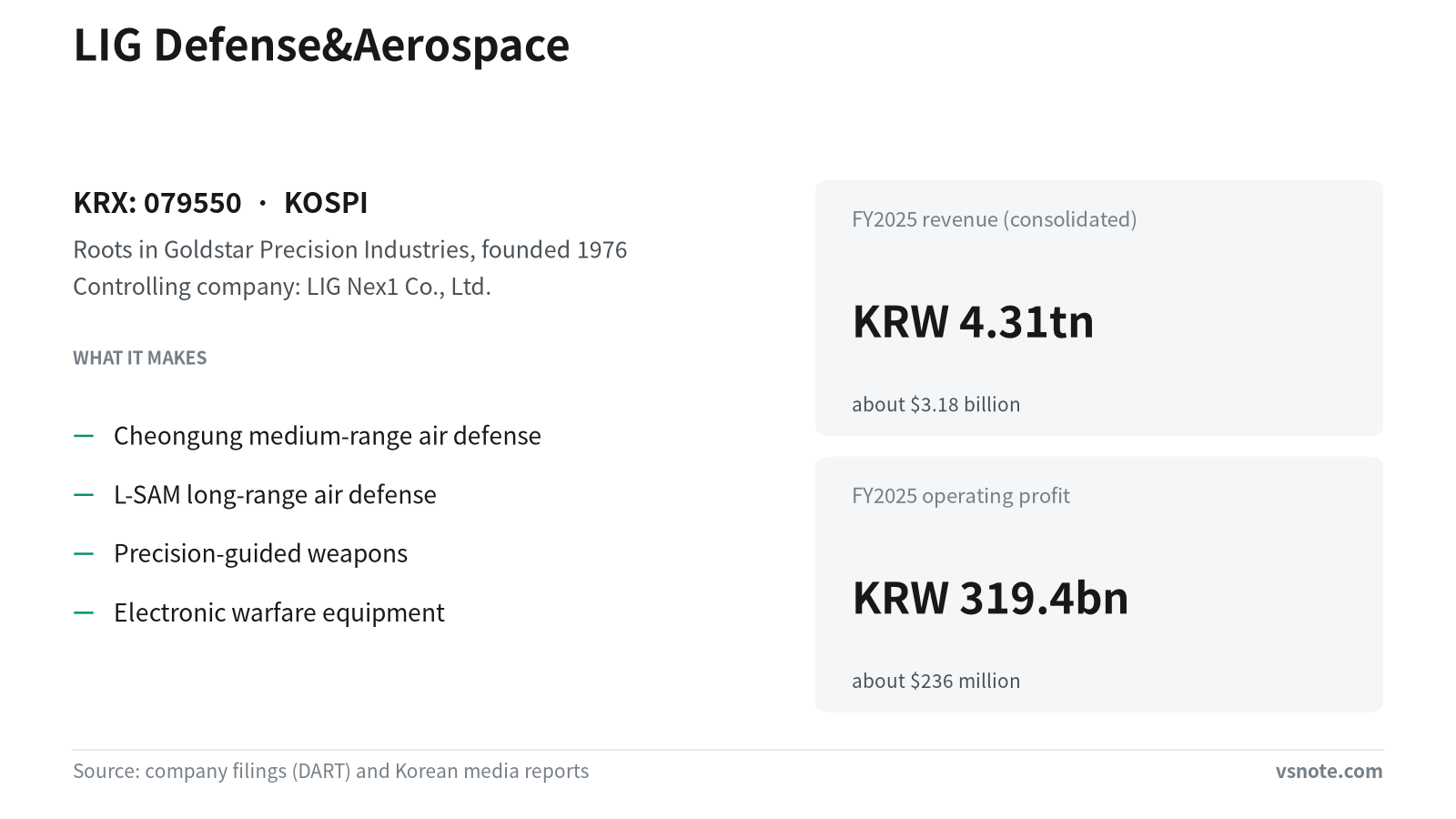
    LIG Defense&Aerospace is a South Korean defense manufacturer listed on KOSPI, the main board of the Korea Exchange, under ticker 079550. It traces its roots to Goldstar Precision Industries, founded in 1976.

    It makes precision-guided weapons, surveillance and reconnaissance systems, command, control and communications equipment, avionics and electronic warfare equipment. Its best-known products are air defense systems: the missiles, radars and launchers that detect incoming missiles and aircraft and shoot them down.

    Two of these are Cheongung, a medium-range system, and L-SAM, a long-range system. Each covers one layer of a country’s air defense network. The rest of this article follows from that: which layer the company sells, who it competes with for that layer, and why a new export contract is not the same thing as this year’s revenue.

    LIG Defense&Aerospace Co., Ltd. (엘아이지디펜스앤에어로스페이스) · KRX: 079550 · KOSPI

    Won amounts are converted at ₩1,353.3 per US dollar (Bank of Korea ECOS, KRW/USD base rate, 2026-09-16) for scale only.


    What the company’s missiles are built to stop

    The company’s annual report lists five business areas: precision-guided weapons, surveillance and reconnaissance, command, control and communications, avionics, and electronic warfare. Precision-guided munitions (PGM) are weapons that steer themselves onto a target after launch instead of flying a fixed path. The company reports PGM as a separate product line in its sales breakdown.

    Its core business is exporting two air defense systems, Cheongung (medium range) and L-SAM (long range). L-SAM is described as covering upper-tier defense at altitudes of 40–60km.

    Readers who know the name LIG Nex1 are looking at the same company. It was renamed LIG Defense&Aerospace, and Korean media reported the change at the end of March 2026 — after the FY2025 annual report was filed on March 23, which is why that report still carries the former name. The listing did not change: the same KRX ticker, 079550, and the same DART corporate registration.


    Which layer it covers, and who buys it

    The filings cited here do not give market shares. The company’s position is easier to judge on three points: which layer of air defense it supplies, who its customers are, and where it sits in the supply chain.

    In the air defense network, Cheongung covers the medium-range layer and L-SAM the upper layer. According to Korean media reports, the company will take part in L-SAM mass production.

    The company’s buyers are governments. It works with Korea’s Defense Acquisition Program Administration (the government agency that buys weapons), the Agency for Defense Development and the Defense Agency for Technology and Quality. Korean media report that Cheongung has already been exported to Saudi Arabia, Iraq and the UAE, and that other Middle Eastern countries, including Qatar, are seeking to buy it.

    In the supply chain, the company buys parts and subassemblies from smaller suppliers and turns them into complete weapon systems. One supplier reportedly signed a contract to supply metal assembly parts and ten other items for the government’s Block-1 electronic warfare aircraft development program. Another listed supplier reportedly counts the company as a major customer that makes up 33% of its revenue.


    Who it competes with, and who it works with

    Competition in air defense happens layer by layer. According to Korean media reports, the Swiss government is running a program for a next-generation long-range ground-based air defense system, and L-SAM is competing against SAMP/T NG from Eurosam, a French-Italian joint venture.

    Two outside factors reportedly shape that contest. Switzerland ordered five Patriot batteries from the United States in 2022, and deliveries have been delayed by 5–7 years. Reports also say the US-Iran war has left Patriot missiles in short supply.

    Europe is also changing the rules for buying weapons. The EU reportedly requires at least 65% of component costs to be sourced from Europe or certain partner countries for a large defense lending program. Korean media report that the company is responding with local factories and joint ventures.

    The Swiss Federal Council was reported to be due to decide the program’s direction by 18 September. The sources cited here do not include the outcome.

    With Germany’s Rheinmetall, the relationship is a partnership in which each company covers a different layer. The two reportedly plan to enter NATO markets together by combining Rheinmetall’s very-short-range air defense with the company’s medium- and long-range systems. They are also reportedly developing a short-range air defense (SHORAD) system that pairs Rheinmetall’s Skyranger 30 with the company’s Singung system.

    At home, bids have closed for the KF-21 fighter’s long-range air-to-air missile program, which is reportedly worth KRW 1.90 trillion (about $1.40 billion). Korean media report that the procurement agency is considering restricting the company’s eligibility to bid on government contracts over a bribery case involving executives. Under such a restriction, the company would be barred from government tenders for a set period. Reports say no sanction has been decided yet.


    Revenue already earned versus orders still to deliver

    Korean companies number their fiscal periods from their founding year. The company’s 24th period is FY2025 and its 23rd is FY2024. The figures below are consolidated, meaning they include subsidiaries. Korean filings also report separate (standalone) figures for the parent entity alone.

    The annual report shows FY2025 consolidated revenue of KRW 4.31 trillion (about $3.18 billion), up from KRW 3.28 trillion (about $2.42 billion) in FY2024. Operating profit rose to KRW 319.4 billion (about $236 million) from KRW 223.4 billion (about $165 million).

    Net profit was KRW 237.5 billion (about $175 million), compared with KRW 212.8 billion (about $157 million) a year earlier. Net profit rose less steeply than operating profit, and the filings cited here do not explain why.
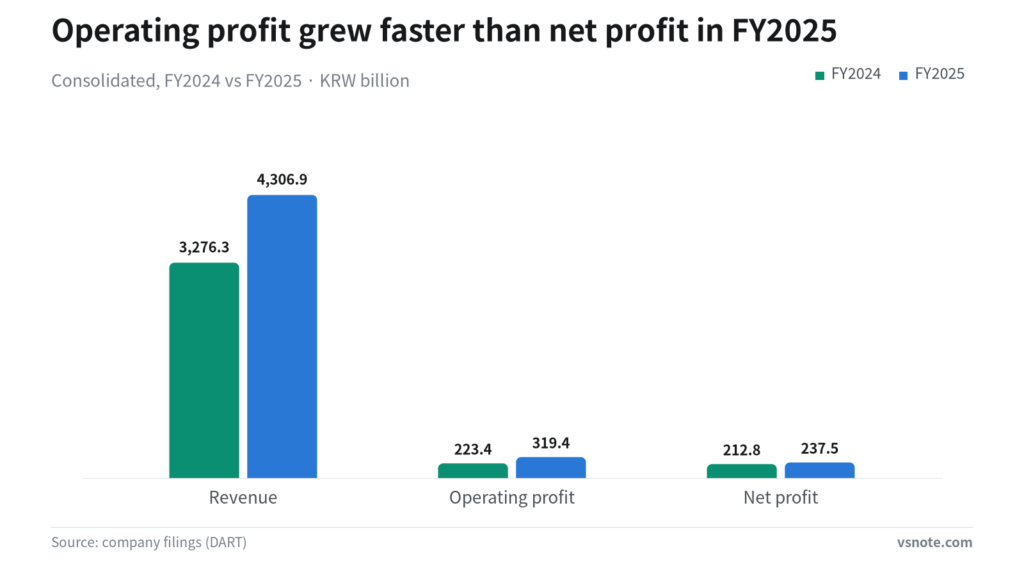
    Grouped bar chart comparing consolidated revenue, operating profit and net profit for FY2024 and FY2025.

    These figures reflect weapons already delivered. Order backlog is different: it counts contracts the company has signed but not yet delivered, so it turns into revenue later.

    According to Korean media reports, the company’s domestic order backlog is KRW 10.52 trillion (about $7.77 billion), or 43% of its total backlog. News of a new export contract therefore adds to backlog first. It does not show up in that year’s revenue right away.


    Where rising air defense spending goes

    The company’s filings define the defense industry as the production and development of goods a country needs for its military defense. In the broader sense, that includes non-combat supplies such as uniforms and field rations. Either way, demand ultimately comes from government budgets.

    Korean media reports trace the growth of Korean defense exports. Export orders won by Korean defense companies ran at about $2.6 billion to $3.1 billion a year in 2016–2020, peaked at $17.3 billion in 2022, and were $15.4 billion last year. Korea Investors Service, a Korean credit rating agency, has said export competition for Korean defense companies has entered a new phase.

    Extra spending does not reach a supplier directly. It passes through each government’s tenders for specific air defense layers and, in Europe, through local-sourcing conditions such as the EU’s 65% rule, before it becomes a multi-year contract.
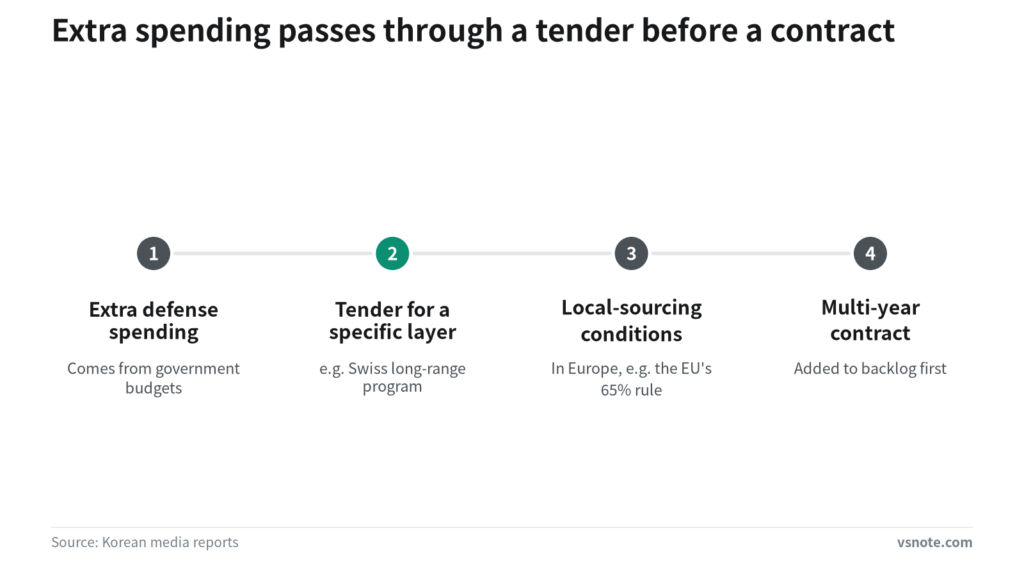
    Four steps from extra air defense spending through a government tender for a specific layer and local-sourcing conditions to a multi-year contract.

    According to Korean media reports, the company’s air defense exports to the Middle East are picking up, and it is pursuing European markets. It is also named as a company whose European prospects could grow depending on the Swiss long-range program.

    Winning one layer does not mean supplying a country’s whole network. Other layers can go to other countries’ products, as the Rheinmetall pairing shows. Whether more spending turns into contracts for this company is left for readers to judge.


    Frequently asked questions

    Q. Is LIG Defense&Aerospace the same as LIG Nex1?

    A. Yes. LIG Nex1 is the former name. Korean media reported the change at the end of March 2026, and the KRX ticker (079550) and DART registration are unchanged. The FY2025 annual report was filed on March 23, before the change, so it still uses the old name.

    Q. What are Cheongung and L-SAM?

    A. They are the company’s two main air defense systems. Cheongung covers the medium-range layer. L-SAM covers long-range, upper-tier defense and is described as operating at altitudes of 40–60km.

    Q. Which countries have bought the company’s air defense systems?

    A. According to Korean media reports, Cheongung has been exported to Saudi Arabia, Iraq and the UAE, and other Middle Eastern countries, including Qatar, are seeking to buy it.

    Q. What is the procurement sanction issue?

    A. According to Korean media reports, Korea’s Defense Acquisition Program Administration is considering restricting the company’s eligibility to bid on government contracts over a bribery case involving executives. Reports say no decision has been made.

    Q. How large is the company’s order backlog?

    A. Korean media report a domestic order backlog of KRW 10.52 trillion (about $7.77 billion), which is 43% of the total. Backlog is signed orders not yet delivered, so it is separate from reported revenue.


    Sources

    • https://dart.fss.or.kr/dsaf001/main.do?rcpNo=20260323001211
    • https://www.thelec.kr/news/articleView.html?idxno=54362
    • https://www.newsquest.co.kr/news/articleView.html?idxno=301069
    • https://biz.newdaily.co.kr/site/data/html/2026/09/16/2026091600107.html
    • https://blog.naver.com/foresttotree/224413895687
    • http://www.wowtv.co.kr/NewsCenter/News/Read?articleId=A202609160262&t=NN
    • https://dealsite.co.kr/articles/169078
    • https://www.cnbizm.com/news/articleView.html?idxno=315228
    • https://www.newsway.co.kr/news/view?ud=2026091515023765043
    • https://www.bloter.net/news/articleView.html?idxno=673669
    • https://theviewers.co.kr/View.aspx?No=4227155

    This article explains company filings and published figures for information only. It is not investment advice or a recommendation to buy or sell any security. Figures can change after publication — check the original filings before making decisions.
  • Hanwha Aerospace: what it builds, and how to size an export contract

    Hanwha Aerospace: what it builds, and how to size an export contract

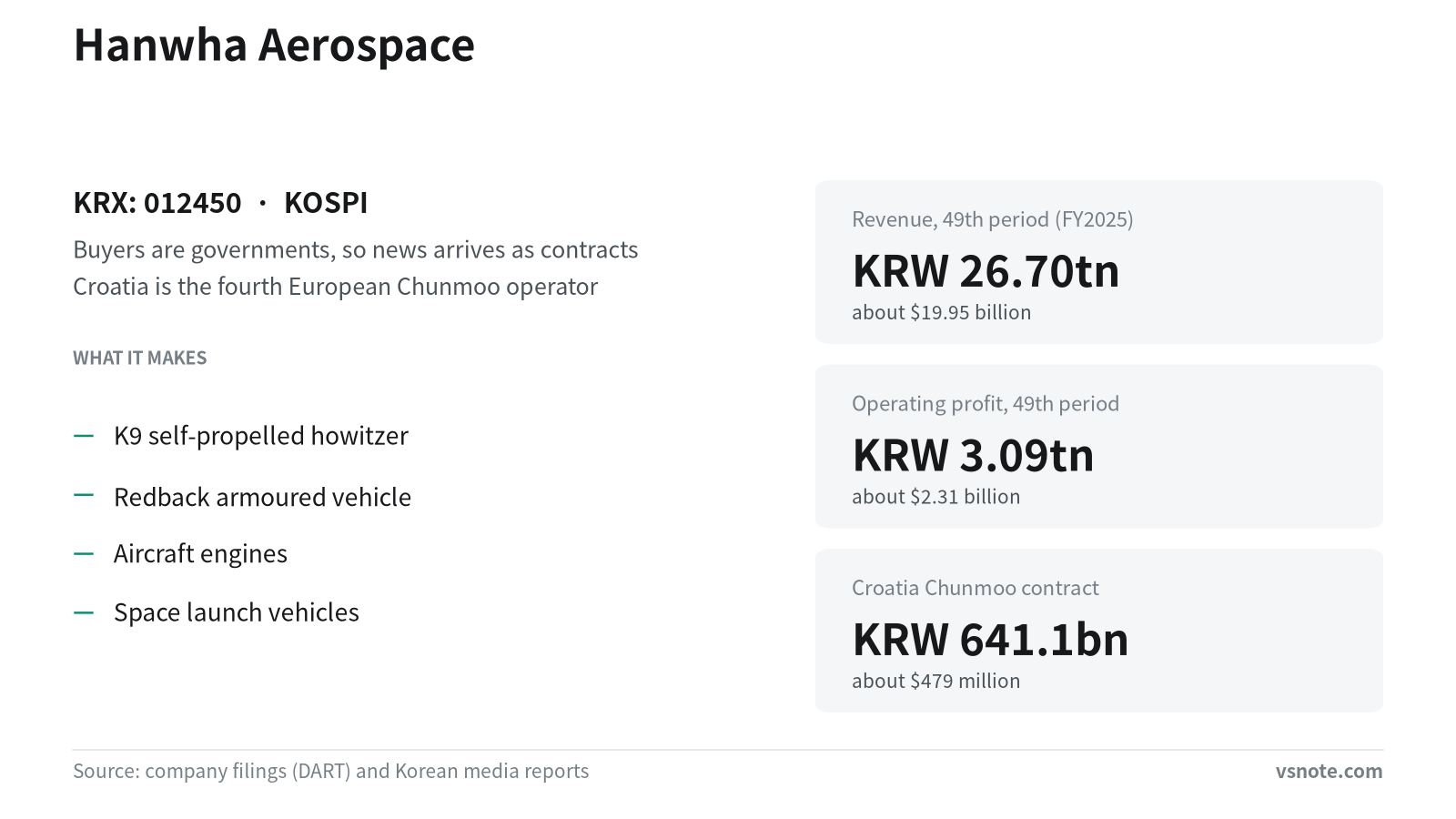
    Hanwha Aerospace is a Korean manufacturer listed on the KOSPI, the main board of the Korea Exchange (the KOSDAQ is its board for smaller companies), under ticker 012450. It builds ground weapon systems such as self-propelled howitzers and armoured vehicles, aircraft engines, and space launch vehicles.

    Its buyers are governments, so news about the company usually arrives as a contract announcement. The one that brings most English-language readers here is an export contract with Croatia’s defence ministry for Chunmoo, a multiple-launch guided missile system, reported at about KRW 641.1 billion (about $479 million).

    A contract total on its own tells you very little. This article sets that figure next to the contract’s four-year term, next to what the package actually contains, and next to the company’s own disclosed revenue and order backlog.

    HANWHA AEROSPACE CO., LTD. (한화에어로스페이스) · KRX: 012450 · KOSPI

    Won amounts are converted at ₩1,338.2 per US dollar (Bank of Korea ECOS, KRW/USD base rate, 2026-09-11) for scale only.


    An aerospace name, an order book on the ground

    The name points at air and space, and the company does make aircraft engines and work on space launch vehicles. Its other leg is ground defence — self-propelled howitzers and armoured vehicles — with the K9 self-propelled howitzer and the Redback armoured vehicle among its main product lines.

    Chunmoo sits on that ground side. The material cited here describes it as a multiple-launch guided missile weapon system: a launch vehicle carrying several guided missiles rather than a single round.

    According to Korean media reports, ground-defence revenue came to KRW 2.11 trillion (about $1.57 billion), and the segment’s order backlog has grown to around KRW 38.30 trillion (about $28.62 billion). Backlog here means work already under contract but not yet delivered, which will be recognised as revenue in later periods.

    That is the mismatch worth holding on to from the start: the thickest layer of contracted-but-undelivered work is in the part of the business that rolls on the ground.


    What the Croatia contract actually covers

    According to Korean media reports, the contract was signed with Croatia’s defence ministry and runs from 10 September 2026 to 9 September 2030.

    It is not a handover of launchers and nothing else. The package covers 18 Chunmoo launchers together with ammunition resupply vehicles, fire command vehicles, precision guided rockets, integration with a command-and-control system, training, and integrated logistics support — the part of a defence contract that commits the seller to supply spare parts, maintenance and training after delivery.

    The same reports describe this as the first Korean weapon system exported to Croatia and the first large defence contract between the two countries. Croatia becomes the fourth European operator of Chunmoo, after Poland, Norway and Estonia.

    The company also plans to build the maintenance and repair arrangement with local Croatian firms, according to those reports.


    Measuring one contract against the company’s own accounts

    A contract total works like the “total over the plan” printed large on a mobile-phone contract: it only acquires meaning once you divide it by the term. The comparison breaks straight away, though — a phone plan splits evenly month by month, while how much of this contract falls into which year is not something the material cited here sets out.

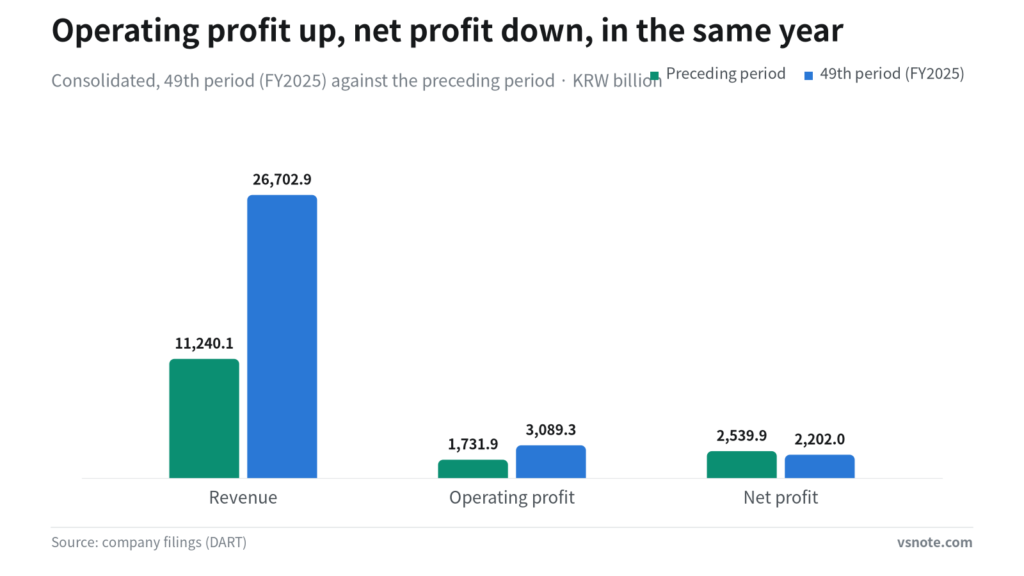
    The company’s annual report for its 49th fiscal period — Korean filings number fiscal years in sequence from a company’s founding, and the 49th is FY2025 — shows consolidated revenue of KRW 26.70 trillion (about $19.95 billion), against KRW 11.24 trillion (about $8.40 billion) in the preceding period — more than double, which is not something a defence order book does on its own in one year. What changed between the two periods, and whether the companies consolidated into the group were the same in both, is not set out in the material cited here; that is the first thing to check in the filing itself before reading the jump as growth. Consolidated means the parent and the companies it controls added together, as distinct from separate (standalone) figures covering the parent alone. Annual reports of this kind are published on DART, the electronic disclosure system run by Korea’s Financial Supervisory Service.

    Operating profit rose from KRW 1.73 trillion (about $1.29 billion) to KRW 3.09 trillion (about $2.31 billion). Net profit moved the other way, from KRW 2.54 trillion (about $1.90 billion) to KRW 2.20 trillion (about $1.65 billion) — items below the operating line land in the net figure, and the report cited here does not break out what drove the divergence. Total assets are shown at KRW 53.95 trillion (about $40.32 billion).

    Grouped bars comparing consolidated revenue, operating profit and net profit for the 49th fiscal period against the preceding period.

    For the second quarter of 2026, Korean media reports give consolidated revenue of KRW 9.29 trillion (about $6.94 billion), up 47.2% from a year earlier, and operating profit of KRW 1.37 trillion (about $1.02 billion), up 58.5% — reported as the first quarter in which quarterly operating profit passed KRW 1.00 trillion (about $747 million).

    Set KRW 641.1 billion (about $479 million) beside a single year of consolidated revenue, beside the ground-defence backlog cited earlier, and across a delivery window that runs to 2030, and the number reads differently from the headline. That is the measuring exercise to repeat the next time an export figure appears in a headline: term, annual revenue, backlog — and a reminder that operating profit and net profit are different lines that can move in opposite directions.


    Another Korean name in the same field, and why the backlogs do not line up

    Hyundai Rotem is classified in the same ground-defence field. According to Korean media reports, its order backlog stood at about KRW 30.40 trillion (about $22.72 billion) in the second quarter of 2026, passing KRW 30.00 trillion (about $22.42 billion) for the first time.

    The two backlog figures look adjacent, but they measure different things. Hanwha Aerospace’s number covers its ground-defence segment; Rotem’s covers the whole company, so reading them as like-for-like would be a mistake.

    Two further items appear in the same reports: Rotem’s K2 tank obtained NATO’s AQAP2110 quality assurance certification in July 2026, described as the first Korean case, and Rotem’s second-quarter 2026 operating profit was lower than a year earlier. Hanwha Aerospace’s ground-defence operating profit is given as KRW 533.0 billion (about $398 million).

    The sources cited here do not show contract sizes or market shares for European producers, so this article places the company against no wider competitive field.


    Where further volume is contracted or planned to come from

    The structure of the Croatia deal points past the initial handover: each added operator brings support obligations — maintenance, resupply vehicles, training, logistics — written into the contract rather than sold separately afterwards. Croatia is the fourth such operator in Europe.

    Separately, according to Korean media reports, the company is building its own GPU farm in Yongin, Gyeonggi Province, with total investment of KRW 40.0 billion (about $30 million), installing Nvidia’s high-performance H200 and B300 GPUs.

    The same reports describe a Hanwha plan to spend about KRW 2.00 trillion (about $1.49 billion) through 2040 developing a defence AI model called Defense OS, named for application to the K9A3 self-propelled howitzer, Chunmoo and Arion-SMET. Which AI functions would go into each weapon is not set out in the material cited here.

    On the aircraft engine side, the reports cited record Airbus net orders of 1,091 aircraft for January to August 2026 and Boeing net orders of 453 over the same months, with Boeing deliveries of 600 aircraft in 2025 and 418 in January to August 2026.

    What the material cited here does not contain is any institutional forecast of how large these markets become. The contract term, the disclosed accounts and the company’s stated plans are what this article can show; the last step is the reader’s.


    Frequently asked questions

    Q. What does Hanwha Aerospace actually make?

    A. Ground weapon systems such as self-propelled howitzers and armoured vehicles — the K9 self-propelled howitzer and the Redback armoured vehicle are among its main lines — together with aircraft engines and space launch vehicle work. Chunmoo, the multiple-launch guided missile system in the Croatia contract, belongs to the ground side.

    Q. How large is the Croatia contract relative to the company?

    A. Korean media reports put it at about KRW 641.1 billion (about $479 million), running from 10 September 2026 to 9 September 2030. The company’s annual report shows consolidated revenue of KRW 26.70 trillion (about $19.95 billion) for FY2025, and reports give the ground-defence backlog at around KRW 38.30 trillion (about $28.62 billion). Those are the yardsticks; how much of the contract falls in each year is not set out in the sources cited here.

    Q. Where do these figures come from, and can I check them myself?

    A. The annual figures come from the company’s filing for its 49th fiscal period (FY2025), the kind of report published on DART, Korea’s electronic disclosure system operated by the Financial Supervisory Service. The company trades on the KOSPI under ticker 012450. Filings present both consolidated and separate (parent-only) figures; the ones used here are consolidated. The quarterly and contract details come from Korean media reports rather than from filings.

    Q. Why did net profit fall while operating profit rose?

    A. The annual report shows operating profit rising from KRW 1.73 trillion (about $1.29 billion) to KRW 3.09 trillion (about $2.31 billion) while net profit fell from KRW 2.54 trillion (about $1.90 billion) to KRW 2.20 trillion (about $1.65 billion). Items outside the operating line feed into the net figure, and the material cited here does not break down what produced the gap.

    Q. Can the backlog be compared with Hyundai Rotem’s?

    A. Not directly. Korean media reports give Rotem’s second-quarter 2026 backlog as about KRW 30.40 trillion (about $22.72 billion) on a company-wide basis, while the Hanwha Aerospace figure covers its ground-defence segment only. The two cover different scopes, so putting them side by side as equivalents would mislead.


    Sources

    • https://dart.fss.or.kr/dsaf001/main.do?rcpNo=20260316001112
    • https://www.gukjenews.com/news/articleView.html?idxno=3692632
    • https://www.newsworks.co.kr/news/articleView.html?idxno=853496
    • https://news.bbsi.co.kr/news/articleView.html?idxno=4106134
    • https://www.mediawatch.kr/news/article.html?no=261005
    • http://www.efnews.co.kr/news/articleView.html?idxno=132360
    • https://www.pointe.co.kr/news/articleView.html?idxno=84616
    • https://dealsite.co.kr/articles/168864
    • https://biz.sbs.co.kr/article_hub/20000334107?division=NAVER
    • https://www.ktv.go.kr/content/view?content_id=760861
    • https://blog.naver.com/daily_benefit365/224408313205
    • https://blog.naver.com/sky230718/224408342386
    • https://blog.naver.com/jony97/224408697560
    • https://blog.naver.com/treehome_0121/224408693255

    This article explains company filings and published figures for information only. It is not investment advice or a recommendation to buy or sell any security. Figures can change after publication — check the original filings before making decisions.