Turn over a bottle of Korean sunscreen and, in small type on the back, there is a line naming the company that made it. It is often a different company from the brand on the front.
One of the names that appears in that line is KOLMAR KOREA CO.,LTD, listed on the KRX KOSPI under ticker 161890.
It is a cosmetics company that sells no cosmetics under its own name.
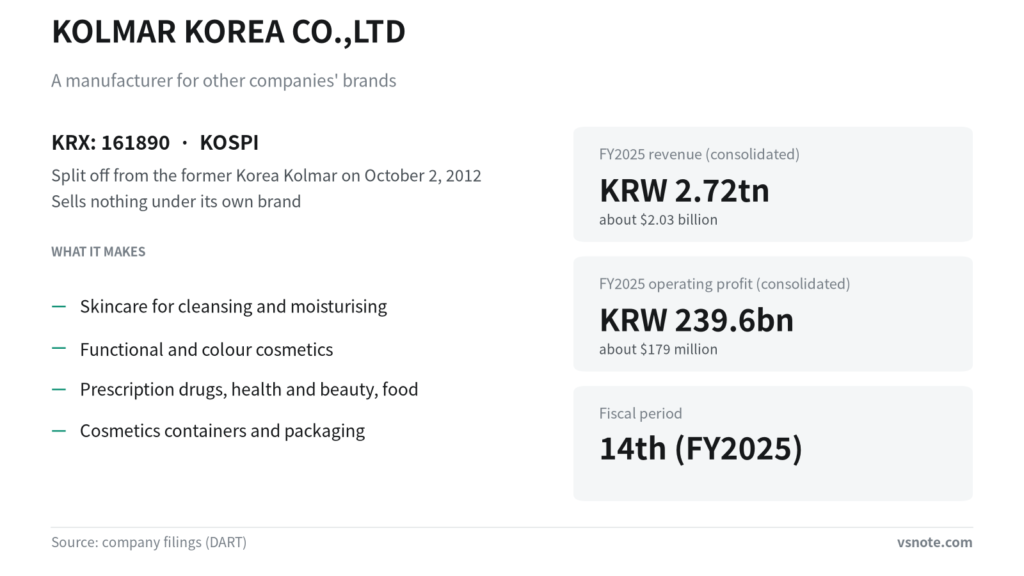
KOLMAR KOREA CO.,LTD (한국콜마) · KRX: 161890 · KOSPI
Won amounts are converted at ₩1,338.2 per US dollar (Bank of Korea ECOS, KRW/USD base rate, 2026-09-11) for scale only.
A cosmetics company with no brand of its own
On a cosmetics box the brand name is printed large on the front, and the name of the company that made it sits in small type on the back. KOLMAR KOREA works on the back-of-the-box side.
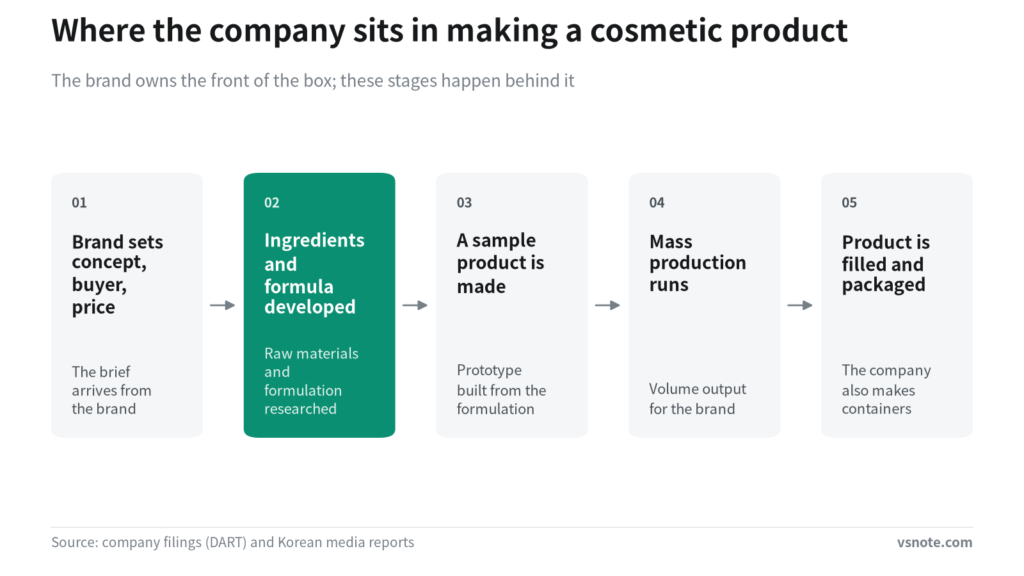
Its model is ODM: a brand supplies a concept, a target buyer and a price point, and the manufacturer researches the ingredients and formulation that fit those conditions, builds a sample, and then carries the product through to mass production.
OEM work is the neighbouring term, and one thing separates them. An OEM makes the product as ordered; an ODM helps decide what to make and how. The dividing line is whether the manufacturer takes on the review of ingredients and formulations.
The name can be confusing. The company as it stands today was established on October 2, 2012, when it was split off from the former Korea Kolmar Co., Ltd., so an earlier company of the same name existed before it. Some Korean media summaries also describe HK inno.N as a subsidiary of KOLMAR KOREA.
“Cosmetics company” does not cover the whole of it either. Four lines of business sit inside the consolidated accounts.
The shares trade on the KRX KOSPI, the Korea Exchange’s main board, under ticker 161890; KOSDAQ is the exchange’s junior market. Consolidated figures in this article add the parent and its subsidiaries together, while separate (standalone) figures would cover the parent alone.
So however well known a finished product becomes, the shopper does not learn who made it — and this company’s revenue is recorded against the volume a brand ordered, not against how popular the product turned out to be.
- Cosmetics ODM — skincare for cleansing and moisturising, functional products and colour cosmetics
- Prescription pharmaceuticals
- Health and beauty products and food
- Cosmetics containers, that is, packaging
What a brand is actually buying
Why would a brand hand its product to a company that has no brand of its own? The sources collected here do not contain a figure for this company’s share of the cosmetics market, so this section uses two other measures: who buys, and which stage of making a product the company occupies.
The company joins at the planning stage. It researches ingredients and formulations, makes a prototype, and then takes the product to volume production — from a brand’s side, that is renting a laboratory and a factory at once.
Sun care is where its name comes up most often. According to Korean media reports, its sun care technology is treated as a domestic strength, and sun care products from a number of indie brands — small, independent labels outside the large groups — are built on it.
Work of that sort includes moving away from formulations that leave a white cast and toward serum- and lotion-type products, which the company also produces.
The same reports say a colour cosmetics brand belonging to a global multinational newly entered the top five customers of the company’s US arm in the second quarter of 2026, and that the company supplies a high-end cream for a global luxury brand. They do not identify the brands.
What a brand pays for is not factory hours but a formulation and a production line that clears the regulator in the destination market. The company has a first plant in Pennsylvania; a second US plant is reportedly moving into construction and operation in earnest, and its production capability is described as meeting US FDA standards for over-the-counter drug facilities. Sunscreen is handled as an over-the-counter drug in the United States.
The two Korean companies doing the same work
There are other places a brand could go. In Korea, COSMAX and Cosmecca Korea are grouped with KOLMAR KOREA as doing the same work.
The figures below are cumulative first-half 2026 numbers compiled on one basis by a single Korean media source, and all are consolidated.
The ranking by revenue size and the ranking by margin do not line up.
All three grew revenue over the half year, but their margins moved in different directions. By the same source, KOLMAR KOREA’s operating margin rose 2.27 percentage points and Cosmecca Korea’s rose 0.51 points, while COSMAX grew revenue 21.84% and saw its margin fall 0.67 points.
What separates them differs as well. COSMAX is reported to have some 5,000 customers in Korea and abroad and names L’Oréal, Estée Lauder and Johnson & Johnson among them, while Cosmecca Korea consolidates overseas subsidiaries including Englewood Lab.
- KOLMAR KOREA — revenue KRW 1.59 trillion (about $1.19 billion), operating profit KRW 189.2 billion (about $141 million), operating margin 11.91%
- COSMAX — revenue KRW 1.48 trillion (about $1.10 billion), operating profit KRW 126.8 billion (about $95 million), operating margin 8.58%
- Cosmecca Korea — revenue KRW 411.2 billion (about $307 million), operating profit KRW 53.9 billion (about $40 million), operating margin 13.12%
When profit grows faster than revenue
If margins are what separates these companies, it is worth laying this one’s own numbers out. The company’s annual report for its 14th fiscal period, filed on March 18, 2026, shows consolidated revenue of KRW 2.72 trillion (about $2.03 billion) and operating profit of KRW 239.6 billion (about $179 million) for FY2025.

Korean filings number fiscal periods from incorporation, so the 14th period is FY2025. Filings of this kind are published through DART, the electronic disclosure system operated by Korea’s Financial Supervisory Service.
Set the two years side by side and revenue rose 11% while operating profit rose 23.6% — profit growing at more than twice the pace of sales.
The gap widened in the first half of 2026, when revenue rose 14.84% and operating profit 41.83% year on year, according to Korean media reports.
That did not happen because the products became cheaper to make. The same reports say gross margin fell in the first half, while selling and administrative expenses grew more slowly than revenue, and that is what lifted the operating margin.
The reason this shape recurs is plain. A company that manufactures to order carries plants, laboratories and administrative staff that are in place before the orders arrive. When orders rise, that standing cost base does not rise with them, so one step up in revenue becomes a larger step up in profit — and when orders fall, profit falls harder for the same reason.
By quarter, Korean media reports put second-quarter 2026 revenue at KRW 861.3 billion (about $644 million), up 17.9% year on year, and operating profit at KRW 110.3 billion (about $82 million), up 50.2%. They describe it as the first time a Korean cosmetics ODM has posted quarterly operating profit above KRW 100.0 billion (about $75 million).
Two things to add. The annual report breaks revenue down by region, subsidiary, business division, sales type and product item, and reports main products with yearly amounts and shares — but the sources cited here do not include those divisional shares.
On dividends, Korean media reports say the company has raised its payout every year for 13 consecutive years since 2012.
Where rising exports actually land
That leaves the question of whether these numbers came from something inside the company or from an industry lifting everything at once. This article does not settle it; it sets out who counted what.

Korean cosmetics exports in January to July 2026 rose 27.6% year on year, on figures cited in Korean media reports. Exports to the United States rose 38.7% and to Europe 65.6%, and the share going outside Greater China rose from 72% in January to 82% in July.
In July 2026, exports to the United States alone passed the whole of Greater China for the first time.
The volume being added attaches to formulations and production stages rather than to brands. Skincare and sun care passed 85% of cosmetics exports during 2026, the United States approved new sunscreen filters, and rising demand for hydrogel masks has manufacturers adding second shifts, equipment and outsourcing to expand capacity.
There are forecasts as well. A Hana Securities report by analyst Park Jong-dae, titled “Cosmetics: in the middle of a historic year”, puts 2026 Korean cosmetics export growth at 33%, against an initial estimate of around 15%.
The annual report describes the cosmetics industry as a branch of fine chemicals in which chemistry, biology, pharmacology and physiology combine with applied technology, and describes cosmetics as taking on the character of a necessity as living standards rise.
One box is still empty. Korean media reports say the company signed a KRW 55.9 billion (about $42 million) logistics automation supply contract with Hyundai Movex in December 2025, covering equipment including automated guided vehicles, but the sources cited here do not show when it starts running or how much capacity it adds.
What to read in the next earnings report
Companies like this exist because most people who want to launch a brand have neither a laboratory nor a factory. ODM fills in formulation development, clearance through each country’s rules and volume production, so the more brands there are, the more volume stacks up on the manufacturing side.
The consequence is that this company’s numbers move with which brand ordered what, and how much of it, rather than with which products people found appealing.
What has been established so far is the first-half margin improvement, which reportedly came from selling and administrative costs rather than from cost of goods.
Past that, the record here runs out. The second US plant is described as moving into operation, and neither the start date of the logistics equipment nor the divisional revenue shares appear in these sources.
So the article is not much use to a reader who wants to go straight from “Korean beauty brands are selling well” to “this company must be doing well”. There is one more box in between: whether the brands placed their orders here.
If the question is instead what to look at in an earnings report, there are three places to look. Which customers are newly attached, whether revenue or profit grew faster, and which businesses other than cosmetics are mixed into the consolidated figures.
The maker’s name is not on the front of the box. Turn it over and it is there.
Frequently asked questions
Q. What does KOLMAR KOREA actually do?
A. It makes cosmetics but does not sell them under its own brand. A brand gives it a concept, a target buyer and a price point; the company researches the ingredients and formulation that fit, makes a sample and handles mass production. Beyond cosmetics, it also runs prescription pharmaceuticals, health and beauty products and food, and cosmetics packaging.
Q. How is ODM different from OEM?
A. An OEM makes the product as ordered. An ODM takes part in deciding what to make and how. The dividing line is whether the manufacturer also handles the review of ingredients and formulations.
Q. How does it compare with COSMAX?
A. Both are cosmetics ODMs, so the work overlaps. On a consolidated basis for the first half of 2026, Korean media reports put KOLMAR KOREA’s revenue at KRW 1.59 trillion (about $1.19 billion) against COSMAX’s KRW 1.48 trillion (about $1.10 billion), with operating margins of 11.91% and 8.58%. The same reports say COSMAX has some 5,000 customers in Korea and abroad and names L’Oréal and Estée Lauder among them.
Q. Is HK inno.N part of KOLMAR KOREA?
A. Korean media summaries describe HK inno.N as a subsidiary of KOLMAR KOREA. The filings cited here do not show how it is treated in the consolidated statements, so that would have to be read in the original disclosure.
Q. If Korean cosmetics exports keep rising, does this company’s revenue rise with them?
A. There is a step in between: a brand has to place an order before anything is booked as revenue. Korean media reports put January-to-July 2026 cosmetics exports up 27.6%, with skincare and sun care above 85% of the total, but how much of that volume went to which manufacturer is a separate question.
Sources
- https://dart.fss.or.kr/dsaf001/main.do?rcpNo=20260318001196
- https://blog.naver.com/43coffee/224399087074
- https://www.polinews.co.kr/news/articleView.html?idxno=741946
- https://blog.naver.com/k-stockrookie/224398133973
- https://magazine.hankyung.com/business/article/202608263466b
- https://www.wikitree.co.kr/articles/1155467
- https://www.imaeil.com/page/view/2026082709042164610
- https://biz.newdaily.co.kr/site/data/html/2026/08/24/2026082400052.html
This article explains company filings and published figures for information only. It is not investment advice or a recommendation to buy or sell any security. Figures can change after publication — check the original filings before making decisions.