Hanwha Ocean is a shipbuilder based in Geoje, South Gyeongsang Province, that builds ships to order. It is listed on KOSPI, the main board of the Korea Exchange, under ticker 042660, and Korean market coverage groups it with shipbuilding and defense stocks. Its predecessor was Daewoo Shipbuilding & Marine Engineering.
It builds three kinds of vessels: commercial ships such as LNG carriers, crude oil tankers and container ships; offshore units that produce and store oil at sea; and warships such as frigates. Most of its money comes from commercial ships sold abroad, and in FY2025 its commercial ship sales were almost entirely exports.
News headlines focus on submarines and frigates, but the figures point elsewhere. A shipbuilder takes an order first and builds the ship later, so today’s results come from orders won earlier. A ‘selection’ or an ‘unveiling’ in this week’s news is not yet a signed contract.
Hanwha Ocean Co., Ltd. (한화오션) · KRX: 042660 · KOSPI
Won amounts are converted at ₩1,345.3 per US dollar (Bank of Korea ECOS, KRW/USD base rate, 2026-09-15) for scale only.
Where the ships built in Geoje go
The company’s annual report is filed on DART, Korea’s electronic disclosure system run by the Financial Supervisory Service. Korean filings label each fiscal year with a sequential period number, so the 26th period is FY2025, the 25th is FY2024 and the 24th is FY2023.
The report lists LNG carriers (LNGC, ships that carry liquefied natural gas), LPG carriers and container ships among the commercial ship segment’s products. The business scope also covers crude oil tankers, FPSOs (floating production, storage and offloading units, which produce crude oil at sea and store it until it is offloaded) and drilling rigs such as drillships.
In FY2025, export sales in the commercial ship segment far exceeded domestic ship sales, and they made up most of the company’s consolidated revenue. The annual report shows consolidated revenue of KRW 12.78 trillion (about $9.50 billion) for FY2025, up from KRW 10.78 trillion (about $8.01 billion) in FY2024. Korean companies publish consolidated figures, which include subsidiaries, and separate figures for the parent company alone. This article uses consolidated figures.
LNG carriers lead the mix. In the report’s main products table, the LNG carrier line in the commercial ship segment has a 77.3% sales share for FY2025.
The company traces its roots to Daewoo Shipbuilding & Marine Engineering, which won a frigate order from Thailand in 2013. Philly Shipyard, a name that also appears in coverage, is a US shipyard that Hanwha acquired. It is not the Geoje yard.
How much of each year’s new orders it wins
A company that builds to order does not measure its market position by units sold. It measures its share of the new orders placed each year. That share is counted in GT (gross tonnage), which measures the space inside a ship rather than its weight.
The market share table in the company’s annual report shows this path:
- 2023: 828 thousand GT of orders, a 5.2% share
- 2024: 4,569 thousand GT of orders, a 24.6% share
- 2025: 7,638 thousand GT of orders, a 30.9% share
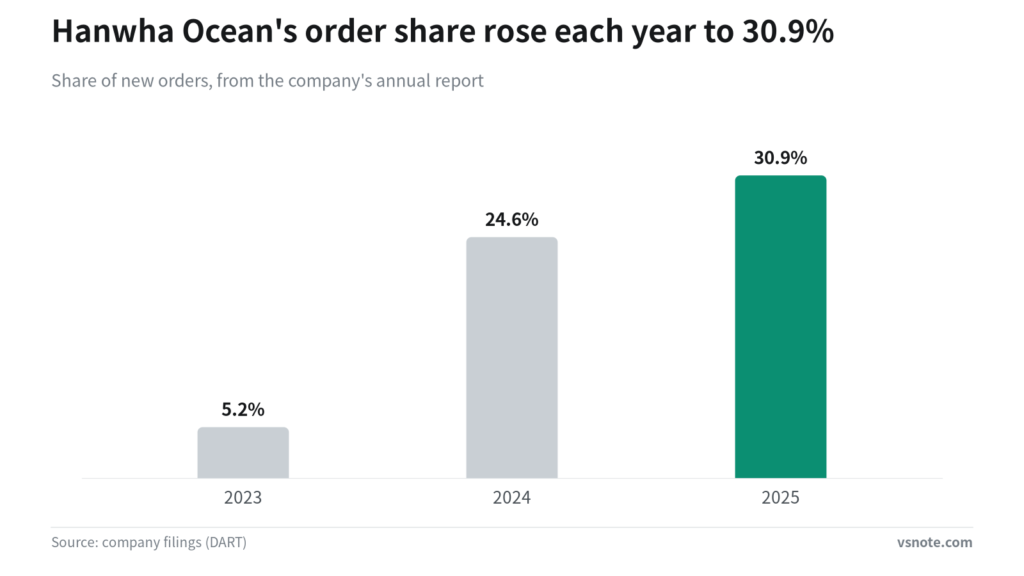
These shares come from the company’s own annual report, not from an outside research firm, and the filings cited here do not show whether the base is the Korean market or the global market. The same table lists HD Hyundai Heavy Industries, whose share over the same three years was 33.2%, 14.7% and 25.1%.
Two kinds of competition: shipowners and governments
Commercial ships are ordered by shipowners. Warships are bought by governments through tenders, so the competition takes a different form and involves shipbuilders from other countries.
According to Korean media reports, the Royal Thai Navy’s next-generation frigate competition drew HD Hyundai Heavy Industries, Spain’s Navantia, Singapore’s ST Engineering and a defense company from Türkiye. In Canada’s next submarine program, Hanwha Ocean did not win, and the Canadian government chose Germany’s TKMS as preferred bidder.
In Thailand the company has a track record. In 2018, as Daewoo Shipbuilding & Marine Engineering, it delivered the 3,700-ton-class frigate Bhumibol Adulyadej to the Royal Thai Navy, and the ship now serves as the navy’s flagship.
Where the frigate and floating data center news stands
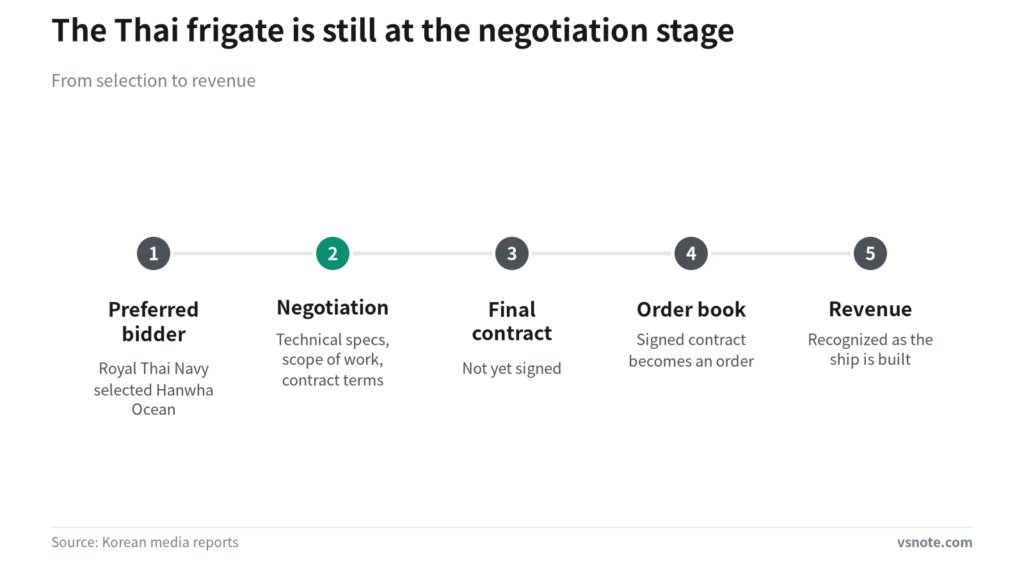
According to Korean media reports, the Royal Thai Navy selected Hanwha Ocean as preferred bidder for its next-generation frigate program. A preferred bidder is the party chosen to negotiate terms before any final contract is signed. The program is reportedly worth about KRW 683.3 billion (about $508 million). For scale, FY2025 consolidated revenue was KRW 12.78 trillion (about $9.50 billion).
The reports say the final contract has not been signed. The company is expected to negotiate detailed technical specifications, the scope of work and contract terms with the navy before the final terms are set.
Its bid is the OCEAN-40F, a 4,000-ton-class export frigate developed from the Bhumibol Adulyadej. After losing in Canada, the company has said it still sees other submarine export opportunities.
The second item is a floating data center the company developed itself, rated at the 60MW class and reportedly shown to the public for the first time at Gastech 2026. The American Bureau of Shipping (ABS), a classification society that certifies ship designs against technical standards, granted Approval in Principle (AiP) for its concept design. AiP is issued at the concept design stage and is not a construction contract.
In the reports cited here, neither the frigate nor the data center is a signed contract, so neither has reached the order book or revenue. The sources cited here contain no forecast for the shipbuilding industry. What they do show is structure: commercial ship sales lean heavily on LNG carriers.
Frequently asked questions
Q. Is Hanwha Ocean a defense company or a commercial shipbuilder?
A. It is both, but the annual report shows that commercial ships sold abroad make up most of its revenue. In FY2025, the LNG carrier line had a 77.3% sales share in the commercial segment’s products table. Warships such as frigates are a separate line of business that gets a lot of news coverage.
Q. Has Hanwha Ocean signed the Thai frigate contract?
A. Not according to Korean media reports. The Royal Thai Navy selected it as preferred bidder, and the final contract is still under negotiation. The program is reportedly worth about KRW 683.3 billion (about $508 million).
Q. What does the 30.9% order share for 2025 mean?
A. It is the company’s share of new orders in 2025, measured in gross tonnage, as reported in its own annual report. The filings cited here do not show whether that share is of the Korean market or the global market.
Q. Is Hanwha Ocean the same company as Daewoo Shipbuilding & Marine Engineering?
A. Daewoo Shipbuilding & Marine Engineering is its predecessor. That company won a frigate order from Thailand in 2013 and delivered the frigate Bhumibol Adulyadej in 2018. Philly Shipyard is a different business: a US shipyard acquired by Hanwha.
Sources
- https://dart.fss.or.kr/dsaf001/main.do?rcpNo=20260317000644
- https://www.pinpointnews.co.kr/news/articleView.html?idxno=487283
- https://blog.naver.com/rktnco/224412200022
- https://blog.naver.com/market_decoder/224411728167
- https://gaundekr.tistory.com/15795069
- https://blog.naver.com/pure-vitamin/224410376873
- https://blog.naver.com/tmishaha/224410961151
- https://www.busan.com/view/busan/view.php?code=2026091313294192853
- https://blog.naver.com/wealthinking0909/224410008283
This article explains company filings and published figures for information only. It is not investment advice or a recommendation to buy or sell any security. Figures can change after publication — check the original filings before making decisions.