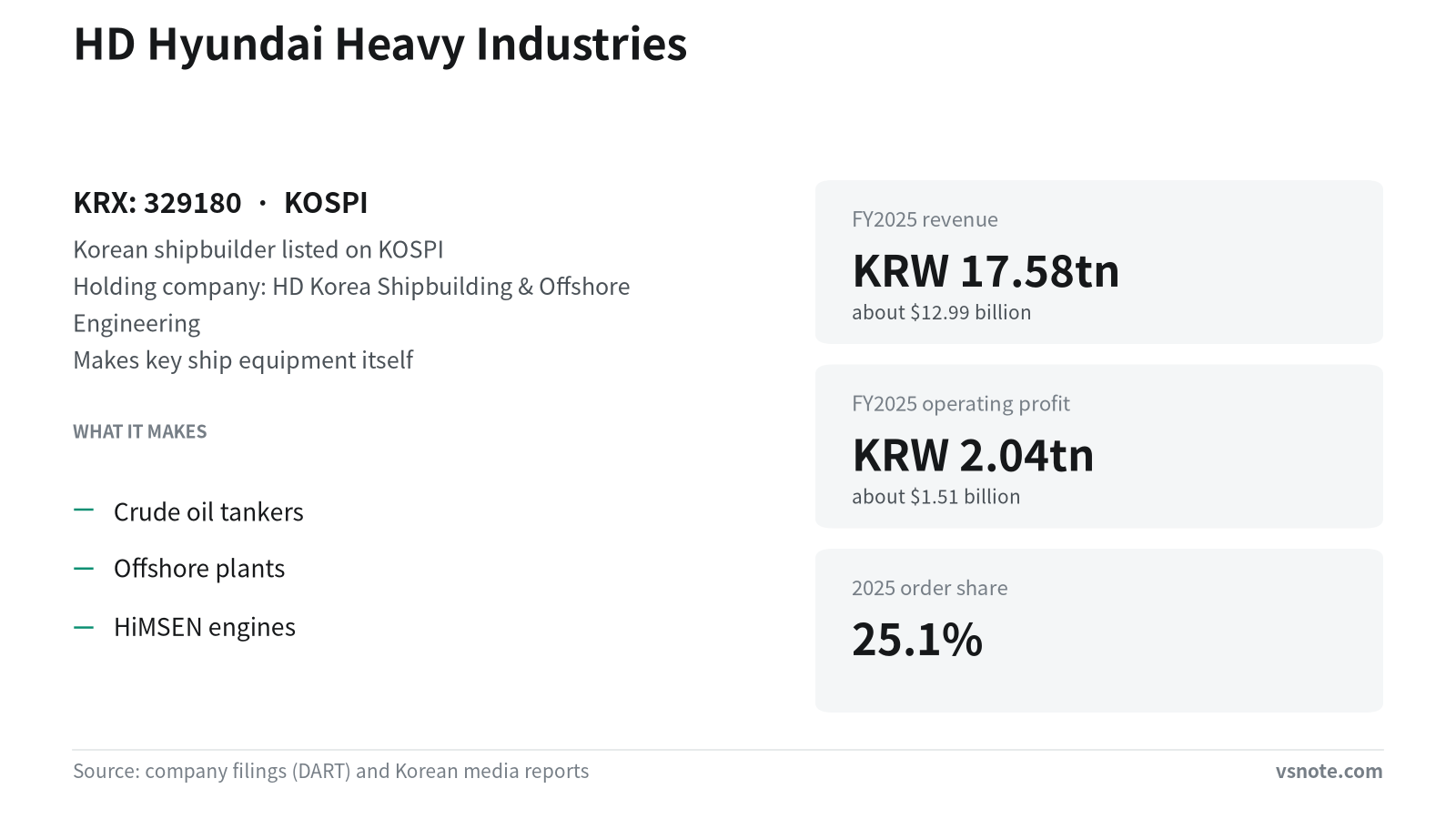
HD Hyundai Heavy Industries is a Korean shipbuilder listed on KOSPI, the main board of the Korea Exchange, under ticker 329180. It builds large vessels such as crude oil tankers, plus offshore plants: the facilities that pump crude oil and natural gas from fields under the sea.
It also makes key ship equipment itself, including engines. Recent news about power plant engines and small nuclear reactor parts is about that engine business moving onto land.
Its holding company is HD Korea Shipbuilding & Offshore Engineering. It also has a subsidiary shipyard in the Philippines. Both names come up in the same news stories, so this guide separates them.
HD HYUNDAI HEAVY INDUSTRIES CO.,LTD. (에이치디현대중공업) · KRX: 329180 · KOSPI
Won amounts are converted at ₩1,353.3 per US dollar (Bank of Korea ECOS, KRW/USD base rate, 2026-09-16) for scale only.
Ships, offshore plants and the engines that drive them
The company’s annual report lists ships such as crude oil tankers as the main products of its shipbuilding division. Its second line of work is offshore plants.
The filing describes the offshore plant industry as covering design, purchasing, construction, transport, installation and commissioning of facilities that produce crude oil and natural gas at offshore fields. These facilities are very large and technically complex, because each one depends on where it is installed and on the properties of the oil or gas it handles.
The company makes or sources the main equipment for its ships itself. That includes HiMSEN, a four-stroke medium-sized engine it developed in 2000. Korean media report that more than 15,000 HiMSEN engines had been produced by 2024, and that the company has decided to sharply expand production of medium-speed engines for power generation on land.
Think of a restaurant that starts bottling the sauce it made for its own dishes and selling it in stores. The engine built for the company’s ships is now being sold to power plants as well.
Three names often appear alongside this one. HD Korea Shipbuilding & Offshore Engineering is the holding company. HD Hyundai Philippines Shipyard is a subsidiary. The Hyundai Heavy Industries branch of the Korean Metal Workers’ Union uses the name without the “HD” prefix.
Who measures the size of a shipbuilder, and how
In its annual report, the company says only that it holds a leading position in shipbuilding. It gives no market share of its own for offshore plants, because each one is built to order and share cannot be calculated for individual products.
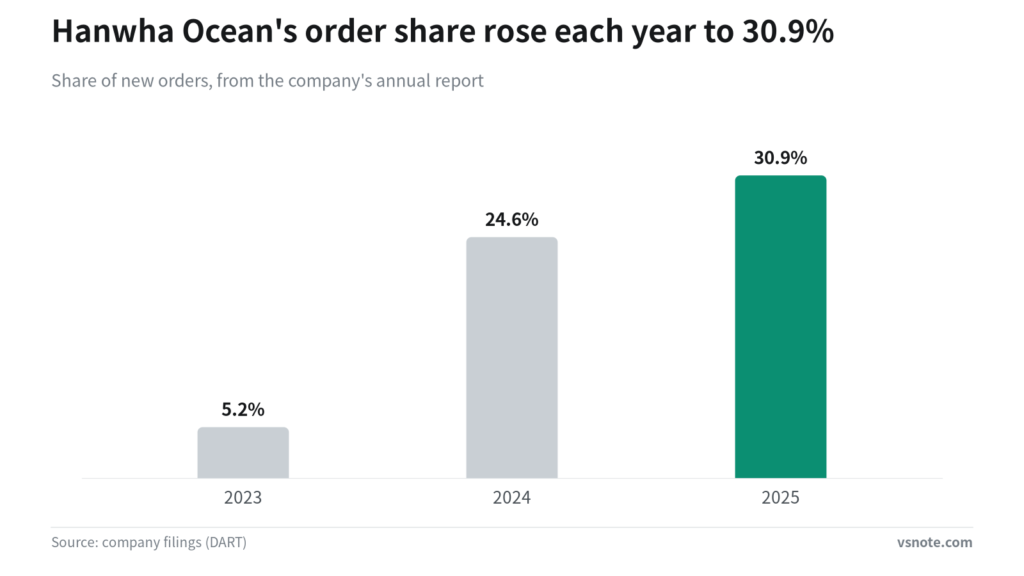
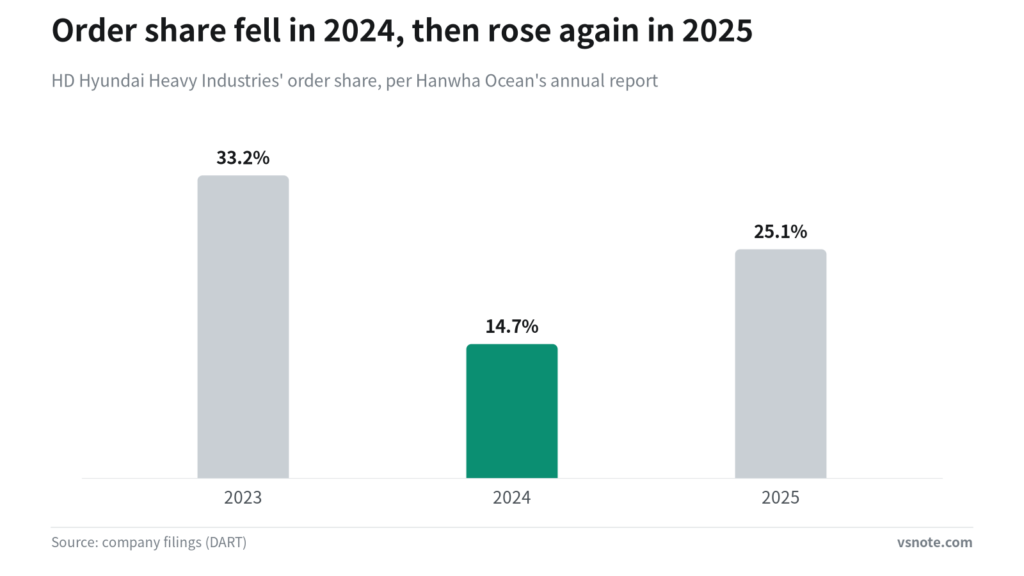
The share figures available here come from somewhere else: the annual report of Hanwha Ocean, another Korean shipbuilder. Orders there are measured in gross tonnage (GT), a measure of a ship’s enclosed volume, not its weight.
Hanwha Ocean’s report gives these figures for HD Hyundai Heavy Industries’ orders:
- 2023: 5,304 thousand GT, an order share of 33.2%
- 2024: 2,730 thousand GT, an order share of 14.7%
- 2025: 6,209 thousand GT, an order share of 25.1%
What the company says sets it apart, and what nearby yards are signing
In its filing, the company lists its competitive strengths: long experience and know-how in building ships, a wide range of products, and a record of business with major shipping lines around the world.
Other Korean yards are signing crude tanker contracts too. According to Korean media reports, the company won orders for four VLCCs (very large crude carriers) in the first half of this year through its subsidiary HD Hyundai Philippines Shipyard.
The same reports say Hanwha Ocean won four VLCCs from Pan Ocean this year for about KRW 736.0 billion (about $544 million). Samsung Heavy Industries disclosed on July 2 a contract with a shipowner in Oceania to build two crude oil tankers, worth KRW 273.4 billion (about $202 million).
These are separate contracts of different sizes. They are listed here side by side, not ranked. The sources cited here do not name any overseas competitor shipyards.
Why revenue rose the year after a low order year
Korean filings number each fiscal year. In the annual report, the 7th period is FY2025 and the 6th period is FY2024. The figures below are consolidated, meaning they include subsidiaries; Korean filings also show separate (standalone) figures for the parent company alone.
Orders were low in 2024, at 2,730 thousand GT. Even so, consolidated revenue rose from KRW 14.49 trillion (about $10.70 billion) in FY2024 to KRW 17.58 trillion (about $12.99 billion) in FY2025.
Operating profit went from KRW 705.2 billion (about $521 million) to KRW 2.04 trillion (about $1.51 billion), and net income from KRW 621.5 billion (about $459 million) to KRW 1.42 trillion (about $1.05 billion). Total assets at year-end grew from KRW 19.39 trillion (about $14.33 billion) to KRW 26.16 trillion (about $19.33 billion).
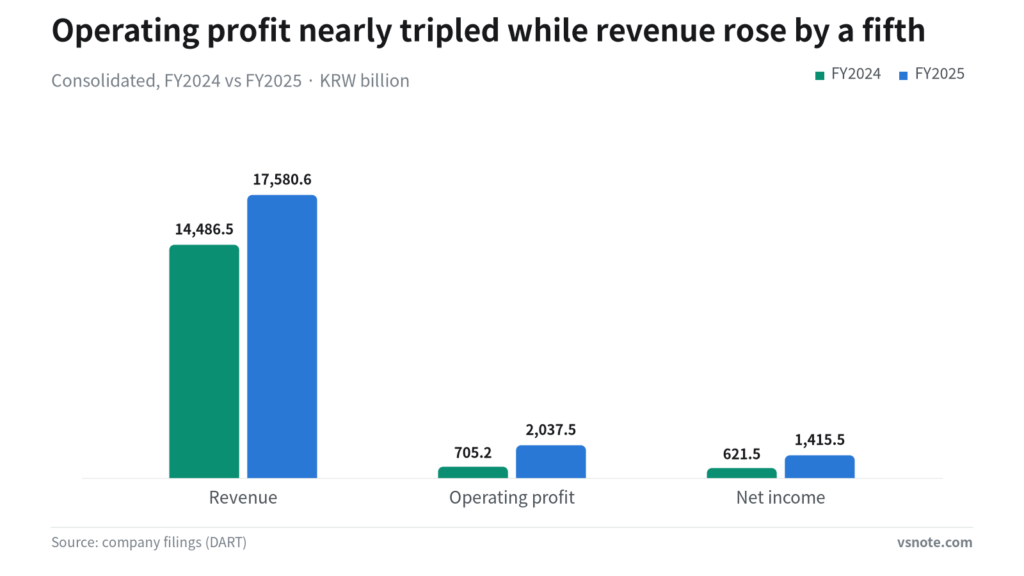
The explanation lies in when each number is counted. An order is counted in the year the contract is signed, while revenue from a ship is booked over the years it takes to build. The order figures and the revenue figures can therefore point to different years.
The sales and order tables in the annual report are as of December 31, 2025.
The engine and SMR plants, and who forecasts the demand
According to Korean media reports, the company announced a total investment of KRW 1.07 trillion (about $792 million) in a power engine production base and an SMR component plant. SMRs are small modular reactors; the plant will make their main components, such as sodium reactors.
Of the total, KRW 833.6 billion (about $616 million), or 78%, goes to a new plant for HiMSEN engines used in power generation on land. The reported annual capacity of that plant is 3GW. The SMR plant receives KRW 238.6 billion (about $176 million).
For scale, the total investment is slightly more than half of FY2025 consolidated operating profit. The company reportedly plans to use the expansion to target power infrastructure for AI data centers.
Others have published forecasts of that power demand. BlackRock put US power demand in 2025 at 489GW, with data centers accounting for 3.9%. The International Energy Agency (IEA) forecast that global data center electricity consumption will rise from about 415TWh in 2024 to about 950TWh in 2030. EPRI projected that US data centers could account for 9–17% of total US electricity consumption in 2030.
Demand for ships has its own measure. According to Clarksons Research figures cited in Korean media, 64 VLCCs were ordered worldwide in the first quarter of this year, compared with 3 in the first quarter of last year.
This is where the sauce analogy breaks down. A bottled sauce can sell the next day, but the engine plant targets completion in May 2028 and the SMR plant in the first half of 2029, so none of this shows up in current results. The buyers also change, from shipping lines to the companies that build power infrastructure.
Frequently asked questions
Q. Is HD Hyundai Heavy Industries the same company as HD Korea Shipbuilding & Offshore Engineering?
A. No. According to the annual report, HD Korea Shipbuilding & Offshore Engineering is the holding company of HD Hyundai Heavy Industries. HD Hyundai Heavy Industries trades on KOSPI under ticker 329180.
Q. Where does the order market share figure come from?
A. The share figures cited here come from Hanwha Ocean’s annual report, not from HD Hyundai Heavy Industries’ own filing. They show 33.2% for 2023, 14.7% for 2024 and 25.1% for 2025. The company itself says only that it holds a leading position, and it does not calculate a market share for offshore plants.
Q. What do the 6th and 7th periods mean in the filings?
A. Korean filings number fiscal years. In this company’s annual report, the 6th period is FY2024 and the 7th period is FY2025.
Q. Do the new engine and SMR plants contribute to revenue yet?
A. Not yet, going by their timelines. According to Korean media reports, the power engine plant targets completion in May 2028 and the SMR component plant in the first half of 2029.
Q. What is a HiMSEN engine?
A. HiMSEN is a four-stroke medium-sized engine that the company developed in 2000. It is used in ships, and the company is expanding production of the version used for power generation on land.
Sources
- https://dart.fss.or.kr/dsaf001/main.do?rcpNo=20260320000859
- https://dart.fss.or.kr/dsaf001/main.do?rcpNo=20260317000644
- https://www.businesspost.co.kr/BP?command=article_view&num=447262
- https://www.mediawatch.kr/news/article.html?no=261050
- https://www.newsquest.co.kr/news/articleView.html?idxno=300974
- https://www.newsquest.co.kr/news/articleView.html?idxno=300948
- https://blog.naver.com/won24_/224407153829
- https://blog.naver.com/prestar_fn/224412156377
- https://blog.naver.com/rfkang49/224411227377
- https://blog.naver.com/sobakcc/224412143266
- https://blog.naver.com/julsongai777/224412061800
This article explains company filings and published figures for information only. It is not investment advice or a recommendation to buy or sell any security. Figures can change after publication — check the original filings before making decisions.