Alteogen is a biotech company listed on KOSDAQ, the Korea Exchange’s market for growth and technology companies, under ticker 196170. It does not sell its own medicines.
Instead, it owns an enzyme technology called Hybrozyme™. It lets a biologic drug that was designed as an intravenous (IV) infusion into a vein be given as a subcutaneous (SC) injection under the skin. Alteogen licenses this technology to global drugmakers such as MSD and Novartis and is paid in stages, not all at once.
In FY2025, 78.5% of the company’s revenue came from this kind of technology income. Keytruda Qlex often appears next to Alteogen’s name in the news, but it is not an Alteogen drug: it is MSD’s product, and it uses Alteogen’s technology.
Alteogen Inc. (알테오젠) · KRX: 196170 · KOSDAQ
Won amounts are converted at ₩1,338.2 per US dollar (Bank of Korea ECOS, KRW/USD base rate, 2026-09-11) for scale only.
A technology licensor, not a drug seller
Headlines about very large licensing deals can make Alteogen sound like a big drugmaker. What it actually owns is narrower. Hybrozyme™ is a protein-engineering technology based on hyaluronidase, an enzyme, and it converts IV drug formulations into SC ones.
A travel plug adapter is a fair comparison. An adapter leaves the appliance unchanged and lets it fit a different socket. In the same way, Alteogen’s technology leaves a partner’s IV drug unchanged and lets it be given as an injection under the skin.
The comparison stops working in two places. An adapter is bought once and simply plugged in, but a drug combined with this technology still has development steps ahead of it. And Alteogen is not paid once, the way a product is sold. Money comes in as the partner reaches set stages.
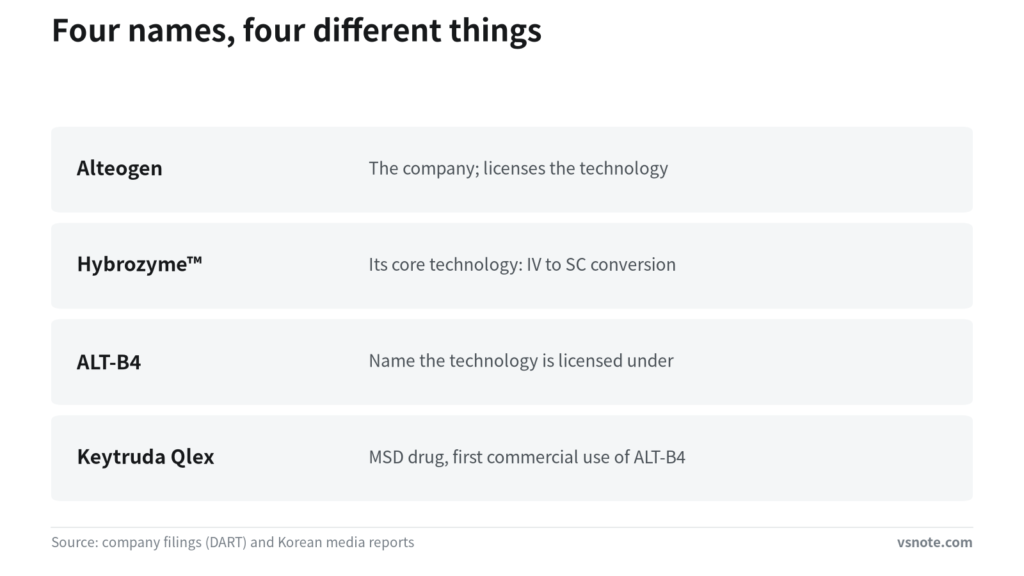
Four names get mixed up in the news. Alteogen is the company, and Hybrozyme™ is its core technology. ALT-B4 is the name under which the technology is licensed to partners. Keytruda Qlex is an MSD drug, and it is reportedly the first commercial product to use ALT-B4.
Whose drugs the technology goes into
The technology works inside someone else’s medicine, so Alteogen’s customers are global drugmakers. The partners named in the sources used here are MSD, Novartis, Daiichi Sankyo, Sandoz and Intas.
It is used at one specific point: when a biologic that already exists as an IV drug is reformulated as an SC version. Keytruda Qlex is the example that is already on the market.
According to Korean media reports, Novartis signed a technology transfer agreement with Alteogen on September 2 to convert IV biologics into SC formulations using ALT-B4. A technology transfer, also called a license-out, means Alteogen grants a partner the right to use its technology in the partner’s own drugs.
Under that deal, Novartis secured options from Alteogen. An option here is the right to decide later, product by product, whether to take a product forward under the licence. Hana Securities, a Korean brokerage, describes the deal as a package covering several products. The filings used here do not state how many.
A Hana Securities report also lists development milestones still ahead from Daiichi Sankyo (for its drug Enhertu), Sandoz and Intas. A milestone is a payment that falls due when a partner’s drug passes an agreed development or sales stage.
The sources used here do not show who else offers similar technology, so they cannot be used to judge the competition.
Why the headline deal value is not money received
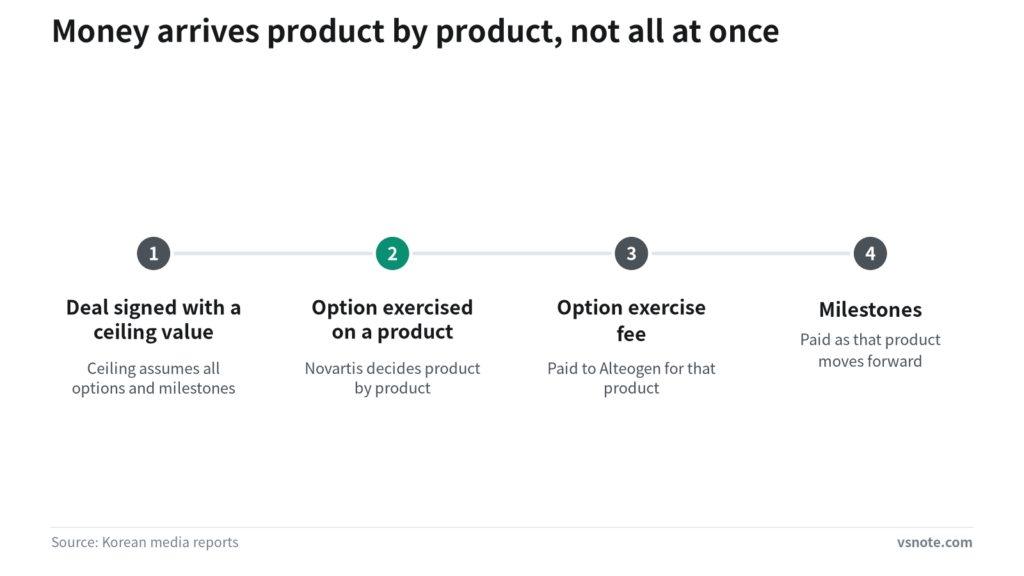
According to Korean media reports, the Novartis agreement is worth up to about KRW 4.40 trillion (about $3.29 billion). That is a ceiling. It assumes every option is exercised and every development and commercialization milestone is met.
In practice, the money comes product by product. Each time Novartis exercises an option on a product, Alteogen receives an option exercise fee. It then receives milestones as that product moves forward.
The MSD contract is also paid in stages. It includes sales milestones linked to Keytruda Qlex, which are payments triggered by the drug’s sales. Alteogen’s first sales milestone arose on August 31, 2026.
The same reports say MSD and Alteogen have not made the detailed milestone conditions public. Before the first milestone was announced, Hana Securities estimated the Qlex sales level that would trigger it. That was the brokerage’s estimate, not a contract term.
Why a licensor’s annual results can change sharply
The company’s annual report is filed on DART, Korea’s electronic disclosure system run by the Financial Supervisory Service. Korean filings number fiscal years in sequence, so FY2025 is Alteogen’s 18th fiscal period and FY2024 its 17th. Korean companies report both consolidated and separate (parent-only) figures, and the figures here are consolidated.
Revenue was KRW 215.9 billion (about $161 million) in FY2025, more than double the KRW 102.9 billion (about $77 million) of FY2024. Operating profit rose to KRW 106.9 billion (about $80 million) from KRW 25.4 billion (about $19 million), and net income rose to KRW 145.2 billion (about $108 million) from KRW 60.7 billion (about $45 million).
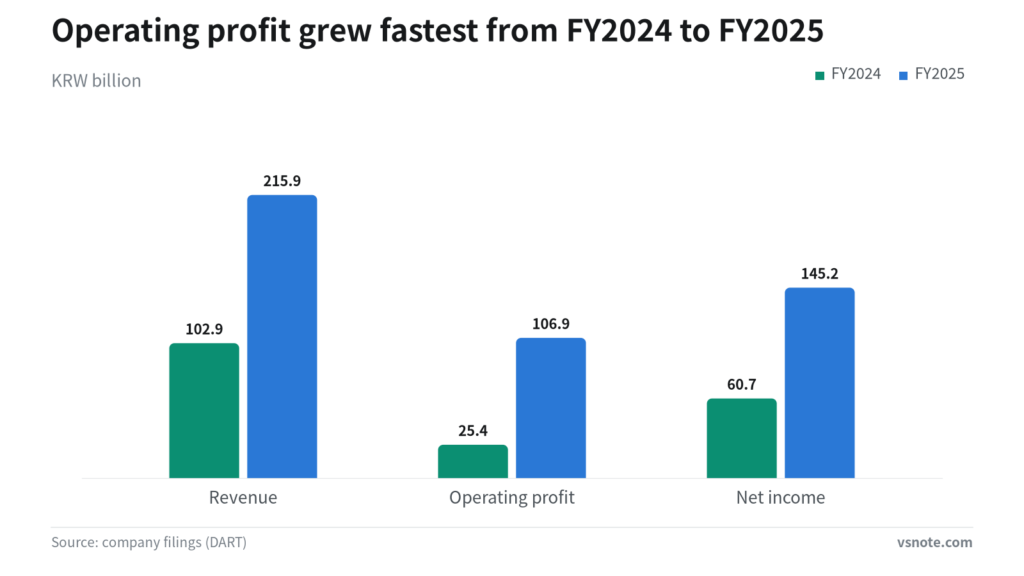
Technology service revenue made up 78.5% of FY2025 revenue. This is the line in the filings that holds income from licensing ALT-B4 and related deals. That income comes with events such as signings, option exercises and milestones, so each year’s total depends on how many of those events happen in it.
A large share of this income is earned abroad. The filings record the export part of technology service revenue in US currency for both years. The Korean-currency figures above can therefore also reflect exchange-rate movements.
Are more IV drugs moving to under-the-skin versions?
Alteogen’s income depends on partners’ drugs being converted and sold. So the real demand question is how far IV drugs move to SC versions and how well those versions sell. In the sources used here, Keytruda Qlex is the only case with sales data.
According to Korean media reports, MSD’s official figures for the first half of 2026 show Qlex sales were higher in the second quarter than in the first.
For July and August, Alteogen published its own estimate based on Bloomberg wholesale acquisition cost (WAC) data. WAC is a list-price measure, not reported sales. On that basis, August was about 14.3% above July, and Qlex was reported at 12.7% of the Keytruda franchise.
Adding MSD’s first-half figure to Alteogen’s WAC estimate gives a January–August total. But that total mixes an official sales report with a list-price estimate.
The next products in line are analysts’ views, not results. Securities-industry analysis says several Novartis drug types in development, including antibodies and ADCs (antibody-drug conjugates), are in late-stage clinical trials. Hana Securities says three AOC (antibody-oligonucleotide conjugate) treatments in the Novartis deal are due to launch one after another from 2027.
Because the reports say the sales milestone conditions are not public, Qlex sales figures cannot be matched to specific payments to Alteogen. Two things show how this area is developing: partners’ reported sales of converted drugs, and news of option exercises.
Frequently asked questions
Q. Is Keytruda Qlex an Alteogen product?
A. No. It is MSD’s drug, and it uses Alteogen’s ALT-B4 technology. According to Korean media reports, it was the first commercial product to use ALT-B4. Alteogen earns from it through payments in its contract, such as sales milestones.
Q. Will Alteogen receive the full reported value of the Novartis deal?
A. Not automatically. According to Korean media reports, the figure of up to about KRW 4.40 trillion (about $3.29 billion) assumes all options are exercised and all development and commercialization milestones are met. The money arrives product by product, as options are exercised and milestones are reached.
Q. Why did Alteogen’s profit change so much in FY2025?
A. The company’s annual report shows consolidated operating profit of KRW 106.9 billion (about $80 million) in FY2025, compared with KRW 25.4 billion (about $19 million) in FY2024. Most of its revenue is licensing income that comes with events such as signings, option exercises and milestones, so results can move sharply from one year to the next.
Q. Where does Alteogen file its reports, and what is the ’18th fiscal period’?
A. Alteogen is listed on KOSDAQ under ticker 196170 and files its disclosures on DART, Korea’s electronic disclosure system run by the Financial Supervisory Service. Korean filings number fiscal years in sequence: the 18th period is FY2025 and the 17th is FY2024.
Q. What triggers a Keytruda Qlex sales milestone?
A. According to Korean media reports, MSD and Alteogen have not made the detailed conditions public. The first sales milestone arose on August 31, 2026. Any estimate of the sales level behind it came from Hana Securities, not from the contract.
Sources
- https://dart.fss.or.kr/dsaf001/main.do?rcpNo=20260323001596
- https://blog.naver.com/infomoney_blog/224408857526
- https://blog.naver.com/briefory/224407738775
- https://www.sisajournal-e.com/news/articleView.html?idxno=423619
- https://www.huffingtonpost.kr/article/260360
This article explains company filings and published figures for information only. It is not investment advice or a recommendation to buy or sell any security. Figures can change after publication — check the original filings before making decisions.