Doosan Enerbility, an affiliate of Korea’s Doosan Group, designs, fabricates and installs the large equipment that sits inside a power plant. Its shares are listed on the KOSPI, the main board of the Korea Exchange, under ticker 034020. (Korea’s second board is the KOSDAQ.)
It does not sell to consumers. Its buyers are the organisations that build power stations — in Korea, the company’s own filings measure its domestic position against equipment ordered by Korea Electric Power Corporation, Korea Hydro & Nuclear Power and independent power producers, and it also works for owners abroad.
The useful way to hold the company in mind is not “a nuclear company” but a made-to-order workshop for very heavy things: the party that designs the plant and the party that cuts the metal are not the same, and the day a contract is signed is not the day the piece is handed over. That gap is why order headlines and the income statement do not move at the same speed.
DOOSAN ENERBILITY CO., LTD. (두산에너빌리티) · KRX: 034020 · KOSPI
Won amounts are converted at ₩1,338.2 per US dollar (Bank of Korea ECOS, KRW/USD base rate, 2026-09-11) for scale only.
Which part of a power plant the company makes
The company’s annual report describes a business that designs, manufactures and services power generation equipment, including nuclear and combined-cycle plants, and that also takes on EPC work — contracts in which one company handles engineering, procurement of materials and construction as a single package.
The items listed for the business are NSSS (the reactor and the steam-producing equipment at the heart of a nuclear plant), BOP (everything apart from that core equipment — the auxiliary systems that make the plant actually run), turbines, desalination and water-treatment facilities, castings and forgings, and plant installation.
Castings and forgings are a business in their own right: the company produces basic materials by casting and forging, which is the starting point for the heaviest components. It also builds renewable-energy equipment including offshore wind turbines.
In nuclear specifically, the equipment industry is the business of producing and supplying a plant’s principal apparatus — reactors, steam generators and the like, often grouped as “main equipment.” The company is described as holding the technology and the production facilities to fabricate reactors and steam generators for large reactors. It does not follow from any of this that it designs reactor types; it makes the hardware.
Outside nuclear, the company developed its own large gas turbine for power generation and has built a product line running from small to large units. Korean media accounts describe the first gas turbine built in Korea as Doosan’s.
According to Korean media reports, its plant business spans three things at once: manufacturing plant equipment, providing plant services, and plant engineering and construction. In wind, it is reported to take part across the value chain — turbine supply, project development, equipment, EPC and maintenance.
One name-level distinction is worth fixing early, because the news flow blurs it. TerraPower, NuScale Power and X-energy appear in stories about this company as counterparties it has built cooperative relationships with — they are partners, not parts of it.
Two market-share numbers, measured with two different rulers
Korean filings label fiscal periods by count rather than by calendar year, so the annual report speaks of the 61st, 62nd and 63rd fiscal years. With a December year-end, those are FY2023, FY2024 and FY2025. In FY2025, the company’s disclosed share of the domestic nuclear main-equipment market was 100%.
That was not a one-period result: the filing shows the same 100% for FY2023, FY2024 and FY2025 alike.
The overseas figure sits in the same disclosure and looks nothing like it. For FY2025, the company’s overseas nuclear market share is given as 3.0%.
The two numbers are not in conflict, because they are not measured the same way. The domestic share counts main equipment ordered by Korea Electric Power Corporation, Korea Hydro & Nuclear Power and independent power producers. The overseas share is calculated on new nuclear units by country over roughly the past ten years, including units under construction.
Read alone, the first number says “sole supplier at home” and the second says “small presence abroad.” Both are true of different questions, and the company’s disclosure keeps them side by side. Market share is also broken out by segment — power generation equipment and desalination equipment are disclosed separately.
Korean media coverage places the company in the domestic nuclear value chain as a reactor and main-equipment firm, and separately as an SMR firm. It is reported to be able to supply main equipment for large reactors, and to produce gas turbines in the 380MW class.
What it takes to make the same things
If one company supplies all the domestic nuclear main equipment, the obvious question is what keeps the position. The annual report answers it directly, in the company’s own words: the core competitive factors in power plant EPC, equipment and services are product technology, competitive manufacturing capability, and the supply chain that supports it.
Nuclear equipment carries a very high quality requirement. Meeting it, the filing says, requires design, materials, welding, machining and assembly capability — a set of skills that has to exist together, not separately.
The broader power equipment industry divides into nuclear plant equipment, combined-cycle equipment and offshore wind turbines. Of these, the nuclear equipment industry is described as having large ripple effects on upstream and downstream industries, requiring long-term technology development and large-scale investment, and being fostered strategically at the national level.
Put together, the dividing line in this business is capability rather than price: whether a shop can make the part at all. The filings cited here do not name any domestic or overseas competitor, so who else clears that bar is not something this material settles.
The same capability framing extends to newer work. The company is developing technology to burn hydrogen mixed into gas turbine fuel and to extend that toward firing on hydrogen alone.
Revenue up, profit down
The figures that follow are consolidated — parent and subsidiaries combined. Korean issuers also file separate, or standalone, statements covering the parent alone; the two sets are different numbers, and everything here is the consolidated set.
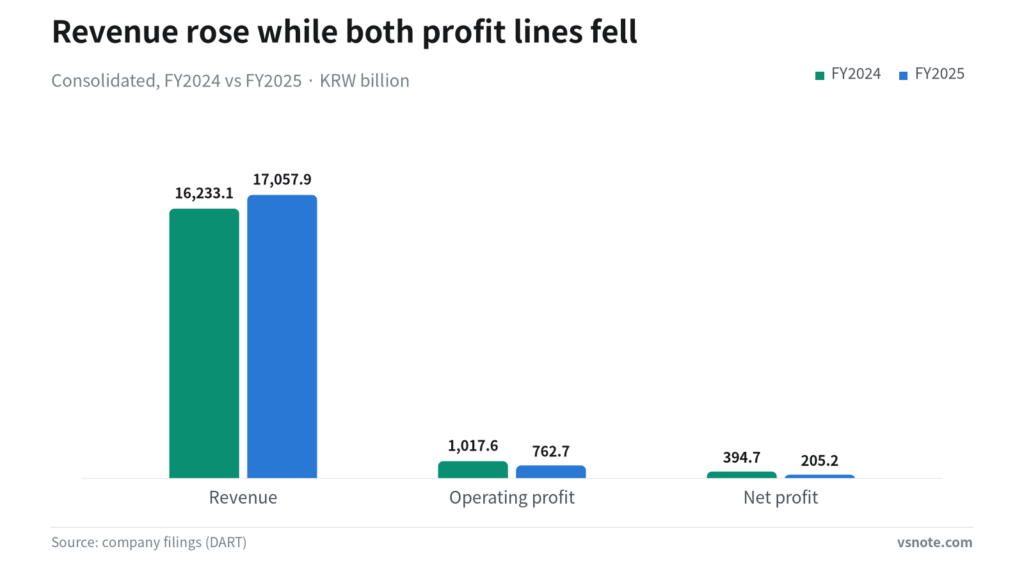
Consolidated revenue in FY2025 was KRW 17.06 trillion (about $12.75 billion), up from KRW 16.23 trillion (about $12.13 billion) in FY2024.
Operating profit moved the other way, from KRW 1.02 trillion (about $760 million) in FY2024 to KRW 762.7 billion (about $570 million) in FY2025. Net profit fell from KRW 394.7 billion (about $295 million) to KRW 205.2 billion (about $153 million) over the same two periods.
Set those earnings against the balance sheet and the shape of the business shows. Total consolidated assets were KRW 27.51 trillion (about $20.56 billion) at the end of FY2025, against KRW 26.31 trillion (about $19.66 billion) a period earlier — a very large asset base carrying a comparatively thin profit.
This is where the workshop image breaks down. A workshop with no orders can simply fold up the bench; a company of this kind carries its plants and heavy machining capacity whether or not the order book is full.
The filings cited here do not give the company’s explanation for the decline in profit, so the cause is not something this article can supply.
The direction did not hold. According to Korean media reports, first-half 2026 revenue rose about 8% against the same period a year earlier and operating profit rose by more than 32%. Those reports point to the half-year report as of June 2026 filed with DART, Korea’s electronic disclosure system run by the Financial Supervisory Service, where Korean issuers lodge their statutory filings.
Two years in one direction and a half-year in the other: one or two years of figures do not settle what this company earns across a cycle.
What stands between an order and an earnings line
The bridge between the news flow and the income statement is the order backlog: work that has been contracted but not yet built and handed over, and therefore not yet recognised as revenue. According to Korean media reports, the backlog stood at KRW 26.40 trillion (about $19.73 billion) at the end of the first half of 2026.
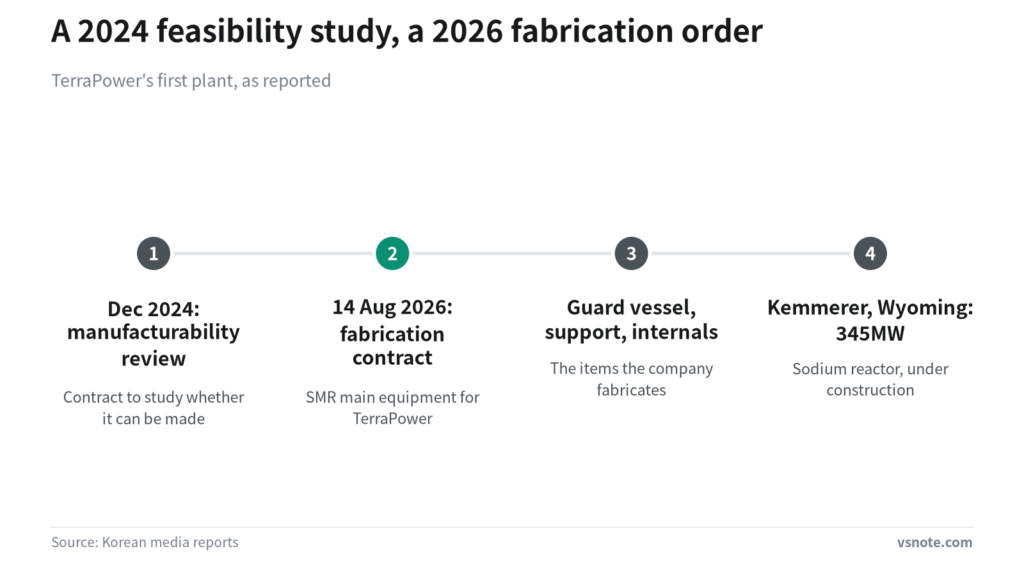
Recent contracts show the timeline involved. Korean media reports say that on 14 August 2026 the company signed a contract with TerraPower to fabricate main equipment for an SMR — a small modular reactor, built in factory-made modules and shipped to site rather than assembled wholly in place.
The same reports describe the scope: equipment for TerraPower’s first plant, under construction in Kemmerer, Wyoming, in the United States. The items are the reactor guard vessel, the reactor support structure and the reactor internals, applied to TerraPower’s sodium reactor. The Kemmerer project is reported at 345MW.
That contract did not appear from nowhere. The cooperation is reported to have begun in December 2024 with a contract to review whether the first unit’s key equipment could be manufactured at all — a study, years before the fabrication order.
Two other contracts are reported in the same window: on 21 August 2026, a construction contract for the Misfah combined-cycle power plant in Oman, and on 27 July 2026, a contract to supply key materials for units 5 and 6 of the Laiyang nuclear plant in China.
For all three, the sources cited here give neither contract values nor when any of the work would be recognised as revenue. That last step — from a signed order to a line in the accounts — is the one the reader has to leave open.
On where demand is said to be coming from, Korean media reports say the Encinal gas-fired combined-cycle plant in Texas, at 6.3 to 6.4 gigawatts, was selected as the first project under Korea’s investment programme in the United States. The project is reported to be staged: about 1.4GW of gas turbine capacity by 2030, then sequential expansion toward 4.9GW of high-efficiency combined-cycle capacity once demand and economics are confirmed.
Writing about that project, Han Seung-hun, an analyst at Shinhan Securities, said in a report that if commercial operation of 1.4GW by 2030 is the target, ordering is likely to move early and to centre on gas turbines, which take a long time to procure. That is a statement about the project’s procurement sequence, not about any company’s order book.
Beyond Encinal, Korean media reports say a plan to build eight large nuclear plants in the United States is under review as a follow-on to the same investment programme. It is reported as under consideration; nothing in the material cited here says it has been decided.
Frequently asked questions
Q. Is Doosan Enerbility a nuclear company?
A. Only in part. Its annual report lists nuclear main equipment alongside turbines, BOP — the auxiliary systems outside the reactor island — desalination and water-treatment facilities, castings and forgings, and plant installation, plus EPC work where it handles engineering, procurement and construction together. It also makes offshore wind turbines and developed its own large gas turbine for power generation.
Q. Its filing shows 100% domestic nuclear main-equipment share and 3.0% overseas. How can both be true?
A. They measure different things. The 100% figure — reported for FY2023 through FY2025 — counts main equipment ordered by Korea Electric Power Corporation, Korea Hydro & Nuclear Power and independent power producers. The 3.0% figure, for FY2025, is calculated against new nuclear units by country over roughly the past decade, including units under construction.
Q. When a new order is announced, does it show up in revenue?
A. Not at signing. Contracted work that has not yet been built and delivered sits in the order backlog, which Korean media reports put at KRW 26.40 trillion (about $19.73 billion) at the end of the first half of 2026. For the 2026 contracts reported in Korean media — TerraPower, Oman and China — the sources cited here give no contract values and no revenue-recognition timing.
Q. What is the company’s relationship to TerraPower, NuScale Power and X-energy?
A. They are counterparties, not parts of the group. Korean media reports describe cooperative relationships built with NuScale Power and X-energy, and a contract signed with TerraPower in August 2026 to fabricate the reactor guard vessel, reactor support structure and reactor internals for its sodium reactor at Kemmerer, Wyoming.
Q. Where do these numbers come from, and which set should I read?
A. The financial and market-share figures here are from the company’s annual report; the company files with DART, Korea’s electronic disclosure system run by the Financial Supervisory Service, and is listed on the KOSPI under ticker 034020. Note two Korean conventions: fiscal periods are numbered rather than named by calendar year (here the 63rd is FY2025), and issuers file both consolidated statements and separate, parent-only statements — every figure in this article is consolidated.
Sources
- https://dart.fss.or.kr/dsaf001/main.do?rcpNo=20260320001246
- https://www.doosanenerbility.com/en
- https://blog.naver.com/iriad80/224407711147
- https://blog.naver.com/salimhae/224407696851
- https://blog.naver.com/jony97/224407004282
- https://blog.naver.com/ryuhongreoul/224406923554
- https://blog.naver.com/warmblack2024/224407142872
- https://blog.naver.com/onulsdaily/224407596295
- https://www.businesspost.co.kr/BP?command=article_view&num=446804
This article explains company filings and published figures for information only. It is not investment advice or a recommendation to buy or sell any security. Figures can change after publication — check the original filings before making decisions.