Every memory chip is built up from extremely thin layers of material laid down on a silicon wafer. Wonik IPS makes the machines that lay down those layers. Its customers are chipmakers, and it also sells equipment to display and solar cell factories.
The company is listed on KOSDAQ, the Korean exchange’s market for growth and technology companies, which is separate from the main KOSPI board. Its ticker is 240810.
Its name often comes up in Korean coverage of Samsung Electronics’ earnings. This article explains what the company sells, who buys it, how large its FY2025 business was, and why a strong quarter at a chipmaker does not turn straight into equipment sales.
WONIK IPS CO., LTD. (원익아이피에스) · KRX: 240810 · KOSDAQ
Won amounts are converted at ₩1,339.2 per US dollar (Bank of Korea ECOS, KRW/USD base rate, 2026-10-08) for scale only.
What its machines do inside a chip plant
Wonik IPS makes and sells core manufacturing equipment for semiconductors, displays and solar cells. Its main field is semiconductor deposition, which means building a circuit layer by settling material onto a wafer surface one very thin film at a time.
Think of deposition as putting very thin coats of paint on a wall, again and again. Wonik IPS does not sell the paint. It sells the machine that applies the coats.
The comparison only goes so far. Real deposition does not involve brushing on a liquid. Gas settles onto the surface inside a vacuum chamber, building films only a few atoms thick. A single chip also contains many films of different materials, stacked over and over.
Its core products are CVD and ALD equipment. CVD (chemical vapour deposition) forms a film when gases react on the wafer. ALD (atomic layer deposition) builds the film one atomic layer at a time, which gives finer control over thickness.
- Semiconductor manufacturing equipment, mainly deposition (CVD, ALD)
- Display manufacturing equipment
- Solar cell manufacturing equipment
Where it sits in the chipmaking chain
Chipmaking runs in stages. Materials suppliers provide wafers, gases and chemicals. Equipment makers build the machines that process them. Chipmakers run those machines in their fabs to make chips, and the chips end up in servers, phones and other devices.
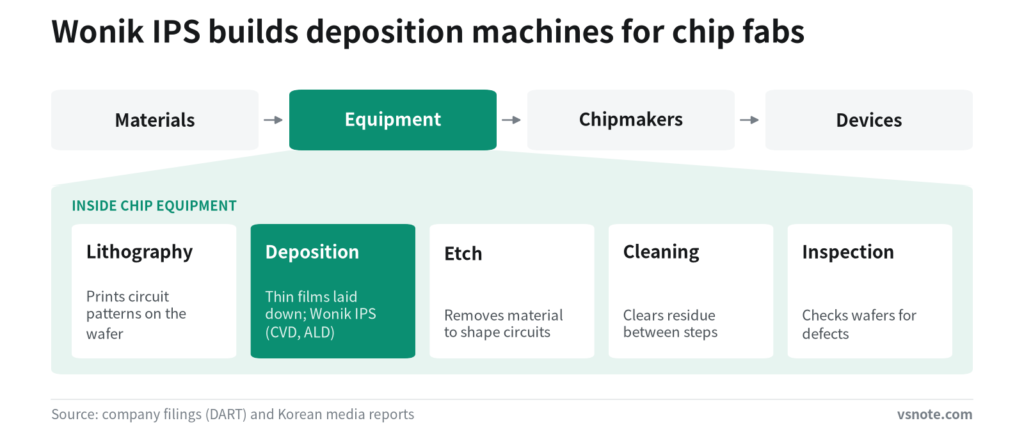
Wonik IPS works at the equipment stage, specifically deposition. According to Korean media reports, it supplies equipment to the semiconductor division of Samsung Electronics, known as Device Solutions (DS).
In Korean financial media, companies like this are grouped as “sobujang”, a short form for materials, parts and equipment suppliers to manufacturers. That is the label the company usually carries in Samsung-related news.
The company’s annual report says US, Japanese and Dutch companies hold high shares of the global semiconductor equipment market. The same report describes Wonik IPS as one of the Korean equipment makers that have localised key semiconductor equipment, meaning they produce in Korea machines that chipmakers used to import. It adds that Korea’s localisation rate for chip equipment is gradually rising.
The filings and reports cited here give no market share figures for Wonik IPS or its competitors in deposition equipment.
Reading the numbers of a company that mostly sells machines
The figures below come from the company’s annual report, filed on DART, the electronic disclosure system run by Korea’s Financial Supervisory Service. Korean companies number their fiscal years from incorporation. For Wonik IPS, the 10th fiscal period is FY2025 and the 9th is FY2024. All figures are consolidated, meaning the parent company and its subsidiaries are combined, as opposed to the separate (standalone) figures for the parent alone.
Consolidated revenue for FY2025 was KRW 909.8 billion (about $679 million), up 21.6% from KRW 748.2 billion (about $559 million) in FY2024.
Operating profit rose from KRW 10.6 billion (about $8 million) in FY2024 to KRW 73.8 billion (about $55 million) in FY2025. Net profit rose from KRW 20.7 billion (about $15 million) to KRW 84.0 billion (about $63 million).
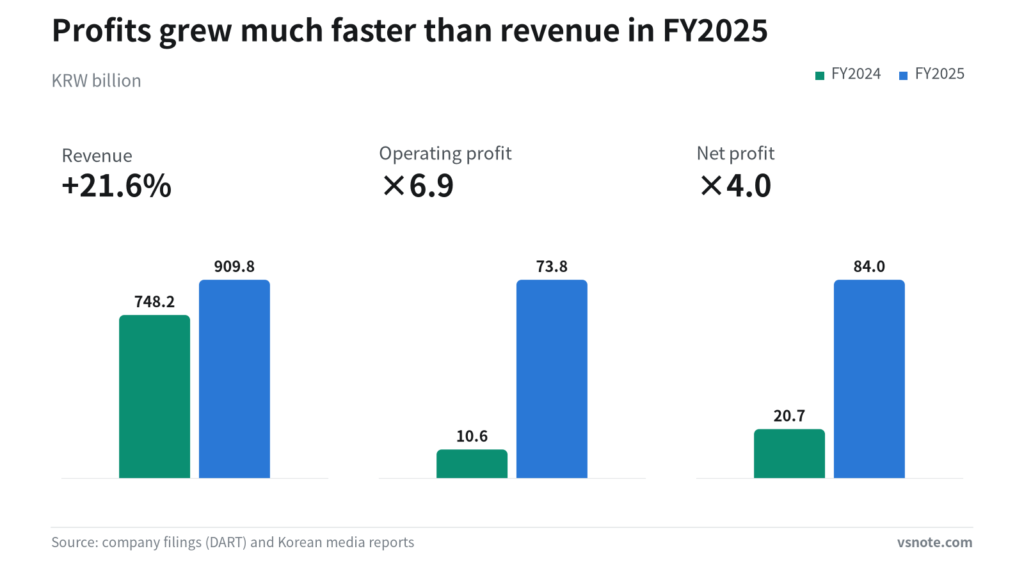
Net profit was larger than operating profit in FY2025. The filing excerpts cited here do not explain why.
Product sales, meaning machines the company builds itself, were KRW 786.6 billion (about $587 million) in FY2025, or 86.5% of revenue. The rest, KRW 123.2 billion (about $92 million), came from goods and services: items bought in and resold, plus work such as servicing installed equipment.
Because most revenue comes from selling machines, these numbers depend on customers deciding to buy equipment. When chipmakers add capacity, product sales rise. When they hold back, product sales fall.
The company reports a single business segment. It says that because it makes all its products at the same limited sites with the same equipment and staff, its business cannot easily be split. As a result, outsiders cannot see how much revenue comes from semiconductors, displays or solar cells.
Does a big Samsung quarter mean more machine orders?
The company’s annual report says the semiconductor equipment industry moves with the growth of its downstream market, the chip industry. So a link to Samsung exists, but it is indirect.
According to Korean media reports, Samsung Electronics announced preliminary results for the third quarter of 2026 on 8 October 2026, with operating profit of KRW 107.40 trillion (about $80.20 billion). The reports describe this as the first time a Korean company’s quarterly operating profit went above KRW 100.00 trillion (about $74.67 billion).
The same reports say the semiconductor division drove the result. The main reason cited was higher DRAM and NAND flash prices as demand for AI servers grew. The reports also say Samsung’s sales of HBM4 for Nvidia’s Vera Rubin platform start to show up from that quarter. HBM (high-bandwidth memory) is stacked DRAM placed next to AI processors to feed them data quickly.
Profit earned from higher chip prices does not become an equipment order by itself. In between, the chipmaker has to decide to expand or upgrade its fabs, the moment in the paint analogy when the owner decides to paint a new room.
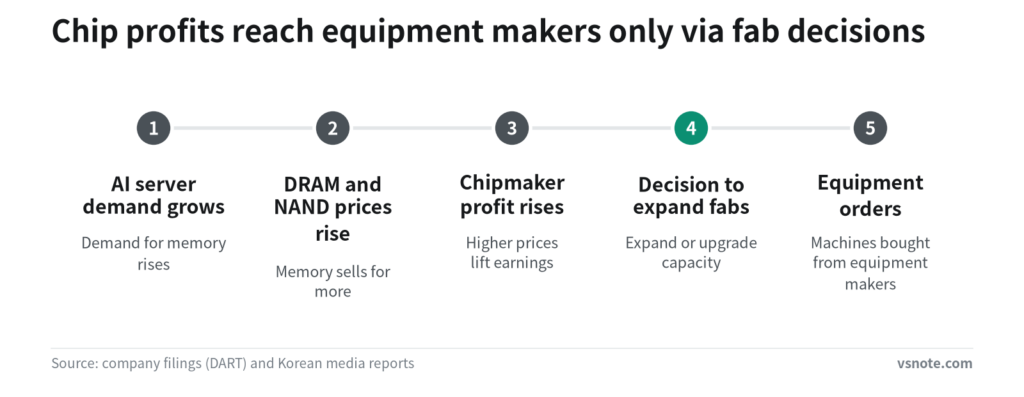
The filings and reports cited here do not show Wonik IPS’s order backlog, its revenue by customer, or any Samsung decision to expand capacity. Those are the facts to look for in the next round of news about Samsung’s capital spending.
Frequently asked questions
Q. What does Wonik IPS actually make?
A. Manufacturing equipment for semiconductors, displays and solar cells. Its main products are deposition machines, specifically CVD and ALD equipment, which lay thin films of material onto wafers.
Q. Is Wonik IPS a Samsung supplier?
A. According to Korean media reports, it supplies equipment to Samsung Electronics’ semiconductor (DS) division. The filings cited here do not show what share of its revenue comes from Samsung.
Q. How large was the business in FY2025?
A. The company’s annual report shows FY2025 consolidated revenue of KRW 909.8 billion (about $679 million), up 21.6% from the prior year, and operating profit of KRW 73.8 billion (about $55 million). Products the company builds itself made up 86.5% of revenue.
Q. Why can’t I see revenue split between chips, displays and solar?
A. The company reports one business segment. It says its products are made at the same sites with the same equipment and staff, so it does not split them.
Q. Where are the company’s filings?
A. On DART, Korea’s electronic disclosure system run by the Financial Supervisory Service. Annual reports use fiscal period numbers: for this company, the 10th period is FY2025.
Sources
- https://dart.fss.or.kr/dsaf001/main.do?rcpNo=20260316001453
- https://blog.naver.com/kodlandman2026/224434886191
- https://blog.naver.com/sorak0131/224434918891
- https://blog.naver.com/jicprid/224432676426
- https://blog.naver.com/jsc415/224435472234
This article explains company filings and published figures for information only. It is not investment advice or a recommendation to buy or sell any security. Figures can change after publication — check the original filings before making decisions.