Category: Batteries

Korean battery makers and their supply chain, explained from their regulatory filings.

  • Ecopro BM: what it makes and what its rights issue involves

    Ecopro BM: what it makes and what its rights issue involves

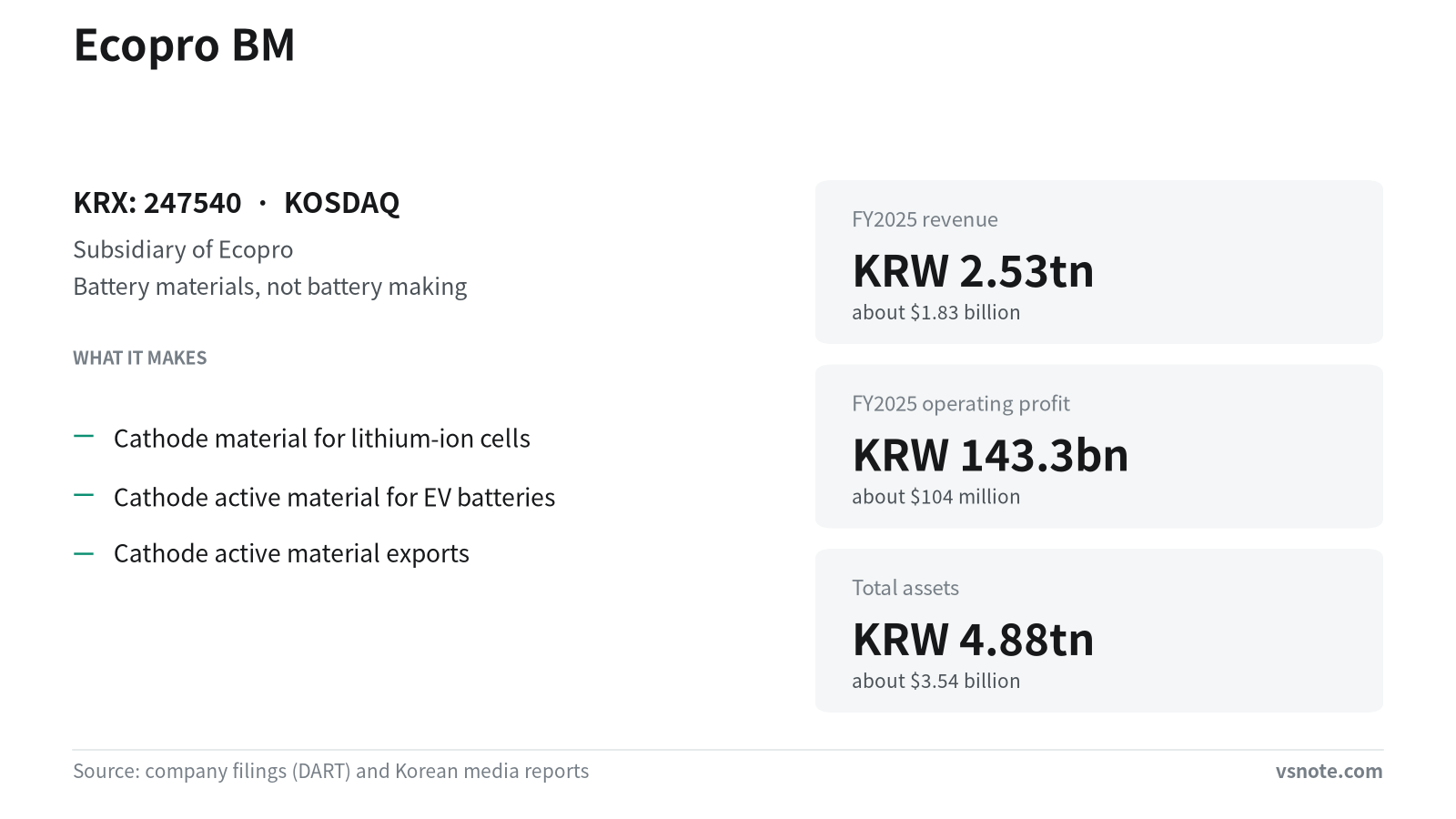
    Ecopro BM develops and produces cathode material — the cathode active material that goes inside a lithium-ion rechargeable cell. It is a battery materials business, not a battery maker: it sells one of the cell’s key materials to the companies that assemble cells.

    The shares trade on KOSDAQ, one of the two main boards of the Korea Exchange alongside KOSPI, under ticker 247540.

    The company is also in the middle of a rights offering, which is why holders may see an unfamiliar second line, Ecopro BM 18R, sitting in their accounts next to the shares. This article covers where the company sits in the battery chain, what its FY2025 figures show, and what the offering does.

    ECOPRO BM CO.,LTD. (에코프로비엠) · KRX: 247540 · KOSDAQ

    Won amounts are converted at ₩1,380.3 per US dollar (Bank of Korea ECOS, KRW/USD base rate, 2026-09-18) for scale only.


    What a cathode material maker actually sells

    A lithium-ion cell is built from four key materials. The cathode is the component with the high charge and discharge voltage; the anode is the component with the low charge and discharge voltage; the electrolyte is the medium through which lithium ions move; and the separator is there to prevent an electrical short.

    Battery manufacturers either buy those key materials or produce them in-house, and then build the cell. The finished cells go on to IT, automotive and energy companies.

    Ecopro BM occupies one of those four slots. It develops and produces the cathode material used in electric-vehicle batteries and hands it to the companies that make the cells — so the customers named in its own sales are battery makers, not carmakers or device brands.


    Why several companies are called Ecopro

    Searching the name turns up a cluster of similar ones, and that is not coincidence: the group splits the process into separate companies. Ecopro is the group’s holding company and Ecopro BM is its subsidiary.

    Ecopro Materials handles precursor — the intermediate compound that is processed further into cathode material. Ecopro Innovation handles lithium processing, and Ecopro AP supplies the industrial gases, such as oxygen and nitrogen, used in the production process.
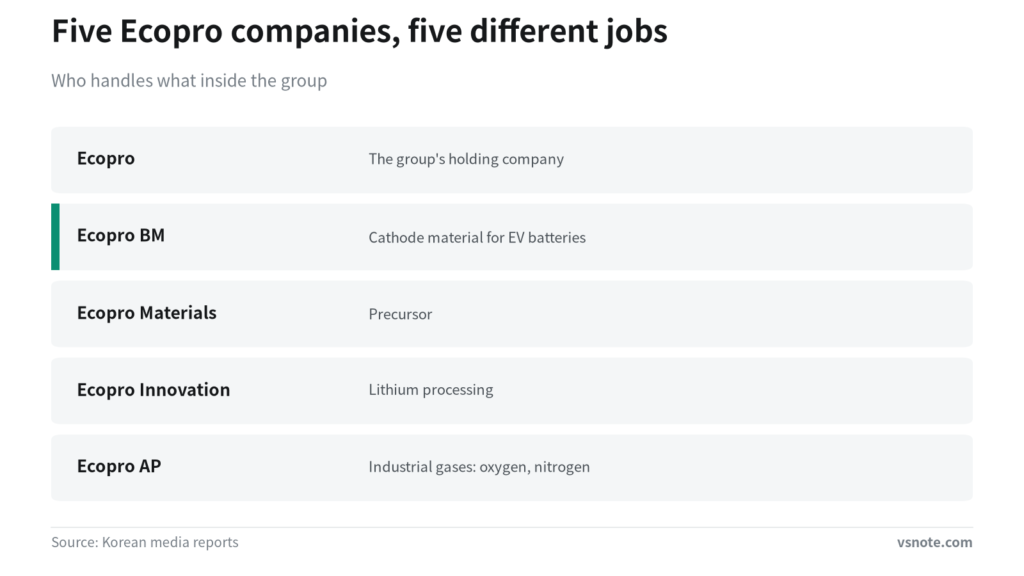
    Five Ecopro group companies listed with what each handles: holding company, cathode material, precursor, lithium processing and industrial gases.

    That places Ecopro BM downstream of the precursor and lithium steps and upstream of the cell makers, with cathode active material exports appearing among its consolidated sales items.

    Readers usually want a market share figure at this point. The filings and reports cited here do not show one, so the company’s position is described only by what sits on either side of it in the chain.


    Revenue down, operating profit back in the black

    Korean companies file their annual reports through DART, the electronic disclosure system run by the Financial Supervisory Service, and they number their fiscal years from incorporation. The company’s 10th fiscal period is 2025.

    The annual report shows consolidated revenue for FY2025 of KRW 2.53 trillion (about $1.83 billion), down from KRW 2.77 trillion (about $2.00 billion) in the preceding period.

    Operating profit moved the other way, to KRW 143.3 billion (about $104 million) from KRW -34.1 billion (about -$25 million). Net profit followed, at KRW 91.6 billion (about $66 million) against KRW -58.5 billion (about -$42 million) a year earlier.

    Total assets stood at KRW 4.88 trillion (about $3.54 billion), up from KRW 4.32 trillion (about $3.13 billion).

    What the disclosure establishes is the direction of each line: sales fell while profit turned positive. Whether that swing came from volumes or from costs and selling prices is not something these figures separate out.


    Why shareholders are being asked to buy new shares

    The company announced a rights offering to fund facility spending, working capital and the acquisition of securities in other companies. According to Korean media reports, the size was subsequently cut, and the facility and working-capital uses were removed from the stated plan, leaving about KRW 886.1 billion (about $642 million) for the acquisition of securities in other companies; net proceeds are put at roughly KRW 881.6 billion (about $639 million).

    For scale, the same reports can be read against the annual report: FY2025 net profit of KRW 91.6 billion (about $66 million) and total assets of KRW 4.88 trillion (about $3.54 billion).

    The structure is a rights offering to existing shareholders, with any shares left unsubscribed then offered to the general public. Reports put the issue at 9,900,990 new shares; the allotment ratio per share held on the record date is fixed in the filing.

    Those rights arrive in the account as a separate listed line with its own ticker, distinct from 247540 — the certificate shown as Ecopro BM 18R. It can be sold during its trading window or used to subscribe; if a holder does neither, the right lapses and is extinguished.

    The dates that govern all of this — when the certificates trade, when the issue price is fixed, when subscription and payment fall due — are set out in the securities registration statement the company filed on DART on 2 September 2026, and in the correction filing that revised the indicative price downward. Anyone acting on the offering should read those filings rather than a summary.


    Where the money is pointed, and what the rating agencies did

    According to the prospectus dated 2 September 2026 as reported in Korean media, about KRW 765.0 billion (about $554 million) of the proceeds is earmarked for an investment in BNSI, an Indonesian smelter that processes nickel into battery raw material. That is roughly 86% of the stated use of funds.

    The money is to go into a special-purpose vehicle — a company set up solely to hold the stake — and the precise mix of equity injection and lending is reported as not yet fixed.

    The remaining KRW 121.1 billion (about $88 million) is allocated to the company’s Hungarian entity. The company said on 24 August 2026 that it had begun converting a line at the Hungarian plant, with a plan to supply material for European premium electric vehicles from the fourth quarter of 2027; reports described the intended customer as a German automaker. That plan is pending.

    Alongside that, reports record rating actions on the parent. Korea Ratings lowered Ecopro’s unsecured bond rating one notch in June 2025, from A- with a negative outlook to BBB+ with a stable outlook, and NICE Investors Service in August 2026 kept the rating at A- while moving the outlook from stable to negative.

    The same reports put Ecopro’s net debt as having risen from KRW 2.20 trillion (about $1.59 billion) to KRW 3.21 trillion (about $2.32 billion), and note that its last public bond market raise was KRW 40.0 billion (about $29 million) in February 2026.

    On 2 September 2026, Ecopro is reported to have issued KRW 95.0 billion (about $69 million) of unsecured private placement notes: KRW 38.0 billion (about $28 million) of 18-month paper at 5.6% and KRW 57.0 billion (about $41 million) of two-year paper at 6.5%.

    Those are the two disclosed records that sit side by side — where the company is committing capital, and how the agencies have marked the parent’s funding position.


    Frequently asked questions

    Q. Does Ecopro BM manufacture batteries?

    A. No. It develops and produces cathode material, one of the four key materials in a lithium-ion cell, and supplies it to battery manufacturers. Those manufacturers buy or make the key materials, build the cells, and sell them on to IT, automotive and energy companies.

    Q. What is the difference between Ecopro and Ecopro BM?

    A. Ecopro is the group’s holding company and Ecopro BM is its subsidiary. Within the group, Ecopro Materials handles precursor, Ecopro Innovation handles lithium processing, Ecopro AP supplies industrial gases for the production process, and Ecopro BM makes the cathode material.

    Q. What is the Ecopro BM 18R line that appears next to the shares?

    A. It is the subscription-rights certificate from the rights offering, carried under its own ticker separate from 247540. A certificate like this can be sold while it trades or used to subscribe for the new shares; a right that is neither sold nor exercised lapses. The trading window, the subscription dates and the final price are set in the company’s securities registration statement on DART.

    Q. What is the money being raised for?

    A. The remaining stated purpose is the acquisition of securities in other companies. Korean media reports put the amount at about KRW 886.1 billion (about $642 million), of which roughly 86%, or about KRW 765.0 billion (about $554 million), is allocated to an investment in BNSI, an Indonesian nickel smelter, through a special-purpose vehicle whose equity-and-loan structure is reported as not yet settled; about KRW 121.1 billion (about $88 million) goes to the Hungarian entity. Facility and working-capital uses were deleted from the plan when the size was reduced.

    Q. Do the credit rating changes apply to Ecopro BM itself?

    A. The rating actions described in the reports cited here are on Ecopro, the parent. Korea Ratings moved its unsecured bond rating from A- with a negative outlook to BBB+ with a stable outlook in June 2025, and NICE Investors Service kept A- in August 2026 while changing the outlook to negative.


    Sources

    • https://dart.fss.or.kr/dsaf001/main.do?rcpNo=20260318001622
    • https://blog.naver.com/qrator_bin/224404448490
    • https://blog.naver.com/agentverse/224414588234
    • https://blog.naver.com/h-y-e/224412932187
    • https://blog.naver.com/frimanlo/224413660565
    • https://blog.naver.com/s_note1/224411837381
    • https://blog.naver.com/globalesg/224412357008
    • https://dealsite.co.kr/articles/168918

    This article explains company filings and published figures for information only. It is not investment advice or a recommendation to buy or sell any security. Figures can change after publication — check the original filings before making decisions.

  • LG Energy Solution: what it makes and who orders it

    LG Energy Solution: what it makes and who orders it

    LG Energy Solution makes rechargeable battery cells — cells built to be charged and used again rather than thrown away after one use — for electric vehicles, energy storage systems, IT devices, power tools and light electric vehicles. It is listed on the KOSPI, the main board of Korea Exchange, under ticker 373220.

    You cannot buy its product in a shop. The cells go inside somebody else’s finished product, which means the company’s customers are the carmakers and device makers that build those products, not consumers.

    The numbers in its FY2025 annual report do not all point the same way. Operating profit rose sharply while revenue, net income and the company’s own disclosed world share of EV batteries all fell. That mix is the reason the useful question about this company is not how much it earned, but who places the orders.

    LG ENERGY SOLUTION, LTD. (엘지에너지솔루션) · KRX: 373220 · KOSPI

    Won amounts are converted at ₩1,338.2 per US dollar (Bank of Korea ECOS, KRW/USD base rate, 2026-09-11) for scale only.


    What the company makes, and whose product it ends up in

    The company researches, develops and manufactures battery products used in electric vehicles (EV), energy storage systems (ESS — large installed batteries that take in electricity and release it later), IT devices, power tools and light electric vehicles (LEV).

    Its Energy Solution division lists three main products: batteries for EVs, batteries for ESS, and batteries for small applications.

    Making these cells is an engineering business rather than a consumer one. The company’s annual report describes the industry as requiring chemical, electrical and mechanical engineering — the blending of materials including cathode material, anode material and electrolyte, and the structural design of electrodes and of the battery cell itself.

    The performance elements the report ties to end-user needs are energy density, output, charging time, low-temperature behaviour and safety. Those are the specifications a buyer of cells argues about.

    The report also states that developing battery technology for a sustainable future is the company’s core strategy, and that in part of its business the company delivers according to the production plans of the automakers it supplies. That last line is the structural fact the rest of this article keeps returning to.

    All the filing figures here come from the company’s annual report submitted to DART, Korea’s electronic disclosure system operated by the Financial Supervisory Service, where Korean listed companies file their reports in full.


    Its own filed share of the world’s EV batteries, across three periods

    Korean filings number fiscal years in sequence from a company’s incorporation rather than by calendar year, so the annual report calls its years the fourth, fifth and sixth fiscal periods. With a December year-end, those are FY2023, FY2024 and FY2025, and the company disclosed an EV battery world market share for each.

    The annual report shows 13.6% for FY2023, 10.8% for FY2024 and 9.2% for FY2025. Read in order, the share fell in each year.

    Bar chart of LG Energy Solution's disclosed world EV battery market share: 13.6% in FY2023, 10.8% in FY2024, 9.2% in FY2025.

    The figure is not the company’s own count. The report gives SNE Research as the data source and states the share is measured against the world market — that is, how much of the EV battery volume sold worldwide in a year was this company’s, as counted by an outside research firm.

    The report also dates the oldest of the three: the FY2023 share is an annual cumulative figure prepared from SNE Research data of January 2024.

    Who holds the rest of that world market is a separate question, and the filings cited here do not show it. What the filings do say is that supply volume is fluid — it moves with customers’ actual orders and with future market conditions.


    Operating profit up, net income down, in the same statements

    The figures below are consolidated — the parent company and its subsidiaries combined into one set of statements. Korean filings also carry separate (standalone) figures for the parent alone, and the two sets can differ substantially.

    On a consolidated basis, FY2025 revenue was KRW 23.67 trillion (about $17.69 billion), against KRW 25.62 trillion (about $19.14 billion) in FY2024.

    Operating profit went the other way, rising to KRW 1.35 trillion (about $1.01 billion) from KRW 575.4 billion (about $430 million) — more than double.

    Net income did not follow it. It came in at KRW 80.8 billion (about $60 million), against KRW 338.6 billion (about $253 million) in FY2024. So a headline about a swing in profit and a headline about shrinking earnings can both be describing this same report, one line apart.

    Grouped bar chart comparing consolidated revenue, operating profit and net income for FY2025 and FY2024.

    Total assets over the same comparison rose to KRW 67.15 trillion (about $50.18 billion) from KRW 60.31 trillion (about $45.07 billion). The filings cited here do not show, item by item, what happened between the operating line and the bottom line.

    On the balance-sheet pressure, according to Korean media reports, borrowings grew quickly as the company expanded, and its capital expenditure runs above EBITDA — meaning it spends more on building plants than its operations generate in cash.

    Those same reports carry a Korean credit rating agency’s warning on credit risk in the secondary battery industry: the industry’s swing into the black, in its view, is not a structural improvement.


    The used-battery pilot, and the boxes the coverage leaves empty

    Alongside the vehicle business, the company has an EaaS business unit inside its ESS division — a sign that storage is being sold as a service, not only as hardware.

    According to Korean media reports, the company is taking part in a demonstration project with Hyundai Motor, Kia, Hyundai Engineering and Wonik PNE that puts used EV batteries to work as energy storage. The batteries are used packs from Hyundai Motor Group’s E-GMP platform, and the site is Hwaseong, Gyeonggi Province.

    The build is a UBESS — a storage system assembled from used battery packs — of 200kWh in total, connected to an EV fast charger. The stated purpose is to store power in the used batteries and then draw on it for fast charging, confirming whether the batteries can be reused, and to spread out the electrical load at fast-charging stations, where demand arrives in concentrated bursts.

    The roles are split. The same reports say LG Energy Solution builds the UBESS from packs supplied by Hyundai Motor and Kia and, drawing on its battery diagnosis and operation capability, supports verification of the system’s performance and safety. Hyundai Motor and Kia pursue the technical validation and the business model; Hyundai Engineering examines commercial viability in a real operating environment and whether it can be linked to charging infrastructure rollout.

    Diagram of the four participants in the used-battery storage demonstration and the role each one takes.

    What the material cited here does not contain is as telling as what it does: no duration for the demonstration, no threshold for how much capacity a battery must retain to qualify, and no figure for whether the value of the stored electricity exceeds what it costs to install and run the system.

    Until those boxes are filled in, the cited material does not allow a reader to separate a demonstration from a business. They are the lines to look for in the next report on it.


    Who decides how much it builds

    The annual report is explicit about the mechanism. In part of its business the company delivers to automakers’ production plans, and its supply volume moves with customers’ actual orders and with future market conditions.

    That puts the first variable outside the company. How many cells it ships depends less on what it announces than on how many electric vehicles its customers decide to build.

    The second variable is how far batteries spread outside the car — the ESS, IT device, power tool and light-electric-vehicle applications the report lists, and the storage-as-a-service unit it has staffed.

    Whether that overall market grows or shrinks from here is not something the material cited in this article answers. There is no third-party market forecast in it, and this article does not supply one.


    Frequently asked questions

    Q. Where can I read these filings myself, and what does the fiscal period numbering mean?

    A. Korean listed companies file through DART, the electronic disclosure system operated by the Financial Supervisory Service. The annual report referenced here was filed on 2026-03-12. Korean reports label fiscal years by sequence from incorporation — fourth, fifth, sixth period — rather than by calendar year, so the labels have to be matched to years. In the annual report used here, the sixth period is FY2025.

    Q. Are the revenue and profit figures consolidated or standalone?

    A. The figures in this article are consolidated: the parent and its subsidiaries combined. Korean filings also present separate (standalone) statements covering the parent company alone, and for a group with overseas manufacturing the two sets are not interchangeable — check which basis a headline is using before comparing it with another.

    Q. Who calculated the EV battery market share, and on what basis?

    A. The company’s annual report gives SNE Research as the source and states the measurement is against the world market. The report also dates the oldest of the three disclosed shares: the FY2023 figure is an annual cumulative number prepared from SNE Research data of January 2024.

    Q. Is the second-life battery project a real revenue line?

    A. The material cited here does not allow that call. According to Korean media reports the demonstration is a 200kWh system built from used E-GMP packs in Hwaseong, Gyeonggi Province, connected to an EV fast charger, with the company building the system and supporting performance and safety verification. No demonstration period, no minimum remaining-capacity standard and no cost-versus-revenue figure appear in that coverage.

    Q. If I want to track this company, what should I actually watch?

    A. The filings say supply volume follows automakers’ production plans and customers’ actual orders, and moves with market conditions. That points the reader toward how many electric vehicles the company’s customers are building, and toward whether battery demand widens into the non-automotive applications the report lists, rather than toward the company’s own announcements.


    Sources

    • https://dart.fss.or.kr/dsaf001/main.do?rcpNo=20260312000217
    • https://www.ksilbo.co.kr/news/articleView.html?idxno=1067003
    • http://www.beyondpost.co.kr/view.php?ud=202609102308472847be44c0aacd_30
    • https://www.pinpointnews.co.kr/news/articleView.html?idxno=485967
    • https://www.lcnews.co.kr/news/articleView.html?idxno=208102
    • http://digitalchosun.dizzo.com/site/data/html_dir/2026/09/10/2026091080188.html
    • https://news.tf.co.kr/read/economy/2364588.htm
    • https://www.todayeconomic.com/news/article.html?no=32078
    • https://www.epnc.co.kr/news/articleView.html?idxno=406809
    • http://www.lkp.news/news/articleView.html?idxno=83943
    • https://www.pointdaily.co.kr/news/articleView.html?idxno=318836
    • https://www.ebn.co.kr/news/articleView.html?idxno=1723811

    This article explains company filings and published figures for information only. It is not investment advice or a recommendation to buy or sell any security. Figures can change after publication — check the original filings before making decisions.