LIG Defense&Aerospace is a South Korean defense manufacturer listed on KOSPI, the main board of the Korea Exchange, under ticker 079550. It traces its roots to Goldstar Precision Industries, founded in 1976.
It makes precision-guided weapons, surveillance and reconnaissance systems, command, control and communications equipment, avionics and electronic warfare equipment. Its best-known products are air defense systems: the missiles, radars and launchers that detect incoming missiles and aircraft and shoot them down.
Two of these are Cheongung, a medium-range system, and L-SAM, a long-range system. Each covers one layer of a country’s air defense network. The rest of this article follows from that: which layer the company sells, who it competes with for that layer, and why a new export contract is not the same thing as this year’s revenue.
LIG Defense&Aerospace Co., Ltd. (엘아이지디펜스앤에어로스페이스) · KRX: 079550 · KOSPI
Won amounts are converted at ₩1,353.3 per US dollar (Bank of Korea ECOS, KRW/USD base rate, 2026-09-16) for scale only.
What the company’s missiles are built to stop
The company’s annual report lists five business areas: precision-guided weapons, surveillance and reconnaissance, command, control and communications, avionics, and electronic warfare. Precision-guided munitions (PGM) are weapons that steer themselves onto a target after launch instead of flying a fixed path. The company reports PGM as a separate product line in its sales breakdown.
Its core business is exporting two air defense systems, Cheongung (medium range) and L-SAM (long range). L-SAM is described as covering upper-tier defense at altitudes of 40–60km.
Readers who know the name LIG Nex1 are looking at the same company. It was renamed LIG Defense&Aerospace, and Korean media reported the change at the end of March 2026 — after the FY2025 annual report was filed on March 23, which is why that report still carries the former name. The listing did not change: the same KRX ticker, 079550, and the same DART corporate registration.
Which layer it covers, and who buys it
The filings cited here do not give market shares. The company’s position is easier to judge on three points: which layer of air defense it supplies, who its customers are, and where it sits in the supply chain.
In the air defense network, Cheongung covers the medium-range layer and L-SAM the upper layer. According to Korean media reports, the company will take part in L-SAM mass production.
The company’s buyers are governments. It works with Korea’s Defense Acquisition Program Administration (the government agency that buys weapons), the Agency for Defense Development and the Defense Agency for Technology and Quality. Korean media report that Cheongung has already been exported to Saudi Arabia, Iraq and the UAE, and that other Middle Eastern countries, including Qatar, are seeking to buy it.
In the supply chain, the company buys parts and subassemblies from smaller suppliers and turns them into complete weapon systems. One supplier reportedly signed a contract to supply metal assembly parts and ten other items for the government’s Block-1 electronic warfare aircraft development program. Another listed supplier reportedly counts the company as a major customer that makes up 33% of its revenue.
Who it competes with, and who it works with
Competition in air defense happens layer by layer. According to Korean media reports, the Swiss government is running a program for a next-generation long-range ground-based air defense system, and L-SAM is competing against SAMP/T NG from Eurosam, a French-Italian joint venture.
Two outside factors reportedly shape that contest. Switzerland ordered five Patriot batteries from the United States in 2022, and deliveries have been delayed by 5–7 years. Reports also say the US-Iran war has left Patriot missiles in short supply.
Europe is also changing the rules for buying weapons. The EU reportedly requires at least 65% of component costs to be sourced from Europe or certain partner countries for a large defense lending program. Korean media report that the company is responding with local factories and joint ventures.
The Swiss Federal Council was reported to be due to decide the program’s direction by 18 September. The sources cited here do not include the outcome.
With Germany’s Rheinmetall, the relationship is a partnership in which each company covers a different layer. The two reportedly plan to enter NATO markets together by combining Rheinmetall’s very-short-range air defense with the company’s medium- and long-range systems. They are also reportedly developing a short-range air defense (SHORAD) system that pairs Rheinmetall’s Skyranger 30 with the company’s Singung system.
At home, bids have closed for the KF-21 fighter’s long-range air-to-air missile program, which is reportedly worth KRW 1.90 trillion (about $1.40 billion). Korean media report that the procurement agency is considering restricting the company’s eligibility to bid on government contracts over a bribery case involving executives. Under such a restriction, the company would be barred from government tenders for a set period. Reports say no sanction has been decided yet.
Revenue already earned versus orders still to deliver
Korean companies number their fiscal periods from their founding year. The company’s 24th period is FY2025 and its 23rd is FY2024. The figures below are consolidated, meaning they include subsidiaries. Korean filings also report separate (standalone) figures for the parent entity alone.
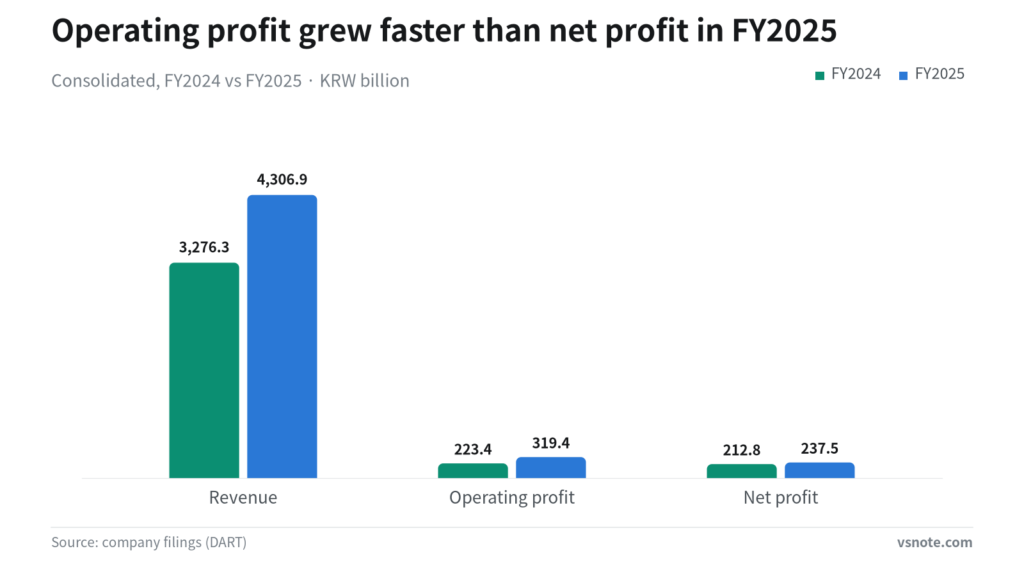
The annual report shows FY2025 consolidated revenue of KRW 4.31 trillion (about $3.18 billion), up from KRW 3.28 trillion (about $2.42 billion) in FY2024. Operating profit rose to KRW 319.4 billion (about $236 million) from KRW 223.4 billion (about $165 million).
Net profit was KRW 237.5 billion (about $175 million), compared with KRW 212.8 billion (about $157 million) a year earlier. Net profit rose less steeply than operating profit, and the filings cited here do not explain why.
These figures reflect weapons already delivered. Order backlog is different: it counts contracts the company has signed but not yet delivered, so it turns into revenue later.
According to Korean media reports, the company’s domestic order backlog is KRW 10.52 trillion (about $7.77 billion), or 43% of its total backlog. News of a new export contract therefore adds to backlog first. It does not show up in that year’s revenue right away.
Where rising air defense spending goes
The company’s filings define the defense industry as the production and development of goods a country needs for its military defense. In the broader sense, that includes non-combat supplies such as uniforms and field rations. Either way, demand ultimately comes from government budgets.
Korean media reports trace the growth of Korean defense exports. Export orders won by Korean defense companies ran at about $2.6 billion to $3.1 billion a year in 2016–2020, peaked at $17.3 billion in 2022, and were $15.4 billion last year. Korea Investors Service, a Korean credit rating agency, has said export competition for Korean defense companies has entered a new phase.
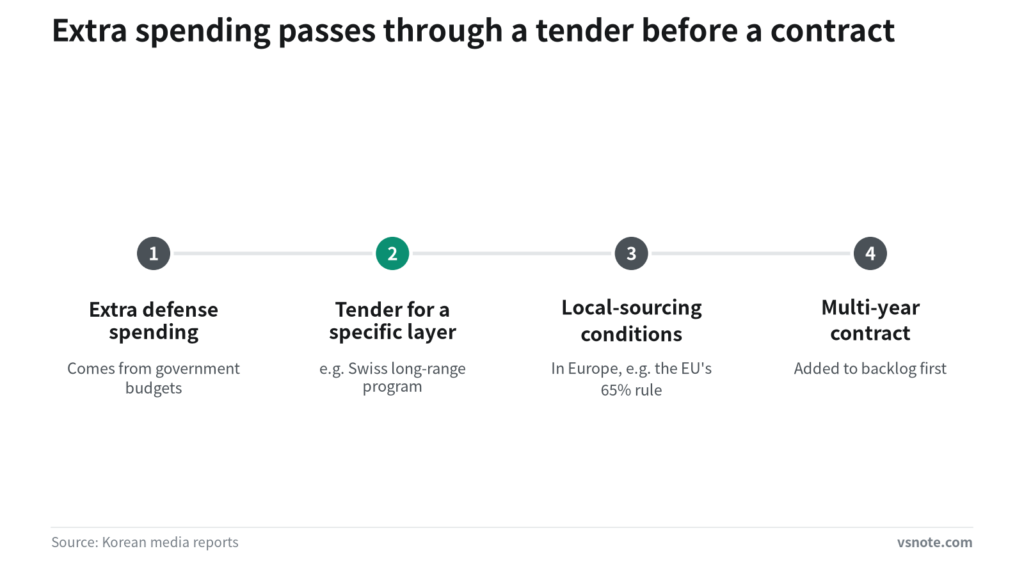
Extra spending does not reach a supplier directly. It passes through each government’s tenders for specific air defense layers and, in Europe, through local-sourcing conditions such as the EU’s 65% rule, before it becomes a multi-year contract.
According to Korean media reports, the company’s air defense exports to the Middle East are picking up, and it is pursuing European markets. It is also named as a company whose European prospects could grow depending on the Swiss long-range program.
Winning one layer does not mean supplying a country’s whole network. Other layers can go to other countries’ products, as the Rheinmetall pairing shows. Whether more spending turns into contracts for this company is left for readers to judge.
Frequently asked questions
Q. Is LIG Defense&Aerospace the same as LIG Nex1?
A. Yes. LIG Nex1 is the former name. Korean media reported the change at the end of March 2026, and the KRX ticker (079550) and DART registration are unchanged. The FY2025 annual report was filed on March 23, before the change, so it still uses the old name.
Q. What are Cheongung and L-SAM?
A. They are the company’s two main air defense systems. Cheongung covers the medium-range layer. L-SAM covers long-range, upper-tier defense and is described as operating at altitudes of 40–60km.
Q. Which countries have bought the company’s air defense systems?
A. According to Korean media reports, Cheongung has been exported to Saudi Arabia, Iraq and the UAE, and other Middle Eastern countries, including Qatar, are seeking to buy it.
Q. What is the procurement sanction issue?
A. According to Korean media reports, Korea’s Defense Acquisition Program Administration is considering restricting the company’s eligibility to bid on government contracts over a bribery case involving executives. Reports say no decision has been made.
Q. How large is the company’s order backlog?
A. Korean media report a domestic order backlog of KRW 10.52 trillion (about $7.77 billion), which is 43% of the total. Backlog is signed orders not yet delivered, so it is separate from reported revenue.
Sources
- https://dart.fss.or.kr/dsaf001/main.do?rcpNo=20260323001211
- https://www.thelec.kr/news/articleView.html?idxno=54362
- https://www.newsquest.co.kr/news/articleView.html?idxno=301069
- https://biz.newdaily.co.kr/site/data/html/2026/09/16/2026091600107.html
- https://blog.naver.com/foresttotree/224413895687
- http://www.wowtv.co.kr/NewsCenter/News/Read?articleId=A202609160262&t=NN
- https://dealsite.co.kr/articles/169078
- https://www.cnbizm.com/news/articleView.html?idxno=315228
- https://www.newsway.co.kr/news/view?ud=2026091515023765043
- https://www.bloter.net/news/articleView.html?idxno=673669
- https://theviewers.co.kr/View.aspx?No=4227155
This article explains company filings and published figures for information only. It is not investment advice or a recommendation to buy or sell any security. Figures can change after publication — check the original filings before making decisions.