Ecopro BM develops and produces cathode material — the cathode active material that goes inside a lithium-ion rechargeable cell. It is a battery materials business, not a battery maker: it sells one of the cell’s key materials to the companies that assemble cells.
The shares trade on KOSDAQ, one of the two main boards of the Korea Exchange alongside KOSPI, under ticker 247540.
The company is also in the middle of a rights offering, which is why holders may see an unfamiliar second line, Ecopro BM 18R, sitting in their accounts next to the shares. This article covers where the company sits in the battery chain, what its FY2025 figures show, and what the offering does.
ECOPRO BM CO.,LTD. (에코프로비엠) · KRX: 247540 · KOSDAQ
Won amounts are converted at ₩1,380.3 per US dollar (Bank of Korea ECOS, KRW/USD base rate, 2026-09-18) for scale only.
What a cathode material maker actually sells
A lithium-ion cell is built from four key materials. The cathode is the component with the high charge and discharge voltage; the anode is the component with the low charge and discharge voltage; the electrolyte is the medium through which lithium ions move; and the separator is there to prevent an electrical short.
Battery manufacturers either buy those key materials or produce them in-house, and then build the cell. The finished cells go on to IT, automotive and energy companies.
Ecopro BM occupies one of those four slots. It develops and produces the cathode material used in electric-vehicle batteries and hands it to the companies that make the cells — so the customers named in its own sales are battery makers, not carmakers or device brands.
Why several companies are called Ecopro
Searching the name turns up a cluster of similar ones, and that is not coincidence: the group splits the process into separate companies. Ecopro is the group’s holding company and Ecopro BM is its subsidiary.
Ecopro Materials handles precursor — the intermediate compound that is processed further into cathode material. Ecopro Innovation handles lithium processing, and Ecopro AP supplies the industrial gases, such as oxygen and nitrogen, used in the production process.
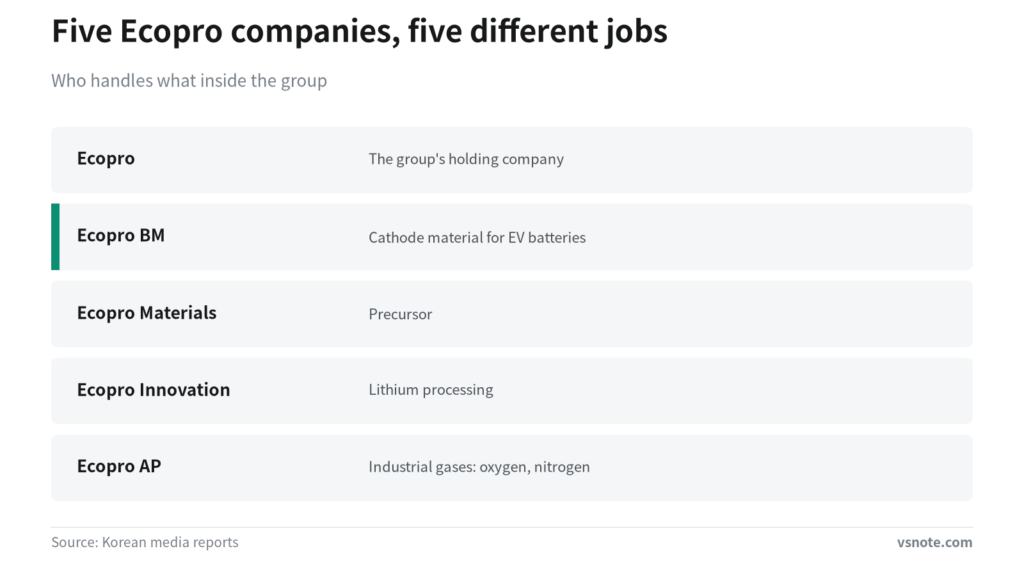
That places Ecopro BM downstream of the precursor and lithium steps and upstream of the cell makers, with cathode active material exports appearing among its consolidated sales items.
Readers usually want a market share figure at this point. The filings and reports cited here do not show one, so the company’s position is described only by what sits on either side of it in the chain.
Revenue down, operating profit back in the black
Korean companies file their annual reports through DART, the electronic disclosure system run by the Financial Supervisory Service, and they number their fiscal years from incorporation. The company’s 10th fiscal period is 2025.
The annual report shows consolidated revenue for FY2025 of KRW 2.53 trillion (about $1.83 billion), down from KRW 2.77 trillion (about $2.00 billion) in the preceding period.
Operating profit moved the other way, to KRW 143.3 billion (about $104 million) from KRW -34.1 billion (about -$25 million). Net profit followed, at KRW 91.6 billion (about $66 million) against KRW -58.5 billion (about -$42 million) a year earlier.
Total assets stood at KRW 4.88 trillion (about $3.54 billion), up from KRW 4.32 trillion (about $3.13 billion).
What the disclosure establishes is the direction of each line: sales fell while profit turned positive. Whether that swing came from volumes or from costs and selling prices is not something these figures separate out.
Why shareholders are being asked to buy new shares
The company announced a rights offering to fund facility spending, working capital and the acquisition of securities in other companies. According to Korean media reports, the size was subsequently cut, and the facility and working-capital uses were removed from the stated plan, leaving about KRW 886.1 billion (about $642 million) for the acquisition of securities in other companies; net proceeds are put at roughly KRW 881.6 billion (about $639 million).
For scale, the same reports can be read against the annual report: FY2025 net profit of KRW 91.6 billion (about $66 million) and total assets of KRW 4.88 trillion (about $3.54 billion).
The structure is a rights offering to existing shareholders, with any shares left unsubscribed then offered to the general public. Reports put the issue at 9,900,990 new shares; the allotment ratio per share held on the record date is fixed in the filing.
Those rights arrive in the account as a separate listed line with its own ticker, distinct from 247540 — the certificate shown as Ecopro BM 18R. It can be sold during its trading window or used to subscribe; if a holder does neither, the right lapses and is extinguished.
The dates that govern all of this — when the certificates trade, when the issue price is fixed, when subscription and payment fall due — are set out in the securities registration statement the company filed on DART on 2 September 2026, and in the correction filing that revised the indicative price downward. Anyone acting on the offering should read those filings rather than a summary.
Where the money is pointed, and what the rating agencies did
According to the prospectus dated 2 September 2026 as reported in Korean media, about KRW 765.0 billion (about $554 million) of the proceeds is earmarked for an investment in BNSI, an Indonesian smelter that processes nickel into battery raw material. That is roughly 86% of the stated use of funds.
The money is to go into a special-purpose vehicle — a company set up solely to hold the stake — and the precise mix of equity injection and lending is reported as not yet fixed.
The remaining KRW 121.1 billion (about $88 million) is allocated to the company’s Hungarian entity. The company said on 24 August 2026 that it had begun converting a line at the Hungarian plant, with a plan to supply material for European premium electric vehicles from the fourth quarter of 2027; reports described the intended customer as a German automaker. That plan is pending.
Alongside that, reports record rating actions on the parent. Korea Ratings lowered Ecopro’s unsecured bond rating one notch in June 2025, from A- with a negative outlook to BBB+ with a stable outlook, and NICE Investors Service in August 2026 kept the rating at A- while moving the outlook from stable to negative.
The same reports put Ecopro’s net debt as having risen from KRW 2.20 trillion (about $1.59 billion) to KRW 3.21 trillion (about $2.32 billion), and note that its last public bond market raise was KRW 40.0 billion (about $29 million) in February 2026.
On 2 September 2026, Ecopro is reported to have issued KRW 95.0 billion (about $69 million) of unsecured private placement notes: KRW 38.0 billion (about $28 million) of 18-month paper at 5.6% and KRW 57.0 billion (about $41 million) of two-year paper at 6.5%.
Those are the two disclosed records that sit side by side — where the company is committing capital, and how the agencies have marked the parent’s funding position.
Frequently asked questions
Q. Does Ecopro BM manufacture batteries?
A. No. It develops and produces cathode material, one of the four key materials in a lithium-ion cell, and supplies it to battery manufacturers. Those manufacturers buy or make the key materials, build the cells, and sell them on to IT, automotive and energy companies.
Q. What is the difference between Ecopro and Ecopro BM?
A. Ecopro is the group’s holding company and Ecopro BM is its subsidiary. Within the group, Ecopro Materials handles precursor, Ecopro Innovation handles lithium processing, Ecopro AP supplies industrial gases for the production process, and Ecopro BM makes the cathode material.
Q. What is the Ecopro BM 18R line that appears next to the shares?
A. It is the subscription-rights certificate from the rights offering, carried under its own ticker separate from 247540. A certificate like this can be sold while it trades or used to subscribe for the new shares; a right that is neither sold nor exercised lapses. The trading window, the subscription dates and the final price are set in the company’s securities registration statement on DART.
Q. What is the money being raised for?
A. The remaining stated purpose is the acquisition of securities in other companies. Korean media reports put the amount at about KRW 886.1 billion (about $642 million), of which roughly 86%, or about KRW 765.0 billion (about $554 million), is allocated to an investment in BNSI, an Indonesian nickel smelter, through a special-purpose vehicle whose equity-and-loan structure is reported as not yet settled; about KRW 121.1 billion (about $88 million) goes to the Hungarian entity. Facility and working-capital uses were deleted from the plan when the size was reduced.
Q. Do the credit rating changes apply to Ecopro BM itself?
A. The rating actions described in the reports cited here are on Ecopro, the parent. Korea Ratings moved its unsecured bond rating from A- with a negative outlook to BBB+ with a stable outlook in June 2025, and NICE Investors Service kept A- in August 2026 while changing the outlook to negative.
Sources
- https://dart.fss.or.kr/dsaf001/main.do?rcpNo=20260318001622
- https://blog.naver.com/qrator_bin/224404448490
- https://blog.naver.com/agentverse/224414588234
- https://blog.naver.com/h-y-e/224412932187
- https://blog.naver.com/frimanlo/224413660565
- https://blog.naver.com/s_note1/224411837381
- https://blog.naver.com/globalesg/224412357008
- https://dealsite.co.kr/articles/168918
This article explains company filings and published figures for information only. It is not investment advice or a recommendation to buy or sell any security. Figures can change after publication — check the original filings before making decisions.